 Italiano
 Türkçe
 Español
 Русский
 فارسی
 Français
 English
 العربية

Good photos for hair transplant consultation are the most useful thing you can send a clinic before you travel. The doctor uses them to see the pattern of your hair loss, judge your donor area and estimate how many grafts you may need. Poor photos can hide thinning or make it look worse, which leads to a vague or wrong plan. This guide explains which angles to take, how to set up light and background, how to prepare your hair and which common mistakes to avoid.
Key takeaways
- Hair transplant practice guidelines list standard photo positions: front facial, chin to chest, right oblique, left oblique and vertex (top) views (Mysore et al., 2021).
- For hair loss, a dermatology photography review recommends the top of the head from above, both sides, and front and back views; an extra front photo with the head tilted down can help (Ali & Thomsen, 2026).
- Flash is generally not recommended; soft indirect daylight near a window and a plain, neutral background work best (Ali & Thomsen, 2026).
- Smartphone photos are perceived to be comparable to professional camera photos for skin assessment (Ali & Thomsen, 2026).
- With good photos and history, remote assessment reached a definitive diagnosis in 91.3% of 321 hair loss cases (Afolabi et al., 2025).
Table of contents
- Why photos for hair transplant consultation matter
- The 6 angles to take
- Light, background and camera position
- How to prepare your hair before the photos
- Close-ups and special cases
- Common mistakes in photos for hair transplant consultation
- Using the same photos during follow-up
- Privacy and consent
- What photos can and cannot show
- Send your photos for a free hair analysis
- Frequently asked questions
- References
Why photos for hair transplant consultation matter
When you cannot visit the clinic first, photos replace the doctor’s first look at your scalp. Research on remote hair care shows that this can work well. In a study of 321 patients with non-scarring hair loss, dermatologists made a definitive diagnosis remotely in 91.3% of cases; the other 8.7% needed an in-person visit, often for a biopsy or further clarification (Afolabi et al., 2025).
Photos for hair transplant consultation also help with planning. A study proposing the PRECISE scale showed that two men with the same Norwood stage needed about 3,900 and 6,150 grafts, because their bald areas measured 80 and 125 cm² (Pittella et al., 2024). Clear photos from several angles help the doctor judge the size of the area to cover.
Finally, photos are a record. Guidelines say the planned and performed graft numbers should be documented with images (Mysore et al., 2021), and the same angles are repeated during follow-up to compare progress.
The 6 angles to take
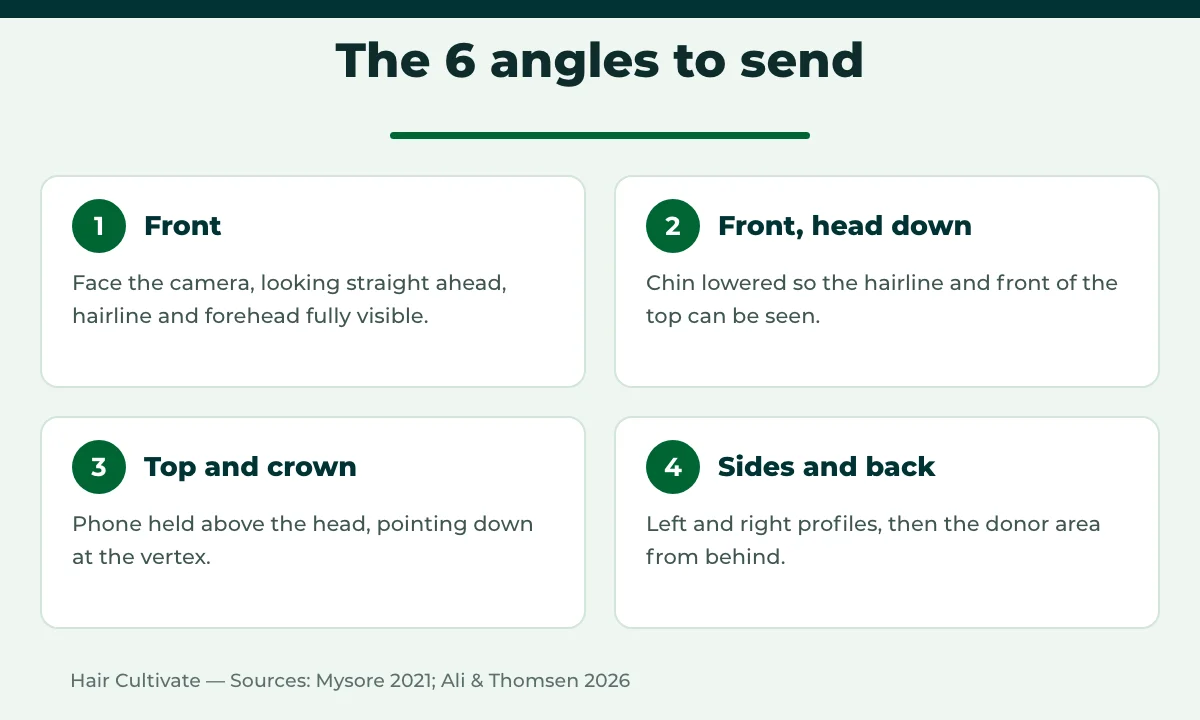
Hair transplant guidelines list five standard positions for preoperative photos: front facial, chin to chest, right oblique, left oblique and vertex (Mysore et al., 2021). A review of photography in dermatology adds, for hair loss, a view of the top from above, left and right side views, and front and back views (Ali & Thomsen, 2026). Based on these, the following six photos for hair transplant consultation cover what most doctors need:
- Front. Face the camera, looking straight ahead, with your whole hairline and forehead visible.
- Front, head tilted down. Lower your chin towards your chest so the camera sees the hairline and the front of the top. The review notes this extra view can help with frontal hair loss (Ali & Thomsen, 2026).
- Top (vertex) from above. Ask someone to hold the phone above your head, pointing down at the crown.
- Left side. A profile view showing the temple and side hair.
- Right side. The same view from the other side.
- Back (donor area). The back of the head from behind, showing the hair above the neck and behind the ears.
If you can, add left and right oblique (three-quarter) views of the front, as the guidelines list them as standard (Mysore et al., 2021).
Light, background and camera position
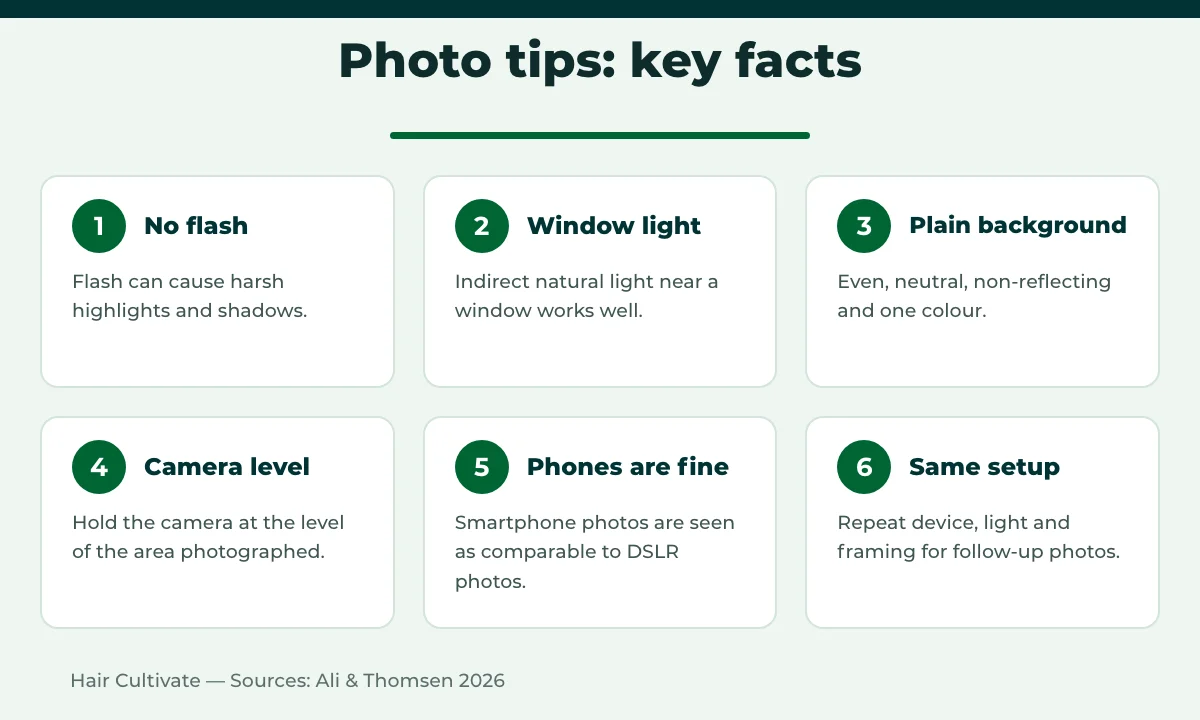
Light changes how dense hair appears in a photo. The dermatology photography review says flash is generally not recommended, because it can cause harsh highlights and shadows. It suggests a well-lit room or a spot near a window with plenty of indirect natural light, and advises avoiding direct sunlight and mixed light sources (Ali & Thomsen, 2026).
For the background, the review prefers an even, neutral, non-reflecting, single-colour background (Ali & Thomsen, 2026). A plain wall works well. Patterned wallpaper, mirrors or a busy room make it harder to judge your hairline.
The camera should be at the same level as the area you are photographing (Ali & Thomsen, 2026). For photos for hair transplant consultation, this means holding the phone at forehead level for the front view and above the head for the top view, rather than shooting from below.
- Use the main (back) camera of your phone rather than the selfie camera when someone can help you.
- Turn off beauty filters and portrait mode, which can blur hair edges.
- Keep the whole head in the frame for overview photos.
- Clean the camera lens before you start.
How to prepare your hair before the photos
The aim is to show your hair as it really is. Hair covering the area of interest should be moved away from it, according to the photography review (Ali & Thomsen, 2026). For a hairline photo, push the hair back from the forehead. For the crown, do not comb hair over the thin area.
- Photograph dry hair, without gel, wax, spray or styling.
- Do not use hair fibres, concealers or tinted products on the day.
- Do not wear a hat beforehand if it flattens the hair, and do not wear a headband in the photos.
- If your hair is long, take one set as it falls naturally and one with the hair pushed back.
Hair colour and skin contrast also matter for planning. A surgical review notes that the lesser the contrast between hair and skin, the better the result tends to look, and that curly or wavy hair can be an advantage (Khanna, 2008). Your photos let the doctor see these features. If you have tightly curled hair, read our page on Afro hair transplant for specific planning points.
Close-ups and special cases
Overview photos show the pattern, but a few close-ups add detail. For close-up photos of the skin, the photography review suggests a distance of about 10 to 20 cm, with the camera at the same level as the area (Ali & Thomsen, 2026). Useful close-ups include the hairline at each temple, the thinnest part of the crown and the donor area at the back.
Some situations need extra photos for hair transplant consultation:
- Previous hair transplant. Add close-ups of the donor area showing any scars, and of the transplanted area, plus the date and graft number of the earlier surgery if you know them.
- Women. If your hair is thinning across the top, add a photo of your usual parting from above. Our page on female hair transplant explains how female hair loss is assessed.
- Beard or eyebrow restoration. Photograph the face from the front and both sides in the same soft light, with no make-up on the brows.
- Scalp problems. Photograph any redness, scaling or patches clearly; these can point to another cause of hair loss that needs a doctor’s review first.
A review of surgical candidacy notes that some types of hair loss, such as alopecia areata and scarring alopecias, are not suitable for a transplant (True, 2021). Clear close-ups help the doctor spot these early.
Common mistakes in photos for hair transplant consultation
These mistakes are the most frequent reasons a clinic asks for new photos:
- Flash. Flash can cause harsh highlights and shadows that distort how dense the hair looks (Ali & Thomsen, 2026).
- Wet hair. Wet hair clumps together and can show more scalp than usual.
- Styled hair. Combing over a thin crown or a receding temple hides the real pattern.
- Only selfies from the front. The crown and donor area are missing.
- Blurry or dark photos. The doctor cannot judge density.
- Different light in each photo. The review advises standardised light for comparison (Ali & Thomsen, 2026).
Taking a few extra minutes to avoid these mistakes means your photos for hair transplant consultation give a clear answer the first time.
Using the same photos during follow-up
The same angles are used after surgery to track progress. The photography review advises using the same camera device whenever possible, with a consistent background, a fixed distance and standardised framing and lighting (Ali & Thomsen, 2026). Keep a note of where you stood and which light you used, so your later photos for hair transplant consultation and follow-up can be compared fairly.
This matters because results take time. New hair usually starts to appear after about 4 months, and full results are seen after 10 to 18 months (NHS). Transplanted hair often falls out between two and eight weeks after surgery, which is expected (AAD). Comparable photos make it easier to see real change. Our hair transplant recovery guide explains each stage.
Privacy and consent
Photos for hair transplant consultation are medical images, so share them carefully. The photography review stresses informed consent before clinical photographs are taken, and recommends secure storage and removing metadata such as GPS location, date and device information before sharing (Ali & Thomsen, 2026).
In practice, you can crop photos so that only your head is visible, check what the clinic does with your images, and ask before your photos are used for anything other than your own care. A trustworthy clinic will never publish your photos without your clear permission.
What photos can and cannot show
Photos for hair transplant consultation are excellent for showing the pattern and stage of hair loss. They are less reliable for measuring donor density or detecting early miniaturisation. A full consultation includes a thorough scalp exam and may include a blood test or a scalp biopsy (AAD).
For this reason, the 2023 minimum guidelines agreed by UK and Turkish surgical societies say you should have a consultation with the doctor who will perform the surgery, who decides the method, the number of follicular units and the hairline design (BAHRS et al., 2023). Your photos start the plan; the in-person examination confirms it.
Send your photos for a free hair analysis
Hair Cultivate is a hair transplant clinic in Istanbul. When your photos for hair transplant consultation are ready, send them to WhatsApp (+905444768387) for a free hair analysis. Add your age, when your hair loss started and any medicines you take.
Our team will review the photos and explain which technique and plan may suit you, for example Sapphire FUE. Packages start from $3,400, with plans at $3,400, $4,200 and $4,900; the price rises with the plan and the needs of your case. Every plan includes a consultation with a specialist doctor, local anaesthesia by an anaesthesiologist, a post-operative medication package and 12 months of follow-up. See our prices page for details.
Frequently asked questions
How many photos for hair transplant consultation should I send?
For a hair transplant consultation, send at least six photos: front, front with the head tilted down, top, left side, right side and back. Guidelines also list left and right oblique views as standard (Mysore et al., 2021).
Should I use flash when taking hair loss photos?
Flash is generally not recommended for hair loss photos, because it can cause harsh highlights and shadows. Soft indirect daylight near a window works better (Ali & Thomsen, 2026).
Are phone photos good enough for a hair transplant consultation?
Phone photos are usually good enough for a hair transplant consultation. Smartphone photos are perceived to be comparable to professional camera photos for skin assessment (Ali & Thomsen, 2026).
Should my hair be wet or dry in consultation photos?
Hair should be dry and unstyled in hair transplant consultation photos. Wet or styled hair changes how much scalp shows and can hide or exaggerate thinning.
Can a doctor estimate grafts from photos for hair transplant consultation?
A doctor can give an estimated graft range from photos for hair transplant consultation. The final number depends on the measured bald area and donor density, so it is confirmed in person (Pittella et al., 2024; BAHRS et al., 2023).
Why does the donor area photo matter in a hair transplant consultation?
The donor area photo shows how much hair is available at the back and sides of the head. The AAD says you need enough healthy donor hair to be a candidate for a hair transplant (AAD).
References
- Mysore V, Kumaresan M, Garg A, et al. Hair transplant practice guidelines. J Cutan Aesthet Surg. 2021;14(3):265–284. PMC8611706
- Ali Z, Thomsen SF. Photography in dermatology. Front Med (Lausanne). 2026;13:1854982. PMC13505408
- Afolabi A, Brown E, Ha EK, English JC III. Asynchronous teledermatology for non-scarring alopecia: a retrospective study. Telemed Rep. 2025;6(1):216–219. PMC12411893
- Pittella F, Castro CG, Trivellini R, et al. PRECISE scale: a quantitative classification for androgenetic alopecia and its application to hair transplantation. Aesthetic Plast Surg. 2024;48(5):775–784. PMC10980655
- Khanna M. Hair transplantation surgery. Indian J Plast Surg. 2008;41(Suppl):S56–S63. PMC2825128
- BAHRS, BAAPS, BAPRAS and TSPRAS. UK and Turkish medical associations unite to issue minimum guidelines for hair transplant surgery. 13 December 2023. baaps.org.uk
- NHS. Hair transplant. nhs.uk
- True RH. Is every patient of hair loss a candidate for hair transplant? Deciding surgical candidacy in pattern hair loss. Indian J Plast Surg. 2021;54(4):435–440. PMC8719975
- American Academy of Dermatology. Hair loss: hair transplant. aad.org
This article is for general information and does not replace a consultation with a qualified doctor.