 Italiano
 Türkçe
 Español
 Русский
 فارسی
 Français
 English
 العربية


- Why Men Consider a Moustache Transplant
- What Is a Moustache Transplant
- Having a Moustache Transplant in Turkey
- Moustache Transplant Techniques
- Step by Step Procedure
- Results and Growth Timeline
- Risks and Side Effects
- What Affects the Cost
- How to Choose the Right Clinic
- Start Your Journey with Hair Cultivate
Why Men Consider a Moustache Transplant
A moustache that grows thinly, unevenly or not at all can be a concern for many men. Some have had low density since birth, while others have hairless patches caused by scars, for example after cleft lip repair. Hair transplantation to the upper lip has been described in the medical literature for decades, and single follicular unit grafting has been used to restore a moustache in patients with cleft lip scars (Dua et al., 2021).
What Is a Moustache Transplant
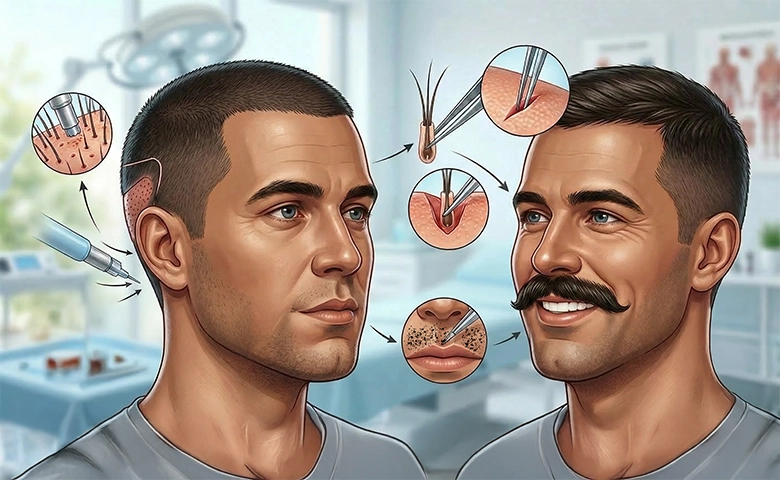
A moustache transplant is a form of hair transplant surgery in which follicular units are taken from a donor area and implanted into the upper lip. The main donor area is the back and sides of the scalp, which do not usually go bald; hair from under the jawline can also be used (ISHRS). Because the moustache is a small area, careful graft selection and placement matter more than graft numbers alone.
Grafts are usually harvested by follicular unit extraction (FUE), where individual grafts are removed one at a time, leaving many tiny scars rather than one linear scar (NHS). If you are also thinking about a fuller beard, see our page on beard transplant in Turkey.
Having a Moustache Transplant in Turkey
Wherever you have the procedure, judge the clinic on who performs the surgery and how much experience they have. The NHS advises asking the surgeon about their experience and how many of their procedures have had complications (NHS). Travelling for treatment also means planning enough time for the procedure and the first check-up; our patient guide explains each stage of the trip.
Moustache Transplant Techniques
The technique is chosen after examining the upper lip and the donor area:
- FUE: grafts are extracted one by one and implanted into small incisions (NHS).
- DHI: a variation of FUE in which grafts are placed with an implanter pen. Learn more about DHI hair transplant.
- Sapphire FUE: FUE in which recipient incisions are opened with sapphire-tipped blades.
For the moustache, the direction of each hair is critical. Dua et al. (2021) describe making the recipient slits at about 10–20 degrees to the skin, matching the direction of existing hair, and placing single-hair grafts along the upper edge of the moustache for a more natural result.
Step by Step Procedure
- Consultation and design: the shape, density and hair direction are planned with you before surgery.
- Local anaesthesia: most people stay awake and receive medication to numb the area being treated (Cleveland Clinic).
- Harvesting: grafts are taken from the donor area and prepared for implantation (ISHRS).
- Implantation: each graft is placed with attention to angle and direction (Dua et al., 2021).
The procedure can take several hours, depending on the number of grafts (Cleveland Clinic). Dua et al. (2021) report that around 300–400 grafts on each side, at a density of about 35–40 grafts per cm², are needed to reconstruct a moustache, although the number for you depends on the size of the gap and the look you want.
Results and Growth Timeline
- First 1–2 weeks: transplanted facial hairs usually begin to fall out, which is expected (Yaseen et al., 2021).
- Around 3–4 months: regrowth starts (ISHRS).
- About 10–14 months: the overall result can be assessed (ISHRS).
A single procedure may not be enough in every case; Dua et al. (2021) note that a second sitting is sometimes needed to reach the best possible outcome, especially when the skin is scarred.
Risks and Side Effects
Mild redness and swelling usually settle within a few days, and swelling or bruising from the anaesthetic fluid over about a week (Dua et al., 2021). The moustache and goatee area is more prone to bumpy or irregular skin after grafting (Dua et al., 2021). Darkening of the skin can occur, mainly in darker skin, and folliculitis is uncommon (ISHRS). General hair transplant risks include infection, bleeding, an allergic reaction to the anaesthetic and grafts not taking (NHS).
What Affects the Cost
The price of a moustache transplant depends on the number of grafts, the technique, whether it is combined with a beard or sideburn transplant, and what the package includes. For comparison, the NHS states that a hair transplant in the UK can cost anywhere between £1,000 and £30,000, depending on the extent of hair loss, the type of procedure and the clinic (NHS).
At Hair Cultivate, DHI packages range from $3,400 to $4,900 and include hotel, transfers, PRP and medication; full details are on our prices page. A moustache quote is given after your photos or examination. Our article on hair transplant cost in Turkey explains the main price factors.
How to Choose the Right Clinic
Ask who will design your moustache and perform each step, and look at moustache cases photographed at least a year after surgery. Ask how many grafts are planned and why, and whether a second session might be needed. The NHS also recommends asking about the surgeon’s experience and complication rate (NHS).
Start Your Journey with Hair Cultivate
At Hair Cultivate in Istanbul, a moustache transplant starts with an assessment of your upper lip, your existing facial hair and your donor area. The plan sets out the design, the estimated number of grafts and a realistic timeline.
To find out whether a moustache transplant suits you, send us your photos through our contact page so our team can assess them.
References
- Dua K, Verma V, Dua A. Beard and moustache reconstruction. Indian J Plast Surg. 2021;54(4):483–488. PMC8719972
- Yaseen U, Ahmed S, Ahmed M. Beard reconstruction. Int J Trichology. 2021;13(6):4–8. PMC8647705
- International Society of Hair Restoration Surgery (ISHRS). Beard and Mustache Transplant. ishrs.org
- NHS. Hair transplant. nhs.uk
- Cleveland Clinic. Hair Transplant: How Does It Work, Success Rates. clevelandclinic.org
This page is for general information and does not replace a consultation with a qualified doctor.
Frequently asked questions about moustache transplant
Who is a good candidate for a moustache transplant?
Men with patchy or thin moustaches, or with scars in the upper lip area, are common candidates, as long as the donor area is healthy.
Where do the grafts come from?
Usually from the back of the scalp, sometimes from under the chin, choosing hairs that match the moustache.
Can I choose my moustache style?
Yes. The shape, density and direction are planned with you before the procedure.
When can I shave after a moustache transplant?
Most doctors advise waiting about a week to ten days, until the crusts have fallen off, before shaving the area.
Is a moustache transplant permanent?
Transplanted follicles usually keep growing long term, so the result is considered permanent.
When will my new moustache grow?
Transplanted hairs often shed after a few weeks and regrow over the following months. The full result takes several months.
Can a moustache transplant be combined with a beard transplant?
Yes, they are often done together in one session if enough donor grafts are available.