 Italiano
 Türkçe
 Español
 Русский
 فارسی
 Français
 English
 العربية


FUE vs FUT is the first decision most people face when they plan a hair transplant. Both move follicular units, natural groups of 1 to 4 hairs, from the back of the head to thinning areas. The difference is how the grafts are taken. In FUT (follicular unit transplantation, or the “strip” method), the surgeon removes a thin strip of scalp and cuts it into grafts. In FUE (follicular unit extraction, also called excision), the surgeon removes each graft one by one with a tiny punch. This guide compares scars, pain, recovery, graft numbers, suitability and cost, using published evidence.
Key takeaways
- FUT removes a thin strip of scalp and cuts it into grafts; FUE removes grafts one by one with a punch under about 1 mm.
- Both leave scars: FUT a single linear scar, FUE many small dot scars. FUE is not scarless (ISHRS).
- In FUE vs FUT, both produce high-quality grafts; the main difference is the donor scar (Gupta et al., 2020).
- Guidelines give 2,500–3,000 grafts per session as an average upper limit, whatever the method (Mysore et al., 2021).
- Pain after surgery was lower after FUE in a study of 241 patients (Kim et al., 2019). FUT is usually cheaper (ISHRS).
Table of contents
- How FUE vs FUT harvesting works
- FUE vs FUT at a glance
- FUE vs FUT scars: dot scars vs a linear scar
- Graft numbers per session in FUE vs FUT
- FUE vs FUT pain: what the studies show
- Recovery after FUE vs FUT
- Who each method suits
- What drives the cost of FUE vs FUT
- FUE variants: manual FUE, Sapphire FUE and DHI
- How to choose between FUE vs FUT
- Frequently asked questions
- References
How FUE vs FUT harvesting works
Both techniques are done under local anesthesia. The difference in FUE vs FUT lies only in how the donor area at the back and sides of the head is harvested.
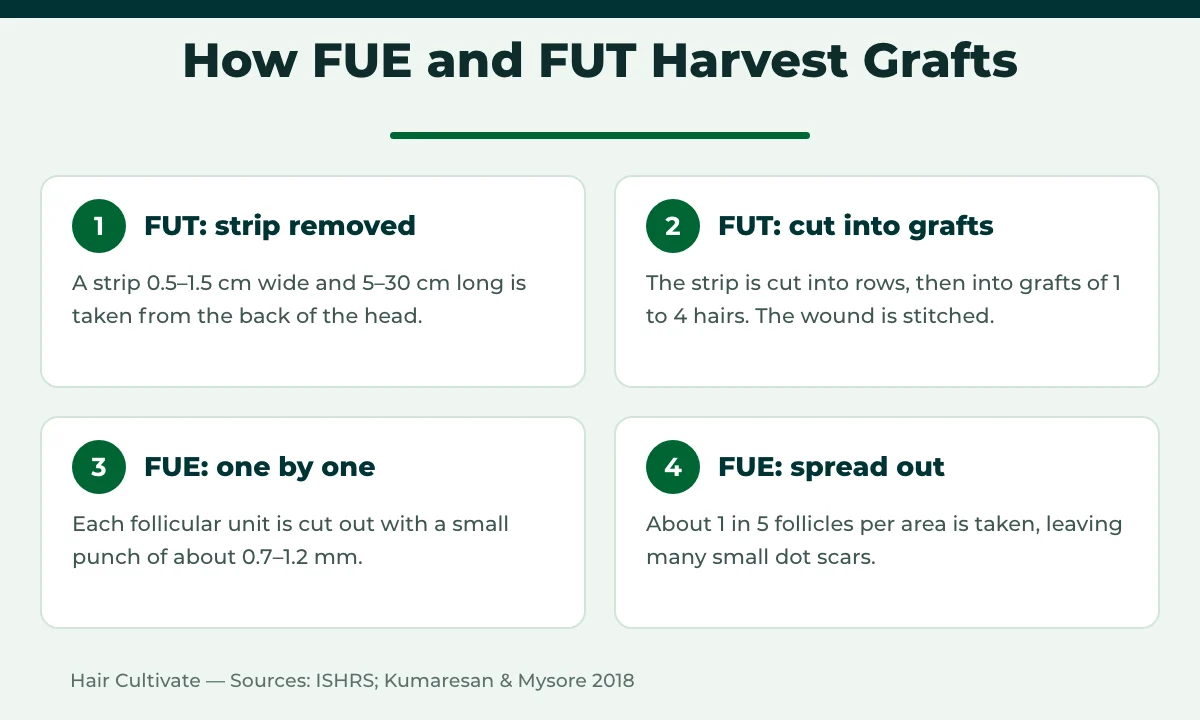
FUT (strip). The surgeon removes a strip of scalp from the back of the head and closes the wound with stitches or staples. The International Society of Hair Restoration Surgery (ISHRS) describes a strip of 0.5 to 1.5 cm in width and 5 to 30 cm in length. The strip is cut into thin rows and then into grafts of 1 to 4 hairs (ISHRS, FUT). Guidelines prefer a strip width under 1.3 cm (Mysore et al., 2021).
FUE (individual extraction). The surgeon cuts around each follicular unit with a small round punch and lifts it out. ISHRS lists punch sizes of 0.7 to 1.2 mm, used by hand, with a motor or with a robot (ISHRS, FUE). The practice guidelines prefer punches under 1 mm and do not recommend punches larger than 1 mm (Mysore et al., 2021). In most cases the donor area is shaved first (NHS; ISHRS, FUE).
FUE vs FUT at a glance
The table summarises the main FUE vs FUT differences; the sections below explain each point.
| Factor | FUE | FUT (strip) |
|---|---|---|
| How grafts are taken | One by one with a punch of about 0.7–1.2 mm | A strip 0.5–1.5 cm wide is removed and cut into grafts |
| Donor scar | Many small dot scars | One linear scar |
| Shaving | Donor area usually shaved | Not shaved; only the strip area is trimmed |
| Donor wound care | Small scabs fall off in about 1–2 weeks | Stitches or staples, usually removed after 10–14 days |
| Pain after surgery | Lower in one study of 241 patients | Higher, mostly gone by day 3 in the same study |
| Grafts per session | Limited by taking about 1 in 5 follicles per area | High numbers in one session; very wide strips cause wide scars |
| Operating time | Longer | Shorter |
| Typical cost | Usually higher | Usually lower |
| Often suits | Short hair, small sessions, body or beard donor hair | Long hair, advanced loss, several planned sessions |
In the FUE vs FUT debate, neither method is superior for everyone. A critical review in Dermatologic Surgery concluded that FUE and FUT are equally effective in producing high-quality grafts, and that the main difference is the scarring pattern in the donor region (Gupta et al., 2020).
FUE vs FUT scars: dot scars vs a linear scar
Both methods leave scars. The NHS says FUT leaves a scar on the back of the head that “should not be visible unless you have very short hair”, while FUE leaves many tiny scars that are not very noticeable (NHS).
FUT scar. The strip leaves a long, narrow scar (AAD). Its width depends on the width of the strip and on the tension at the wound edges (Mysore et al., 2021). A trichophytic closure, in which one wound edge is trimmed so hair can grow through the scar, can make it harder to see (ISHRS, FUT; Mysore et al., 2021). A scar that heals badly can be improved by re-excision, by transplanting hair into it, or by scalp micropigmentation (ISHRS, FUT).
FUE scars. FUE leaves many small round dot scars instead of one line. ISHRS states clearly that “FUE is not scarless” (ISHRS, FUE). The dots are usually easy to hide (Gupta et al., 2020), but small white dots (hypopigmentation) are common, and smaller punches of 0.8 to 0.9 mm are recommended to limit them (Romera de Blas et al., 2026). Over-harvesting, meaning taking too many grafts from one area, can cause visible thinning, scarring and loss of skin colour, especially in darker skin (Mysore et al., 2021).
Scars also behave differently over several sessions. With FUT, the old scar is usually removed in the next strip, so most patients still have one line. With FUE, the dot scars add up with every session, and they may become visible if the donor fringe gets thinner over time (Kumaresan & Mysore, 2018).
Graft numbers per session in FUE vs FUT
The donor area is limited, and hair taken from it does not grow back. ISHRS calls a ruined donor area “an irreversible problem” (ISHRS, FUE). Practice guidelines describe a safe donor area of about 189 to 203 cm² and give 2,500 to 3,000 grafts per session as an average optimum upper limit without visible donor depletion. Over a lifetime, the safe upper limit ranges from about 4,000 to 6,500 scalp grafts across several sessions and techniques (Mysore et al., 2021).
Within these limits, FUE vs FUT yield differs in a practical way:
- FUT takes all follicles in the strip. A strip is limited in width, though: harvesting over 3,000 to 3,500 grafts from strips wider than 2 cm leads to wide scars (Kumaresan & Mysore, 2018). ISHRS says FUT allows a high number of grafts in one session and carries no risk of over-harvesting the donor area (ISHRS, FUT).
- FUE can only take a fraction of the follicles in any area, about 1 in 5 (20%), so that the area does not look thin. The same review cites an upper limit of about 2,500 grafts in one FUE session (Kumaresan & Mysore, 2018). The guidelines advise about 10 to 15 extractions per cm² as a safe single pass (Mysore et al., 2021).

Graft quality is close. Transection (a follicle cut by accident) is higher in FUE because the punch works “blind” below the skin. Reported FUE transection rates have fallen from about 10–20% in the past to about 2–5% today (Kumaresan & Mysore, 2018). In one study of patients who had both methods with the same team, FUE grafts had a higher ratio of hairs per follicular unit. The authors explain that surgeons tend to pick fuller units in FUE, and that this does not make one method superior (Takata Pontes et al., 2024).
For large cases, surgeons can combine the two. The guidelines list combined FUT and FUE for advanced hair loss, revision cases, second sessions and limited donor areas (Mysore et al., 2021). This is different from a hybrid hair transplant that combines DHI and Sapphire FUE implantation after a single FUE harvest; ask your surgeon which combination is meant.
FUE vs FUT pain: what the studies show
A Korean study of 241 patients (202 FUT, 39 FUE) measured pain after surgery on a 0–5 faces scale. Pain was significantly lower after FUE. On day 1, the mean score was 2.03 after FUT and 1.26 after FUE. After FUT, pain had almost gone by day 3 (Kim et al., 2019). The authors link the extra FUT pain to stretching of the skin when the two edges of the strip wound are pulled together and stitched.

The evidence is not completely one-sided. A 2026 review of a recent meta-analysis reported only a non-significant trend toward lower pain rates with FUE than FUT (Romera de Blas et al., 2026). ISHRS notes that recovery differs from surgeon to surgeon and patient to patient (ISHRS, FUT).
Recovery after FUE vs FUT
General recovery is similar. The NHS says a hair transplant usually takes a day, you may need 1 to 2 weeks off work, and your scalp may feel tight, achy and swollen for a few days (NHS). The AAD says the procedure takes between four and eight hours, and the individual-hair (FUE) method takes a lot more time (AAD).
The donor-area recovery is where FUE vs FUT differs:
- After FUT, there is a stitched wound. Non-dissolvable stitches are usually removed after 10 to 14 days (NHS). Because the donor area is not shaved, the longer hair above the wound covers it while it heals (ISHRS, FUT).
- After FUE, there are many tiny wounds. Small scabs usually fall off in about 1 to 2 weeks (ISHRS, FUE). The shaved donor area is visible for about a week (ISHRS, FUT). Donor healing is usually quicker than after FUT (Kumaresan & Mysore, 2018).
The FUE vs FUT choice does not change how fast hair grows. Transplanted hair often sheds two to eight weeks after surgery (AAD). New hair usually appears after about 4 months, and full results are seen after 10 to 18 months (NHS).
Risks for both include bleeding, infection, allergy to the anesthetic, grafts that do not take and a noticeable scar (NHS). Large FUE series estimate overall complication rates of 1.2% to 4.7%. A meta-analysis suggested FUE may have a slightly better safety profile than FUT, but this was not statistically confirmed (Romera de Blas et al., 2026).
Who each method suits
The right choice in FUE vs FUT depends on your hair, your plans and your donor area, not on which method is more fashionable. Distinct groups of patients are suited to FUE, FUT or both (Gupta et al., 2020).
FUE may suit you if:
- you want to wear your hair very short; the AAD notes that avoiding a long scar can help people who prefer buzz cuts (AAD);
- you need a smaller session; FUE “may be an excellent choice for young patients seeking small procedures” (Kumaresan & Mysore, 2018);
- you need beard or body hair as donor hair, which can only be harvested by FUE (Kumaresan & Mysore, 2018).
FUT may suit you if:
- you wear your hair longer and do not want to shave your head (ISHRS, FUT);
- you have advanced hair loss with a narrow donor area; ISHRS says patients at Norwood stage 6 or 7 are better off with FUT in most cases (ISHRS, FUT);
- you expect to need several sessions over your lifetime, or you have very curly hair, which is harder to harvest by FUE (Kumaresan & Mysore, 2018).
For either method, the ideal candidate has hair loss stabilised with medical treatment, good donor hair, realistic goals and fitness for surgery (ISHRS, FUE). Younger patients carry more risk because future hair loss is harder to predict.
What drives the cost of FUE vs FUT
In FUE vs FUT pricing, ISHRS says FUT is usually cheaper because it needs less surgeon time and labour, and that non-shaved FUE takes longer and usually costs more (ISHRS, FUT; ISHRS, FUE).
The main cost drivers are:
- Number of grafts. Guidelines say fees should be based on the number of follicular units, and patients should be charged only for viable grafts that are transplanted (Mysore et al., 2021).
- Time and team. FUE takes a lot more time (AAD), and FUT needs less surgeon labour (ISHRS, FUE).
- Shaving. Unshaved FUE takes more time and usually costs more (ISHRS, FUE).
- Country and clinic. The NHS gives a UK range of £1,000 to £30,000, depending on the extent of hair loss, the type of procedure and the clinic (NHS).
For a breakdown of current prices, see our guide to hair transplant cost in Turkey.
FUE variants: manual FUE, Sapphire FUE and DHI
Most clinics today offer FUE, and ISHRS describes it as the dominant method (ISHRS, FUT). You will see several FUE “brands” when you compare FUE vs FUT offers. The harvest is the same in all of them; the differences lie in the tools and the implantation step:

- Manual FUE uses a hand-held punch, without a motor. Learn more in our article on manual FUE hair transplant.
- Sapphire FUE uses blades with a sapphire tip to open the recipient channels; see our Sapphire FUE article.
- DHI uses implanter pens to place grafts directly into the scalp. Our DHI guide explains the steps.
Be careful with marketing words. A 2024 review warns that much of the appeal of FUE comes from false claims that it is “minimally invasive”, “scarless” or “not even surgery”, and that good FUE technique takes years to master (Anastassakis, 2024). ISHRS warns about unlicensed technicians doing harvesting that a physician should perform (ISHRS, FUE).
How to choose between FUE vs FUT
Bring these questions to your consultation:
- How many grafts do I need now, and how many might I need in 10 or 20 years?
- How large and dense is my donor area, and how many grafts can it safely give in total?
- How short do I want to wear my hair at the back?
- Who performs the harvesting, the extraction and the implantation?
A good surgeon will explain both options for your case and will not promise a “scarless” result.
Frequently asked questions
Is FUE better than FUT?
Not in every case. Both give high-quality grafts; they differ mainly in the donor scar (Gupta et al., 2020).
Does FUE leave scars?
Yes. FUE leaves many small dot scars instead of one line. They are usually easy to hide, but they can show with very short hair or after over-harvesting (ISHRS, FUE; Mysore et al., 2021).
Which hurts more, FUE vs FUT?
In a study of 241 patients, pain after surgery was significantly lower after FUE; after FUT it had almost gone by day 3 (Kim et al., 2019). A later meta-analysis found only a non-significant trend in favour of FUE (Romera de Blas et al., 2026).
How many grafts can I get in one session?
Guidelines give 2,500 to 3,000 grafts per session as an average optimum upper limit, whatever the method (Mysore et al., 2021).
Can I have FUE after FUT?
Yes. Many patients have FUE as a second procedure after FUT (Takata Pontes et al., 2024), and combined FUT and FUE is used for advanced hair loss, second sessions and revisions (Mysore et al., 2021).
Do I need to shave my head for FUE vs FUT?
For FUT, only the strip area is trimmed and the head is not shaved (NHS). For FUE, the donor area is usually shaved; unshaved FUE is possible in some cases but takes longer and often costs more (ISHRS, FUE).
Not sure whether FUE or FUT fits your hair? Send clear photos of the front, top and back of your head for a free hair analysis on WhatsApp (+905444768387) or through our contact page.
References
- International Society of Hair Restoration Surgery (ISHRS). Guide to FUT Hair Transplant: Benefits, Procedure & Recovery. ishrs.org
- International Society of Hair Restoration Surgery (ISHRS). Guide to FUE Hair Transplant: Benefits, Process & Recovery. ishrs.org
- NHS. Hair transplant. nhs.uk
- American Academy of Dermatology (AAD). Hair loss: Hair transplant. aad.org
- Mysore V, Kumaresan M, Garg A, et al. Hair transplant practice guidelines. J Cutan Aesthet Surg. 2021;14(3):265–284. PMC8611706
- Kumaresan M, Mysore V. Controversies in hair transplantation. J Cutan Aesthet Surg. 2018;11(4):173–181. PMC6371731
- Gupta AK, Gupta AK, Love RP, Harris JA. Old friend or new ally: a comparison of follicular unit transplantation and follicular unit excision methods in hair transplantation. Dermatol Surg. 2020;46(8):1078–1083. PubMed 32141930
- Kim YS, Na YC, Park JH. Comparison of postoperative pain according to the harvesting method used in hair restorative surgery. Arch Plast Surg. 2019;46(3):241–247. PMC6536877
- Romera de Blas C, Vega Díez D, Ricart Vayá JM, Gómez Zubiaur A. Complications in follicular unit excision hair transplantation: current evidence and practical approaches. Front Med (Lausanne). 2026;13:1750989. PMC12909172
- Takata Pontes L, Ruston A, de Moraes AM. Strip harvesting follicular unit transplantation versus follicular unit excision: comparing the number of hairs and the ratio of hairs to follicular unit. Dermatol Surg. 2024;50(9):851–854. PubMed 38748590
- Anastassakis K. Paradigm shift from linear strip to follicular unit excision in hair restoration surgery. Facial Plast Surg. 2024;40(2):129–145. PubMed 38092043
This article is for general information and does not replace a consultation with a qualified doctor.


