 Italiano
 Türkçe
 Español
 Русский
 فارسی
 Français
 English
 العربية


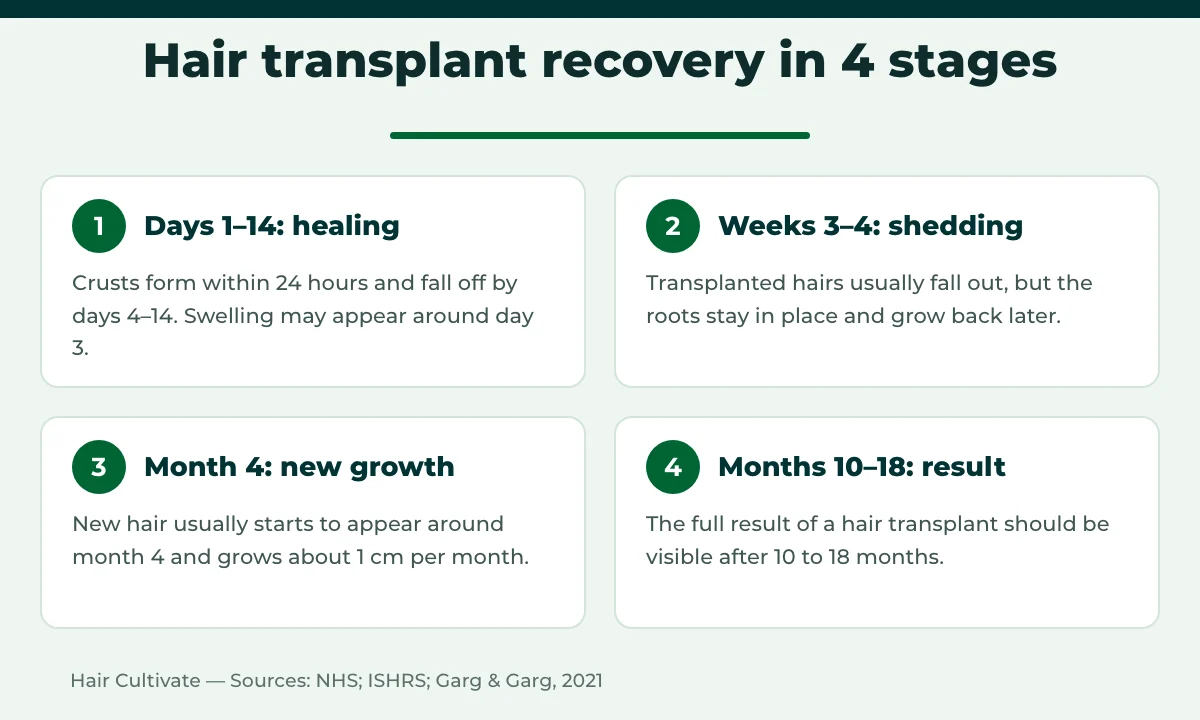
Hair transplant recovery follows a fairly predictable path, but it is slower than many people expect. After FUE or DHI, the scalp usually heals within about two weeks, the transplanted hairs often shed after a few weeks, new hair tends to appear around the fourth month, and the full result can take 10 to 18 months to show (NHS, 2023). This hair transplant recovery guide covers the first 14 days stage by stage, then the months up to the final result, plus normal symptoms, warning signs, aftercare and return to work.
Key takeaways
- Most people need 1 to 2 weeks off work; some return to light work after 3 to 5 days (NHS; Cleveland Clinic).
- Small crusts form within 24 hours and usually fall off between day 4 and day 14 (ISHRS).
- Shedding of the transplanted hairs at 3 to 4 weeks is normal; the roots stay in place (Garg & Garg, 2021).
- New hair usually starts at around 4 months, and the full result takes 10 to 18 months (NHS).
- Fever that does not go away, heavy bleeding, severe redness or pain, or pus are warning signs that need medical attention (Cleveland Clinic).
Table of contents
- Hair transplant recovery at a glance
- Days 1 to 14: the healing phase, day by day
- Months 1 to 18: the growth phase, month by month
- Normal symptoms vs warning signs
- Aftercare dos and don’ts
- When can you return to work and exercise?
- Does recovery differ between FUE and DHI?
- How to support a smooth recovery
- Frequently asked questions
- References
Hair transplant recovery at a glance
A hair transplant moves follicles from a donor area, usually the back and sides of the head, to thinning areas. Most people go home the same day (NHS, 2023; Cleveland Clinic, 2021). The tiny wounds heal quickly, but the hair follows its own growth cycle, and that cycle sets the pace of hair transplant recovery.
Think of it in two phases: the healing phase (about two weeks), when swelling goes down and crusts fall off, and the growth phase (week 3 to month 18), when the transplanted hairs shed, rest and grow back.
| Time after surgery | What usually happens | Source |
|---|---|---|
| Day 1 | Tightness and mild pain; small crusts start to form | ISHRS; Kim et al., 2019 |
| Days 2–5 | Bandages come off; swelling may appear around day 3 | NHS; ISHRS |
| Day 6 | Gentle hand washing of the hair is usually allowed | NHS |
| Days 4–14 | Crusts fall off | ISHRS |
| Days 10–14 | Non-dissolvable stitches removed (strip/FUT only) | NHS |
| Weeks 3–4 | Transplanted hairs shed; roots remain | Garg & Garg, 2021 |
| Around month 4 | New hair starts to appear | NHS |
| Months 10–18 | Full result visible | NHS |
Timing varies between people. The International Society of Hair Restoration Surgery (ISHRS) notes that rules on bandages, sprays, water exposure and exercise differ between surgeons, so your written instructions come first (ISHRS, 2026).
Days 1 to 14: the healing phase, day by day
The first two weeks of hair transplant recovery are about protecting the grafts while the wounds close. The NHS advises being very careful with the transplanted hair during this period (NHS, 2023).
Day 1: the day after surgery
Expect a tight, achy and slightly swollen scalp (NHS, 2023). Most patients feel some tightness in the donor area for one to two days and are given a mild painkiller (ISHRS, 2005). In a study of 241 patients, pain was highest on day 1 and then fell steadily. On a 0–5 scale, the average score on day 1 was 1.26 after FUE and 2.03 after strip surgery (FUT) (Kim et al., 2019). Within 24 hours, small crusts form on each graft (ISHRS, 2005).
Days 2 to 3: sleeping and swelling
You may be asked to sleep in a semi-upright position for two to three days and to use moist compresses or sprays to limit swelling and bruising (ISHRS, 2005). The NHS says the bandages can usually come off between days 2 and 5, but you should not touch the grafts (NHS, 2023). Some clinics allow the first gentle wash on day 2 or day 3, while others wait longer, so follow your own instructions (Cleveland Clinic, 2021; Garg & Garg, 2021).
Days 3 to 7: swelling peaks and fades
Swelling of the forehead is a common part of hair transplant recovery. When it happens, it typically appears around the third day and goes away after three to four days (ISHRS, 2005). One study describes oedema as common, especially 2 to 6 days after the operation; in severe cases it can make it hard to open the eyes (Abbasi et al., 2010). In a large series of 2,896 patients, facial swelling seen in 18 cases settled on its own by day 6 or 7 (Garg & Garg, 2021).
By day 5, pain is usually minimal. In the same pain study, the average score after FUE had fallen to 0.18 out of 5 by day 5 (Kim et al., 2019). From day 6, the NHS says you can usually wash your hair gently by hand (NHS, 2023).
Days 7 to 14: crusts fall off
The crusts flake off between about day 5 and day 14; small follicular unit crusts often fall off at days 4 to 6 (ISHRS, 2005). The ISHRS also says that, after FUE, tiny scabs in both the donor and recipient areas usually stay until they are gently rubbed away, often one to two weeks after surgery (ISHRS, 2026). If you had strip surgery (FUT) with non-dissolvable stitches, these are usually removed between days 10 and 14 (NHS, 2023). FUE does not need stitches (ISHRS, 2005).
By the end of week two, the healing part of hair transplant recovery is usually complete.
Months 1 to 18: the growth phase, month by month
Once the skin has healed, hair transplant recovery becomes a test of patience, because the follicles rest before producing new hair.
Weeks 3 to 8: the shedding phase
The NHS says the transplanted hair often falls out within a few weeks and later starts to grow back (NHS, 2023). A review of complications reports that implanted hairs usually fall out 3 to 4 weeks after surgery (Garg & Garg, 2021). This is expected: the hair shaft falls out, but the root stays in the skin (ISHRS, 2026).
Some people also lose some of their own existing hair near the grafts. This is called postoperative effluvium or “shock loss”. It mostly appears 3 to 4 weeks after surgery, and the hair usually grows back after 3 to 4 months (Garg & Garg, 2021). The ISHRS notes that it can be upsetting, but the native hair should return over the following months (ISHRS, 2026).
Months 3 to 4: first new growth
After shedding, the roots rest for about 10 to 14 weeks, and then new hairs begin to grow (ISHRS, 2005). The NHS says new hair usually starts to appear at around 4 months (NHS, 2023). Small pimple-like spots can appear in this period (see below).
Months 5 to 9: gradual change
Hair grows about 1 cm per month (ISHRS, 2026). This is why change is gradual: even after new hairs appear, they need several more months to gain length and fill in.
Months 10 to 18: the final result
The NHS says the full results should be seen after 10 to 18 months (NHS, 2023). Cleveland Clinic says it can take up to a year, and the ISHRS says a year or more is often needed for the full result to appear (Cleveland Clinic, 2021; ISHRS, 2026). So judge your hair transplant recovery at the end of this window, not at month 6.
Transplanted hair usually keeps growing for most of your life, but a slight loss of density with age can also affect it (ISHRS, 2005). Because a transplant does not stop ongoing hair loss, many surgeons recommend medical treatment to protect the hair around the grafts (ISHRS, 2005; Mysore et al., 2021).
Normal symptoms vs warning signs
Most side effects of hair transplant surgery are temporary (Cleveland Clinic, 2021). Knowing what is normal in hair transplant recovery helps you act quickly when something is wrong.
What is normal in hair transplant recovery
- Tightness, aching and mild swelling for a few days (NHS, 2023).
- Crusts or scabs on the grafts and in the donor area (NHS, 2023; Cleveland Clinic, 2021).
- Itching and a feeling of numbness in the donor or recipient area (Cleveland Clinic, 2021).
- Shedding of the transplanted hairs at 3 to 4 weeks (Garg & Garg, 2021).
- Small pimple-like spots: minor inflammation around a new follicle can occur and usually responds to warm compresses (ISHRS, 2005).
Numbness usually disappears within 2 to 8 months (ISHRS, 2005). In the large series above, minor numbness settled within 6 to 8 weeks in most cases (Garg & Garg, 2021). Sterile (non-infected) folliculitis was the most common problem, seen in 203 of 2,896 patients, and lasted from 3 weeks to 3 months after surgery (Garg & Garg, 2021).
Warning signs: contact your clinic
Cleveland Clinic advises contacting your provider right away if you have any of the following (Cleveland Clinic, 2021):
- A fever that does not go away.
- Heavy bleeding from the scalp.
- Severe redness or pain on the scalp.
- Signs of infection, such as green or yellow pus from the wounds.
The NHS also advises contacting the clinic as soon as possible if you have severe pain or any unexpected symptoms (NHS, 2023). Real infection is rare: in the series of 2,896 patients, it occurred in two people, both with diabetes (Garg & Garg, 2021).

Aftercare dos and don’ts
Your surgeon will tell you how to look after your grafts, and you may be given a spray to support healing (NHS, 2023). The points below are general hair transplant recovery advice; your written instructions take priority.
Do
- Do sleep semi-upright for the first two to three nights if your surgeon advises it (ISHRS, 2005).
- Do use the sprays or compresses you are given, exactly as instructed (ISHRS, 2005; NHS, 2023).
- Do wash your hair only when your clinic says so, and gently by hand (NHS, 2023).
- Do keep your follow-up appointments, so the team can check that your scalp is healing well (Cleveland Clinic, 2021).
- Do continue any medical treatment for hair loss that your doctor recommends after surgery (Mysore et al., 2021).
Don’t
- Don’t touch, scratch or pick at the grafts or crusts in the first two weeks (NHS, 2023).
- Don’t drink alcohol for seven days before and after the procedure, as advised by hair transplant practice guidelines (Mysore et al., 2021).
- Don’t do heavy exercise in the early weeks; the NHS says you may be told to cut down on exercise in the first month to reduce scarring (NHS, 2023).
- Don’t assume another clinic’s rules on swimming, hats or water exposure apply to you; these vary between surgeons (ISHRS, 2026).
- Don’t judge the result before month 10 to 12.
If you are travelling for surgery, our patient guide for hair transplant in Turkey explains how to plan your stay around the first days of aftercare.
When can you return to work and exercise?
The NHS says you may need 1 to 2 weeks off work after a hair transplant (NHS, 2023). Cleveland Clinic gives a shorter estimate: you may be able to return to work and light activities after 3 to 5 days (Cleveland Clinic, 2021). The right time depends on your job and on how visible the crusts are.
| Activity | Typical timing | Source |
|---|---|---|
| Office or desk work | 3–5 days to 2 weeks | Cleveland Clinic; NHS |
| Light activities (walking) | From days 3–5 | Cleveland Clinic |
| Exercise and sports | From about 3 weeks; reduce exercise in the first month | Cleveland Clinic; NHS |
| Alcohol | Avoid for 7 days after surgery | Mysore et al., 2021 |
If your job involves heavy physical work or helmets, ask your surgeon for advice suited to your hair transplant recovery.
Does recovery differ between FUE and DHI?
In both FUE and DHI, the grafts are taken one by one from the donor area (follicular unit extraction), so there is no linear wound to close with stitches (ISHRS, 2005). The main difference is how the grafts are placed: in DHI hair transplant, an implanter pen is used, while in classic or Sapphire FUE, channels are opened first and the grafts are then placed. The hair transplant recovery timeline in this guide applies to both.

The bigger difference is between FUE-type methods and strip surgery (FUT). The ISHRS states that FUE offers a faster recovery than FUT, and many patients report less pain after FUE (ISHRS, 2026). In a study of 241 patients, pain scores were significantly higher after FUT than after FUE from day 1 to day 4 (Kim et al., 2019). You can compare the techniques in more detail on our hair transplant methods page.
How to support a smooth recovery
There is no proven shortcut: the hair cycle sets the pace of hair transplant recovery. What you can do is follow your aftercare plan closely in the first 14 days, protect the grafts from pressure and knocks, report warning signs early, and discuss ongoing hair loss treatment with your doctor (ISHRS, 2005).
Some clinics offer supportive treatments after surgery. Practice guidelines mention reports that PRP may reduce hair loss after a transplant and lead to earlier regrowth of the implanted hair (Mysore et al., 2021). The evidence is still limited, so ask your doctor whether PRP hair treatment makes sense in your case.
When you plan your budget and time off, our hair transplant cost guide explains what a package usually includes.
Frequently asked questions
How long does hair transplant recovery take?
The skin usually heals in about two weeks, when the crusts have fallen off (ISHRS, 2005). The growth phase is much longer: new hair usually appears at around 4 months, and the full result takes 10 to 18 months (NHS, 2023).
Is shedding normal during hair transplant recovery?
Yes. The transplanted hairs usually fall out 3 to 4 weeks after surgery, but the roots stay in place and grow new hair later (Garg & Garg, 2021; ISHRS, 2026).
When can I wash my hair after a hair transplant?
It depends on your clinic. The NHS says you can usually wash your hair gently by hand from day 6, while some clinics allow a first gentle wash on day 2 or 3 (NHS, 2023; Cleveland Clinic, 2021).
How painful is hair transplant recovery?
Most people describe tightness and aching rather than strong pain. In one study, pain after FUE averaged 1.26 out of 5 on day 1 and dropped to 0.13 by day 7 (Kim et al., 2019).
When can I exercise during hair transplant recovery?
Cleveland Clinic suggests returning to exercise or sports after about 3 weeks, and the NHS says you may be told to cut down on exercise during the first month (Cleveland Clinic, 2021; NHS, 2023).
What are the signs of infection after a hair transplant?
A fever that does not go away, severe redness or pain, heavy bleeding, or green or yellow pus. Contact your clinic straight away if you notice any of these (Cleveland Clinic, 2021).
Not sure what your own hair transplant recovery would look like? Send a few photos of your hair for a free hair analysis on WhatsApp (+905444768387) or through our contact page.
References
- NHS. Hair transplant. Reviewed 2023. nhs.uk
- Cleveland Clinic. Hair Transplant: How Does It Work, Success Rates. 2021. clevelandclinic.org
- International Society of Hair Restoration Surgery (ISHRS). Medical and Surgical Options to Restore and Maintain Scalp Hair (patient brochure). 2005. ishrs.org (PDF)
- International Society of Hair Restoration Surgery (ISHRS). Guide to FUE Hair Transplant: Benefits, Process & Recovery. ishrs.org
- Garg AK, Garg S. Complications of Hair Transplant Procedures—Causes and Management. Indian J Plast Surg. 2021;54(4):477–482. PMC8719980
- Kim YS, Na YC, Park JH. Comparison of postoperative pain according to the harvesting method used in hair restorative surgery. Arch Plast Surg. 2019;46(3):241–247. PMC6536877
- Abbasi G, Pojhan S, Emami S. Hair Transplantation: Preventing Post-operative Oedema. J Cutan Aesthet Surg. 2010;3(2):87–89. PMC2956963
- Mysore V, Kumaresan M, Garg A, et al. Hair Transplant Practice Guidelines. J Cutan Aesthet Surg. 2021;14(3):265–284. PMC8611706
This article is for general information and does not replace a consultation with a qualified doctor.


