 Italiano
 Türkçe
 Español
 Русский
 فارسی
 Français
 English
 العربية


DHI (Direct Hair Implantation) is a hair transplant technique in which each graft is placed into the scalp with a pen-shaped tool called a Choi implanter. The pen creates the opening and implants the graft in a single move, so the surgeon does not need to open channels in advance. Grafts are still taken from the donor area with FUE. What DHI changes is how they are put back. This guide explains how DHI works, how it compares with Sapphire FUE, who it suits, and what the evidence says.
Key takeaways
- DHI uses a Choi implanter pen to create the site and place each graft in one step.
- Extraction is the same as FUE. The difference is in implantation.
- Implanters reduce graft handling and time outside the body, two factors linked to graft survival (Parsley & Perez-Meza, 2010; Marwah & Mysore, 2018).
- DHI is especially useful for hairlines and adding density between existing hairs, often without shaving that area.
- It is slower for very large areas, which is why many surgeons combine it with Sapphire FUE in a hybrid transplant.
Table of contents
- What is DHI?
- Where the Choi pen came from
- How DHI works, step by step
- DHI vs Sapphire FUE
- Advantages of DHI
- Limitations of DHI
- Who is a good candidate?
- What affects graft survival
- Recovery timeline
- DHI in Turkey: choosing a clinic
- Frequently asked questions
- References
What is DHI hair transplant?
Every modern hair transplant has two main stages: harvesting grafts from the donor area, and implanting them into the thinning or bald area. In DHI, harvesting is done with FUE: follicular units are removed one by one with a punch less than 1 mm wide (Garg & Garg, 2018).
Implantation is where DHI is different. Instead of opening hundreds of small channels first and then placing grafts with forceps, the surgeon uses a Choi implanter. The graft sits inside the pen’s hollow needle. When the needle enters the skin at the planned angle and depth, a plunger pushes the graft into place. One move creates the site and implants the graft.
Where the Choi pen came from
The implanter was developed in South Korea in the early 1990s at Kyungpook National University to reduce the labor of implantation. The first published description, by Choi and Kim in 1992, presented it as a tool for single-hair transplantation, with clear cosmetic advantages for refining hairlines and rebuilding eyebrows, eyelashes and beards (Choi & Kim, 1992). Today several implanter designs exist, and the Choi pen remains the best known (Marwah & Mysore, 2018).
How DHI works, step by step
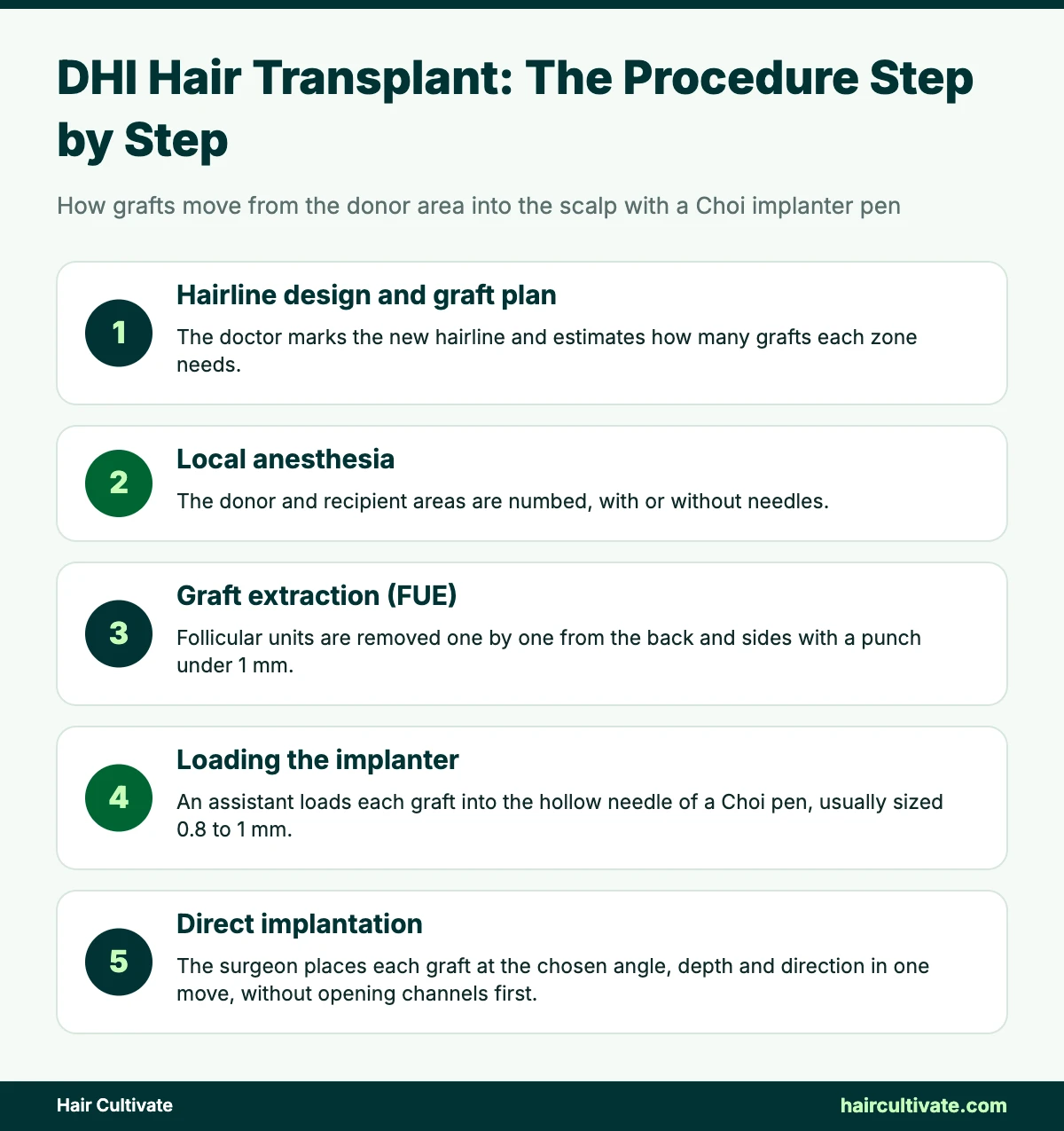
- Hairline design and graft plan. The doctor draws the new hairline using facial landmarks and estimates graft numbers for each zone.
- Local anesthesia. The donor and recipient areas are numbed. Many clinics now offer needle-free anesthesia for this step.
- FUE extraction. Grafts are removed one by one and kept in a cool holding solution.
- Loading the pens. Assistants load each graft into an implanter. Needles usually come in sizes such as 0.8, 0.9 and 1 mm, and teams often work with about four pens at once so the surgeon is never waiting (Marwah & Mysore, 2018).
- Direct implantation. The surgeon inserts each pen at the chosen angle, depth and direction and releases the graft.
DHI vs Sapphire FUE
DHI and Sapphire FUE share the same extraction method. The difference is the recipient area: Sapphire FUE opens all channels first with sapphire blades, then grafts are placed with forceps. DHI creates each site and places the graft at the same time.

| Factor | DHI (Choi pen) | Sapphire FUE |
|---|---|---|
| Extraction | FUE | FUE |
| Implantation | Site creation and placement in one move | Channels first, then forceps placement |
| Shaving | Small areas can be unshaven | Usually shaved |
| Best for | Hairlines, density between existing hair | Large bald areas, high graft numbers |
| Speed in large areas | Slower | Faster |
| Planning | Graft by graft | Whole area planned in one go |
Neither technique is “better” in every case. The right choice depends on your hair loss pattern, how much native hair you still have and how many grafts you need.
Advantages of DHI
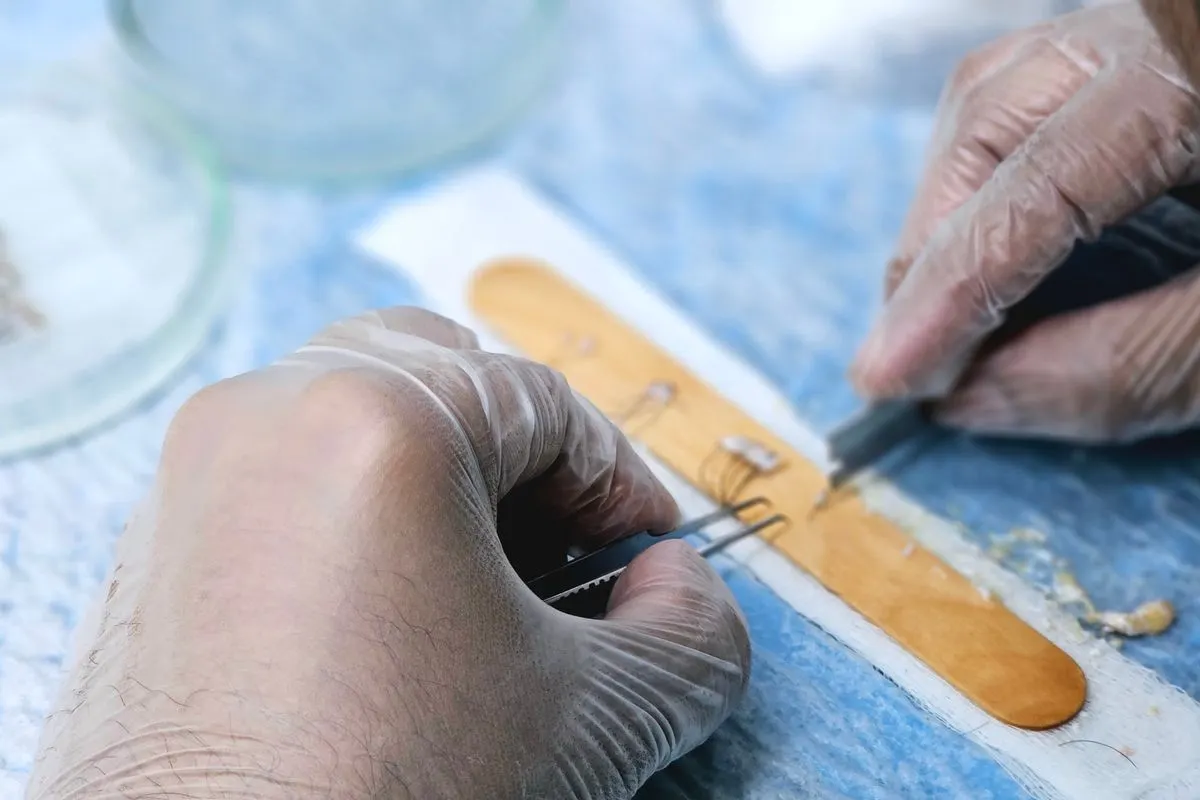
- Less graft handling. Grafts go from the pen straight into the skin, which reduces trauma to the follicle (Marwah & Mysore, 2018).
- Shorter time outside the body. Implanter pens shorten the time a graft spends out of the body, which improves its chance of survival (Marwah & Mysore, 2018).
- Precise angle and depth. The surgeon controls the direction of each hair, which matters most at the hairline.
- Works between existing hairs. DHI can add density to thinning areas without damaging native hair.
- Unshaven options. For small sessions, the recipient area can often stay unshaven.
Limitations of DHI
A published review of implanter techniques lists these trade-offs (Marwah & Mysore, 2018):
- Higher cost. Implanter needles are disposable, which adds to the price.
- Trained team required. Loading grafts into pens takes skill and extra staff.
- Precise dissection needed. Grafts must be trimmed to fit the needle.
- Popping. A graft can occasionally pop out and has to be re-placed.
- Slower in large areas. Only one surgeon implants at a time, so very large sessions take longer.
Who is a good candidate for DHI?
- Men and women who mainly need a new or refined hairline.
- People with diffuse thinning who still have native hair in the area.
- Patients who want to avoid shaving the front of the head.
- Eyebrow, beard and sideburn transplants, where precise angles are essential.
- Patients with a strong donor area who need a moderate number of grafts.
If you have extensive baldness, a combination of DHI at the hairline and Sapphire FUE elsewhere may give the best balance of density and efficiency. Your doctor will confirm this after examining your donor area.
What affects graft survival?
No technique guarantees results on its own. A review of graft survival concluded that surgeons should focus first on the fundamentals: keeping grafts hydrated and cool, limiting time out of body, and handling them gently. Storage solutions and additives help only once these are in place (Parsley & Perez-Meza, 2010). DHI supports two of these fundamentals, less handling and shorter time out of body, but the skill of the team still matters most.
Recovery timeline after DHI
- Days 1–3: mild swelling and tightness. Sleep with your head raised.
- Days 7–10: small crusts fall off. Most people return to work.
- Weeks 2–8: temporary shedding of transplanted hairs. This is normal.
- Months 3–4: new growth starts.
- Month 12: final result in most patients; the crown can take a little longer.
For a full timeline and aftercare checklist, read our patient guide.

DHI hair transplant in Turkey: choosing a clinic
Turkey, and Istanbul in particular, is one of the world’s main destinations for hair transplants. That also attracts unqualified operators. In the International Society of Hair Restoration Surgery 2025 Practice Census, 59% of member surgeons said black market clinics operate in their cities, and repair cases from such clinics made up an average of 10% of their work (ISHRS, 2025).
Before booking, check that:
- A licensed doctor designs your hairline and performs the key surgical steps.
- The clinic tells you who will extract and who will implant your grafts.
- Anesthesia is supervised by a qualified doctor, with emergency equipment on site (Mysore et al., 2021).
- You get a written graft estimate and a clear aftercare and follow-up plan.
At Hair Cultivate in Istanbul, every plan uses the DHI Choi pen technique and includes a specialist doctor consultation, anesthesia by an anesthesiologist, a medication package, a 12-month follow-up and a guarantee certificate. Compare plans on our prices page, or send your photos for a free assessment on WhatsApp (+90 544 476 83 87).
Frequently asked questions
Is DHI better than FUE?
DHI is a type of FUE transplant. Grafts are extracted with FUE in both cases. DHI only changes how grafts are implanted. It is ideal for hairlines and adding density between existing hair, while Sapphire FUE is often faster for large bald areas.
How many grafts can be done with DHI in one session?
It depends on your donor area and the team. Because implantation is slower than with pre-made channels, very large sessions are often done as a hybrid with Sapphire FUE.
Can DHI be done without shaving?
Yes, for small and medium sessions the recipient area can often stay unshaven. The donor area usually needs at least partial trimming for extraction.
Is DHI painful?
The procedure is done under local anesthesia, so the main discomfort is the numbing itself. Needle-free anesthesia can reduce that further.
When will I see results after DHI?
New hair usually starts to grow at 3 to 4 months, with the final result at around 12 months.
Is DHI suitable for women?
Yes. DHI is often a good option for women because it can add density between existing hair without shaving.
Why is DHI more expensive at some clinics?
The implanter needles are disposable and the technique needs a larger trained team to load the pens.
References
- Choi YC, Kim JC. Single hair transplantation using the Choi hair transplanter. J Dermatol Surg Oncol. 1992;18(11):945–948. PMID 1430550
- Marwah MK, Mysore V. Recipient area. J Cutan Aesthet Surg. 2018;11(4):202–210. PMC6371721
- Garg AK, Garg S. Donor harvesting: follicular unit excision. J Cutan Aesthet Surg. 2018;11(4):195–201. PMC6371717
- Parsley WM, Perez-Meza D. Review of factors affecting the growth and survival of follicular grafts. J Cutan Aesthet Surg. 2010;3(2):69–75. PMC2956960
- Mysore V, Kumaresan M, Garg A, et al. Hair transplant practice guidelines. J Cutan Aesthet Surg. 2021;14(3):265–284. PMC8611706
- International Society of Hair Restoration Surgery. 2025 Practice Census. ishrs.org
This article is for general information and does not replace a consultation with a qualified doctor.


