 Italiano
 Türkçe
 Español
 Русский
 فارسی
 Français
 English
 العربية


- Why People Consider an Eyelash Transplant
- What Is an Eyelash Transplant
- Who It Suits and Who It Does Not
- Having the Procedure in Turkey
- Eyelash Transplant Techniques
- Step by Step Procedure
- Results and Growth Timeline
- Risks and Side Effects
- Advantages and Considerations
- Eyelash Transplant Cost in Turkey and Abroad
- How to Choose the Right Clinic
- Start Your Journey with Hair Cultivate
Why People Consider an Eyelash Transplant
Eyelashes protect the eyes and frame the face, and losing them can be distressing. Eyelash loss, called madarosis, has many causes: skin conditions around the eyes such as blepharitis, autoimmune diseases such as alopecia areata, infections, chemotherapy or radiation, certain medicines, thyroid disorders and trichotillomania (compulsive hair pulling). It is usually reversible once the cause is treated, but when the follicles have been destroyed, for example by scarring, the loss can be permanent. In that situation a hair transplant is one of the options to discuss with an eye specialist (Cleveland Clinic, 2023).
Lashes can also be lost after facial injuries, car or work accidents, chemical and thermal burns, or eyelid surgery (Martinick, ISHRS, 2014).
What Is an Eyelash Transplant
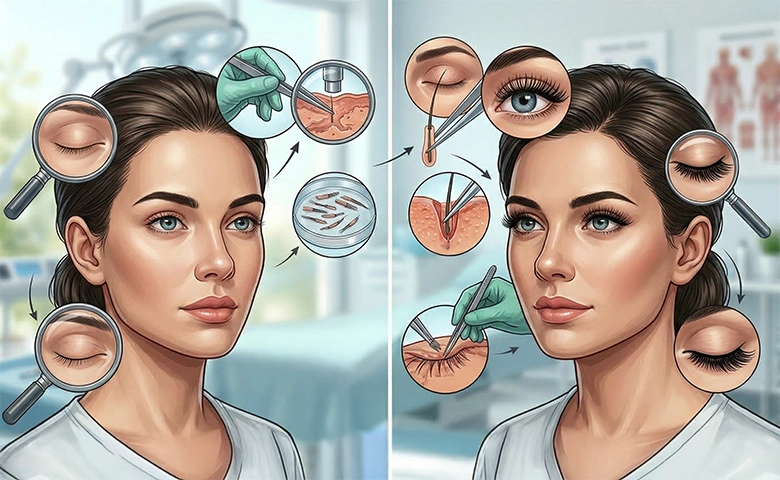
An eyelash transplant moves individual hair follicles, usually from the scalp, to the edge of the eyelid. Donor hair is commonly taken from the nape of the neck or from the area above or behind the ears (Martinick, ISHRS, 2014). For comparison, a normal upper eyelid has about 100 lashes and the lower eyelid about 60 (Martinick, ISHRS, 2014).
Unlike eyebrow transplantation, there is no single gold-standard technique for eyelashes. Donor hair is usually harvested by follicular unit extraction (FUE), and about 35 to 60 follicles are needed to replenish the lashes (Klingbeil & Fertig, 2018). Each hair has to be placed at the correct angle and curve so that it grows away from the eye.
Who It Suits and Who It Does Not
Eyelash transplantation is mainly a reconstructive procedure for lashes lost through trauma or disease. It can also be done for cosmetic reasons, but the thickness and curl of scalp hair can make the result look unattractive (Martinick, ISHRS, 2014). Scalp hair is usually straight, fairly rigid and fast-growing, which means more maintenance and a less natural look if the hairs are thick (Umar, 2015).
Before surgery, medical causes of lash loss such as hypothyroidism and alopecia areata should be ruled out or treated (Klingbeil & Fertig, 2018), and an eye examination helps find the cause (Cleveland Clinic, 2023). People with congenital atrichia, a condition in which hair is absent from birth, are candidates only for eyelash prostheses, not for a transplant (Martinick, ISHRS, 2014).
Having the Procedure in Turkey
Many patients consider Turkey because the consultation, the procedure and follow-up can be arranged in one trip, often with accommodation and transfers included. For eyelashes, though, the most important factor is not the country but the surgeon’s experience with eyelid work, because misplaced lashes can irritate or even damage the eye. The NHS advises choosing a surgeon who is qualified and experienced in this type of surgery and asking about their experience and the complicated cases they have handled (NHS).
Eyelash Transplant Techniques
The technique is chosen according to the surgeon’s preference and the patient’s situation (Klingbeil & Fertig, 2018). The main options are:
| Option | How it works | Notes |
|---|---|---|
| FUE from the scalp | Single follicles are taken one by one from the nape or behind the ears | The usual approach for eyelashes (Klingbeil & Fertig, 2018) |
| FUE from leg or eyebrow hair | Body hair is used as the donor instead of scalp hair | Leg and eyebrow hair are also used as donors (Martinick, ISHRS, 2014); in a case report, leg-hair lashes stayed shorter and needed trimming less often than nape-hair lashes (Umar, 2015) |
| Manual FUE | Follicles are extracted with a hand-held punch | A way of harvesting the follicles, not a separate way of placing them |
Our article on manual FUE hair transplant explains how hand-held extraction works.
Step by Step Procedure
- Consultation and assessment. The doctor checks the eyes and eyelids, looks for the cause of the lash loss and plans the number and direction of the new lashes.
- Anaesthesia. The procedure is done under local anaesthesia, and mild sedation can help you relax (Martinick, ISHRS, 2014).
- Extraction. Single follicles are taken from the donor area. In one published case report, 25 to 31 grafts were placed per eyelid (Umar, 2015).
- Implantation. Each follicle is placed along the eyelid margin with the hair angled away from the eye.
A session takes one to three hours, and a satisfactory result may need one to three sessions (Martinick, ISHRS, 2014).
Results and Growth Timeline
Complete recovery after surgery takes about 7 to 14 days (Martinick, ISHRS, 2014). Transplanted hairs are expected to shed about two weeks after surgery and start growing again four to five months later, with maximum density reached within 8 to 14 months. For that reason, any repeat session should wait at least eight months (Klingbeil & Fertig, 2018).
Because the new lashes come from scalp hair, they keep growing. They must be trimmed and curled to stop them growing downwards (Klingbeil & Fertig, 2018), and patients need to use an eyelash curler and trim the lashes for the rest of their life (Martinick, ISHRS, 2014). In one case report, lashes from nape hair needed trimming every two to three weeks, while lashes from leg hair needed it every five to six weeks (Umar, 2015).
Risks and Side Effects
Itching of the eyelids is common straight after surgery, but itching that lasts more than a day may signal a complication and should be checked by the doctor. Other possible complications include grafts dislodged by scratching, eyelid infection, bruising and swelling, ingrown hairs, the eyelid turning outwards (ectropion) or inwards (entropion), and poor graft placement (Martinick, ISHRS, 2014).
The most serious risk is lashes growing towards the eye. Eyelash transplantation can lead to blepharitis or trichiasis, and in severe cases trichiasis can scar the cornea and cause vision loss (Klingbeil & Fertig, 2018). Follow-up within the first week is recommended to check for infection or graft failure (Klingbeil & Fertig, 2018).
Advantages and Considerations
| Advantages | Considerations |
|---|---|
| Transplanted hair continues to grow in the eyelid | Lifelong trimming and curling |
| Uses your own hair | Scalp hair may look thicker and straighter than natural lashes |
| An option when lash loss is permanent | One to three sessions may be needed |
| Done under local anaesthesia | Misdirected lashes can irritate or damage the eye |
Eyelash Transplant Cost in Turkey and Abroad
Independent, published prices for eyelash transplants are scarce, so we have only listed figures we could verify, with their source:
| Where | Published figure | Source |
|---|---|---|
| United States | $5,000 to $10,000 is common for eyelash transplantation | ISHRS (Martinick, 2014) |
| United Kingdom | £1,000 to £30,000 for hair transplants in general (not eyelash-specific) | NHS |
| Hair Cultivate, Istanbul | Quoted individually after a consultation | Hair Cultivate |
The US figure comes from a 2014 ISHRS article and may not reflect current prices. What actually drives the cost of an eyelash transplant:
- Number of grafts. Around 35 to 60 follicles are needed to replenish the lashes (Klingbeil & Fertig, 2018), and a case report placed 25 to 31 grafts per eyelid (Umar, 2015). Upper and lower lids, or one eye versus both, change the total.
- Number of sessions. One to three sessions may be needed for the desired result (Martinick, ISHRS, 2014).
- Donor area. Scalp hair is the usual source; body hair such as leg hair is a less common option (Umar, 2015).
- Cause of the lash loss. Scarring after burns or injury can make the work more complex (Klingbeil & Fertig, 2018).
- Ongoing care. Lifelong trimming and curling is part of the real cost of living with transplanted lashes (Martinick, ISHRS, 2014).
- Travel. If you travel for surgery, include flights, accommodation and the follow-up visit in your budget.
For reference, our scalp hair transplant packages with the DHI technique range from $3,400 to $4,900 and include accommodation, transfers, a PRP session and post-operative medication. Our article on hair transplant cost in Turkey explains in more detail what shapes prices.
How to Choose the Right Clinic
Because the eyelid sits right next to the eye, precision and follow-up matter more here than in almost any other hair transplant. Before booking:
- Ask who will place the lashes and how many eyelash procedures they have performed.
- Ask to see results of eyelash cases, ideally a year or more after surgery.
- Make sure your eyes and eyelids are examined and the cause of the lash loss is assessed.
- Ask how complications such as inward-growing lashes would be managed after you return home.
The NHS also recommends asking about the surgeon’s qualifications, experience and patient satisfaction (NHS).
Start Your Journey with Hair Cultivate
At Hair Cultivate in Istanbul, an eyelash transplant begins with an assessment of your eyes and the reason for the lash loss, so you know whether a transplant is the right option before any decision is made. If your brows are also thin, you can read about our eyebrow transplant service.
To discuss your case and receive a personal quote, contact our team for a consultation.
References
- Klingbeil KD, Fertig R. Eyebrow and eyelash hair transplantation: a systematic review. J Clin Aesthet Dermatol. 2018;11(6):21–30. PMC6011870
- Martinick JH. Eyelash transplantation: who, why and how. International Society of Hair Restoration Surgery (ISHRS). 2014. ishrs.org
- Umar S. Eyelash transplantation using leg hair by follicular unit extraction. Plast Reconstr Surg Glob Open. 2015;3(3):e324. PMC4387146
- Cleveland Clinic. Madarosis (Eyebrow & Eyelash Hair Loss): Causes & Treatment. 2023. clevelandclinic.org
- NHS. Hair transplant. nhs.uk
This page is for general information and does not replace a consultation with a qualified doctor.
Frequently asked questions about eyelash transplant
Where do the hairs for an eyelash transplant come from?
They are usually taken from the back of the scalp and implanted one by one along the eyelid margin.
Will transplanted eyelashes need trimming?
Yes. Transplanted hairs keep the growth pattern of scalp hair, so they keep growing and need regular trimming and, often, curling.
Is an eyelash transplant painful?
The procedure is done under local anaesthesia, so you should not feel pain. Mild swelling and discomfort around the eyes for a few days afterwards is common.
When will I see the final result?
The transplanted hairs often shed in the first weeks, then new growth appears over the following months. The final result takes several months.
Who is a good candidate for an eyelash transplant?
People with thin or missing lashes due to genetics, injury or previous procedures may be candidates. The eyes and eyelids must be healthy, so an eye examination may be needed first.
What are the risks of an eyelash transplant?
Possible risks include infection, cysts, irritation of the eye and lashes growing in the wrong direction. That is why it should be performed by an experienced specialist.
Can I wear makeup after an eyelash transplant?
Avoid eye makeup and rubbing your eyes during healing. Your doctor will tell you when it is safe to use mascara again.