 Italiano
 Türkçe
 Español
 Русский
 فارسی
 Français
 English
 العربية


Sleeping after hair transplant surgery is one of the first practical worries patients have, because the first nights are when the scalp is swollen and the new grafts are still fragile. You cannot control how you move in your sleep, and your pillow touches your head all night. This guide explains why surgeons ask you to keep your head raised, how long the swelling usually lasts, which positions are safer, how a neck pillow can help, what to do if you touch the grafts at night, and when you can sleep normally again. It only includes points supported by medical sources.
Key takeaways
- Swelling of the forehead and eyelids is the most common problem after surgery; it usually starts around day 2–3 and settles within about 5–7 days (Romera de Blas et al., 2026; Garg & Garg, 2021).
- Keeping the head slightly raised (about 20–30°) in the first days is one of the simple measures used to reduce this swelling (Romera de Blas et al., 2026).
- Sleeping on your back, flat or slightly propped up, is the usual advice; sleeping on your side or face down should be avoided in the early phase (Garg & Garg, 2021).
- You should not touch the grafts, and the NHS advises being very careful with the transplanted hair for the first 2 weeks (NHS).
- Minor oozing can be stopped with gentle pressure from sterile gauze for 5–10 minutes; bleeding that does not stop needs a medical check (Romera de Blas et al., 2026).
Table of contents
- Why sleeping after hair transplant needs care
- Head elevation and swelling
- How many nights should you sleep elevated?
- Back or side: which position is safer?
- Neck and travel pillows
- Protecting the grafts in the recipient area
- If you touch or rub the grafts at night
- When normal sleeping is fine again
- Warning signs to report
- Frequently asked questions
- References
Why sleeping after hair transplant needs care
A hair transplant is usually a day procedure: most patients go home the same day (Cleveland Clinic). So the first night is spent at home or in a hotel, without a nurse nearby.
Two areas are affected. The donor area, usually at the back and sides of the head, is where the grafts were taken. The recipient area, usually the front and top of the head, is where they were placed. Both can feel tight, sore and swollen for a few days (NHS). The recipient area needs the most protection, because the grafts sit in tiny openings in the skin and can be moved by pressure or friction.
For these reasons, sleeping after hair transplant surgery has three simple goals:
- Limit swelling by keeping the head higher than the rest of the body in the first days.
- Keep pressure and friction away from the recipient area.
- Avoid touching or scratching the grafts, even when half asleep.
Your surgeon’s written instructions always come first, because aftercare details for sleeping after hair transplant can differ between FUE, Sapphire FUE and DHI.
Head elevation when sleeping after hair transplant: why it reduces swelling
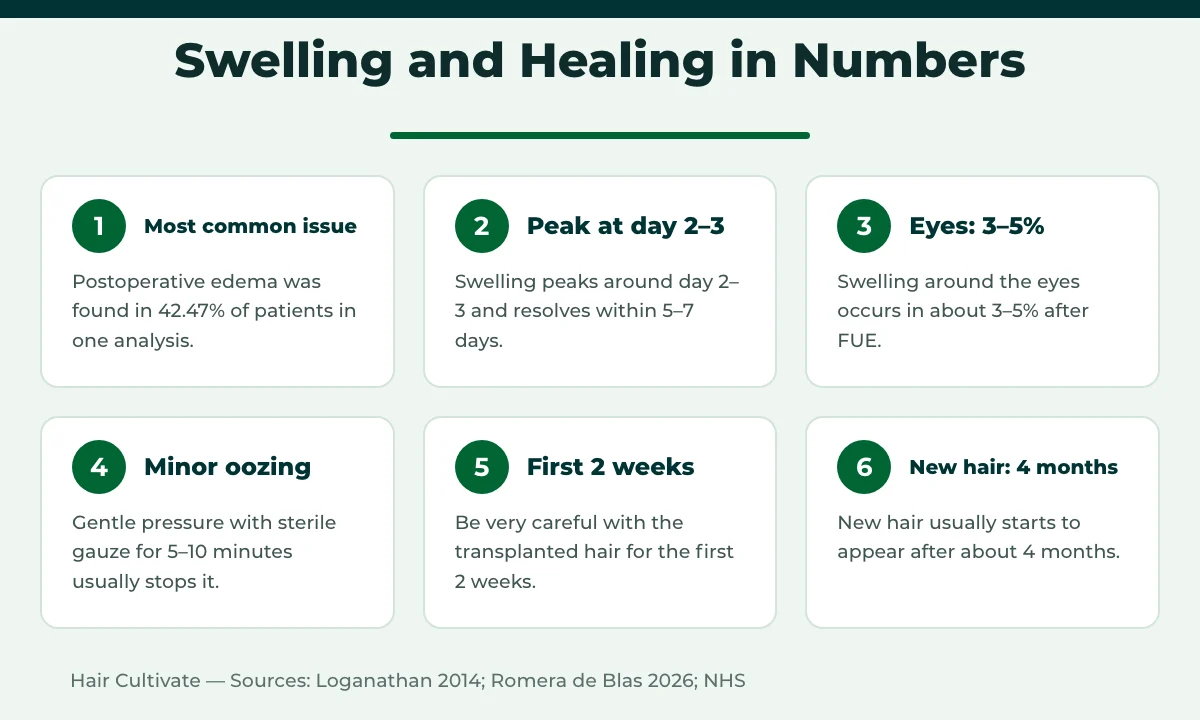
Swelling (oedema) is the most frequent complication after hair restoration. In a retrospective analysis of 73 patients, postoperative edema was found in 42.47% of them, more than any other complication (Loganathan et al., 2014). A 2026 review of FUE complications reports frontal edema in nearly half of patients in FUE cohorts, while swelling around the eyes occurs in about 3–5% (Romera de Blas et al., 2026).
The swelling is linked to the fluid injected into the scalp during local anesthesia: studies show that changing how this fluid is given changes how often edema occurs (Sun et al., 2026). It does not stay on the scalp. It typically appears first on the forehead and then spreads to the upper eyelids, lower eyelids and cheeks (Garg & Garg, 2021). In some patients the eyelids swell so much that they cannot open their eyes for a while (Loganathan et al., 2014).
For sleeping after hair transplant, this is the main reason for a raised head. The 2026 review lists intermittent cold compresses and head elevation of 20–30° during the first postoperative days among the measures used to manage swelling (Romera de Blas et al., 2026). An older analysis also lists keeping a semi-lying position after surgery, together with a firm headband, tapes below the hairline and ice packs (Loganathan et al., 2014).
Be realistic: elevation helps, but it does not prevent swelling completely. The same authors note that none of these methods has been found fully satisfactory, and they saw swelling even when steroids and a headband were used (Loganathan et al., 2014). How the anesthetic is given also matters. In a multicentre study of 1,167 patients, edema occurred in 8.94% of patients with one tumescent technique and in 2.66% with a modified technique (Sun et al., 2026).
How many nights should you sleep elevated?
There is no single number that applies to every patient, and published studies do not set a fixed count of nights. What they do describe is the time course of the swelling. Swelling of the forehead or eyelids is common especially 2–6 days after the operation (Loganathan et al., 2014). In the FUE review it peaks around 2–3 days after surgery and resolves on its own within 5–7 days (Romera de Blas et al., 2026). In a series of 2,896 patients, facial swelling usually appeared on the third day and settled by day 6 or 7 (Garg & Garg, 2021).
So the logical approach to sleeping after hair transplant surgery is to keep your head raised at least through this swelling window, that is, roughly the first week, unless your surgeon gives you a different plan. If swelling remains, continue until it has gone.

To raise your head, use two or three firm pillows, a wedge pillow or a reclining chair. The aim is a gentle slope, not sitting bolt upright. One case report describes a man who slept almost upright after surgery and later developed a rare eye-nerve palsy; the authors suggested the long upright posture might have played a role (González Martín-Moro et al., 2025). It was a single case and only a hypothesis, but a slight slope is enough.
Back or side: the best position for sleeping after hair transplant
The usual recommendation is to lie on your back, flat or slightly propped up, and to avoid sleeping on one side or face down (Garg & Garg, 2021). On your back, the recipient area at the front and top of the head faces the ceiling and touches nothing.

Back sleeping does put the donor area at the back of the head on the pillow. This area is usually sore for a few days, and some patients find it uncomfortable (González Martín-Moro et al., 2025). A soft, clean pillowcase and a neck pillow that takes some of the weight can make it easier. The table below compares the main positions in the first days.
| Position | Recipient area (grafts) | Swelling | Early phase |
|---|---|---|---|
| On the back, head raised | Free of contact | Helps fluid drain downwards | Usually recommended |
| On the back, flat | Free of contact | Less help with drainage | Acceptable for some surgeons |
| On the side | Can rub against the pillow | May increase facial swelling | Avoid |
| Face down | Direct pressure on grafts | May increase facial swelling | Avoid |
| Fully upright for long periods | Free of contact | Not needed | Not necessary; a slight slope is enough |
Neck and travel pillows
The main risk is not the position you start in, but the one you roll into. A U-shaped neck pillow, the kind used on flights, holds the head in the middle and makes it harder to roll onto your side. The idea is not new: a letter published in Plastic and Reconstructive Surgery in 2002 already discussed the role of a “travel pillow” in follicular hair transplant surgery (Mohmand & Toor, 2002).
A neck pillow is also useful on the journey home, when sleeping in a plane or car seat with the head falling sideways onto a window can rub the grafts. Tips for sleeping after hair transplant with a neck pillow:
- Wear the pillow with the open side at the front so it supports the neck and keeps the back of the head slightly lifted.
- Use a clean cover, because the donor area may ooze a little in the first days.
- Do not let the pillow or any hood press on the recipient area.
If you are travelling to Istanbul for surgery, the hair transplant patient guide explains how the first days are usually organised after surgery.
Protecting the grafts in the recipient area while sleeping after hair transplant
The NHS advises that you should not touch the grafts, even once bandages are removed after 2 to 5 days, and that you need to be very careful with your transplanted hair for the first 2 weeks (NHS). For sleeping after hair transplant, this means no pillow contact with the recipient area.
Grafts are most vulnerable at the very beginning. In a series of 2,896 patients, graft dislodgement in the first 24 hours after surgery was seen in 8 patients (Garg & Garg, 2021). It is rare, but the first nights matter most.
Itching is another night-time risk. Itching is a frequent complaint during early healing in both the donor and recipient areas, and avoiding scratching is essential to prevent graft dislodgement and infection (Romera de Blas et al., 2026). Simple measures include:
- Keep your fingernails short in the days before and after surgery.
- Follow the washing schedule you were given; early, gentle cleansing within 48–72 hours is recommended to lower the risk of folliculitis, and delayed washing is listed as a risk factor (Romera de Blas et al., 2026).
- Ask your surgeon about a soothing product or medicine if itching wakes you up. One author recommends washing from the third day and, if needed, a short course of a topical steroid for itching that does not settle (Garg & Garg, 2021).
- Avoid alcohol around the procedure; practice guidelines advise avoiding it for seven days before and after surgery (Mysore et al., 2021).
What to do if you touch or rub the grafts at night
Waking up with your hand on your head is common, and usually nothing serious has happened. Check the area in a mirror with good light, without pressing on it.

- Do not rub, pick or try to push anything back. Leave any scabs in place.
- If there is a small amount of blood, press gently with a sterile gauze for 5–10 minutes. Postoperative bleeding is infrequent and usually stops on its own, and minor oozing can be managed in this way (Romera de Blas et al., 2026).
- If bleeding continues despite pressure, it should be checked by a doctor (Romera de Blas et al., 2026).
- If you think a graft has come out, take a clear photo and send it to your clinic. Your surgeon can tell you whether it matters and what to do next.
- Go back to sleep on your back with your head raised and the neck pillow in place.
This is why a stable position is so useful when sleeping after hair transplant: it prevents repeated rubbing and scratching.
When is normal sleeping after hair transplant fine again?
Normal sleeping returns in stages. According to the NHS, bandages can usually come off after 2 to 5 days, gentle hand washing is usually possible from day 6, non-dissolvable stitches are removed after 10 to 14 days, and you need to be very careful with the transplanted hair for the first 2 weeks (NHS). Many people return to work within 3–5 days, and to exercise or sports after about 3 weeks (Cleveland Clinic).
In practice, sleeping after hair transplant surgery can be divided into three phases:
- First week: back position, head raised about 20–30°, neck pillow, no contact with the grafts.
- Second week: keep protecting the recipient area. Once the swelling has gone, a flat back position is usually acceptable, but avoid pressing the grafts into a pillow until your surgeon confirms that healing is on track.
- After about 2 weeks: the careful period described by the NHS ends, and most people can return gradually to their usual position, including side sleeping, if their surgeon agrees.
Remember that the transplanted hairs often fall out after a few weeks and later grow back; new hair usually starts to appear after about 4 months (NHS). This shedding is normal and is not caused by the way you slept. Full results can take 10 to 18 months (NHS).
Warning signs to report
The procedure is generally safe, but there is a small risk of bleeding, infection and allergic reaction to the anesthetic (NHS). Contact your clinic without delay if you notice:
- Swelling together with pain and redness over the donor or recipient area or the face, with or without fever; this should be taken seriously (Garg & Garg, 2021).
- Bleeding that does not stop after 5–10 minutes of gentle pressure (Romera de Blas et al., 2026).
- Swelling that is getting worse after the first week instead of better.
- Pus, a bad smell, or spots that become painful; folliculitis typically appears within the first 1–4 weeks (Romera de Blas et al., 2026).
- Any new problem with vision, eye movement or double vision.
When you compare clinics, look beyond the price list in our guide to hair transplant cost in Turkey and ask who answers your questions about sleeping after hair transplant in the first two weeks. The procedure itself is explained on the hair transplant in Turkey page.
Frequently asked questions
How should I position my head when sleeping after hair transplant?
Lie on your back with your head gently raised, about 20–30°, using firm pillows or a wedge. Avoid lying on your side or face down in the early phase.
How long does the swelling last?
It usually peaks around day 2–3 and settles within about 5–7 days. It often moves from the forehead to the eyelids before it goes away.
Do I need a neck pillow for sleeping after hair transplant?
It is not mandatory, but a U-shaped travel pillow helps keep your head centred and makes it harder to roll onto the grafts, at night and during travel.
When can I start side sleeping after hair transplant?
Not in the early phase. Wait until the careful period of about 2 weeks has passed and your surgeon agrees.
I touched my grafts in my sleep. Are they ruined?
Usually not. Check in a mirror, press gently with sterile gauze if there is a little blood, and send a photo to your clinic if you are unsure.
Should I sleep sitting upright?
No. A gentle slope is enough for sleeping after hair transplant; sitting fully upright for many nights is not necessary.
Does sleeping after hair transplant affect the final result?
Careful sleep protects the grafts while they are fragile. Later shedding of the transplanted hair is normal and is not caused by your sleeping position.
If you are planning a procedure and want an honest opinion first, you can send photos of your scalp for a free hair analysis on WhatsApp or through our contact page.
References
- Romera de Blas C, Vega Díez D, Ricart Vayá JM, Gómez Zubiaur A. Complications in follicular unit excision hair transplantation: current evidence and practical approaches. Front Med (Lausanne). 2026;13:1750989. PMC12909172
- Garg AK, Garg S. Complications of hair transplant procedures—causes and management. Indian J Plast Surg. 2021;54(4):477–482. PMC8719980
- Loganathan E, Sarvajnamurthy S, Gorur D, Suresh DH, Siddaraju MN, Narasimhan RT. Complications of hair restoration surgery: a retrospective analysis. Int J Trichology. 2014;6(4):168–172. PMC4212293
- Sun Y, Xu F, Zhang J, et al. Comprehensive prevention for edema after hair transplantation: a multicenter study of 1167 patients. Plast Reconstr Surg. 2026;157(1):49e–57e. PMID 40663782
- Mohmand MH, Toor AS. Role of “travel pillow” in single follicular hair transplant surgery. Plast Reconstr Surg. 2002;110(1):355. PMID 12087292
- González Martín-Moro J, Miralles Pechuan V, Gómez Sanz F, Aguilera Del Hoyo F, Gómez de Liaño MR. Fourth nerve palsy after hair replacement surgery and prolonged vertical position in a patient with mega-cisterna-magna: report of a case. Cureus. 2025;17(10):e95830. PMC12665333
- Mysore V, Kumaresan M, Garg A, et al. Hair transplant practice guidelines. J Cutan Aesthet Surg. 2021;14(3):265–284. PMC8611706
- NHS. Hair transplant. nhs.uk
- Cleveland Clinic. Hair Transplant: How Does It Work, Success Rates. clevelandclinic.org
This article is for general information and does not replace a consultation with a qualified doctor.


