 Italiano
 Türkçe
 Español
 Русский
 فارسی
 Français
 English
 العربية


- Why People Consider an Eyebrow Transplant
- What Is an Eyebrow Transplant
- Who Is a Suitable Candidate
- Having the Procedure in Turkey
- Eyebrow Transplant Techniques
- Step by Step Procedure
- Results and Growth Timeline
- Risks and Side Effects
- Advantages and Considerations
- What Affects the Cost of an Eyebrow Transplant
- How to Choose the Right Clinic
- Start Your Journey with Hair Cultivate
Why People Consider an Eyebrow Transplant
Eyebrows frame the eyes and shape facial expression, so thin, patchy or missing brows can change how the whole face looks. Eyebrow hair can be lost for many reasons, including skin conditions near the eyes, autoimmune diseases such as alopecia areata, thyroid disorders, chemotherapy or radiation, and trichotillomania (compulsive hair pulling) (Cleveland Clinic, 2023). People also seek a transplant after years of over-plucking, after a brow tattoo has faded, or after burns and scars (Cleveland Clinic, 2022).
In a systematic review of 67 published articles covering 354 patients who had eyebrow or eyelash transplantation, burns were the most common reason for surgery (57.6% of cases), followed by previous surgical treatment and physiological ageing (Klingbeil & Fertig, 2018).
What Is an Eyebrow Transplant
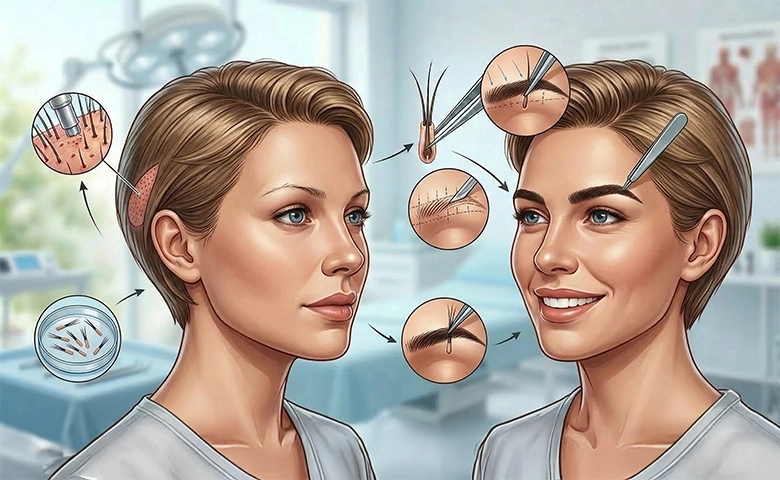
An eyebrow transplant is a permanent cosmetic procedure in which a surgeon moves hair follicles, usually from the scalp, into the brow area to add fullness or replace lost hair (Cleveland Clinic, 2022). It follows the same principle as a scalp hair transplant, but the work is far more detailed: each brow is planned hair by hair.
Follicular unit transplantation has been described as the gold standard for eyebrow transplantation since the early 1990s. Single-hair units are recommended for the head and tail of the brow, and the angle and direction of each hair must match the part of the brow it is placed in (Klingbeil & Fertig, 2018). In practice, the hairs should leave the skin at a very acute angle, almost flat against it, to look natural (Gupta et al., 2017).
Who Is a Suitable Candidate
Suitable candidates include people with congenitally sparse or short brows, trichotillomania, scarring after trauma, burns or tumour surgery, and brow loss from conditions that are stable or treated, such as stable alopecia areata or hypothyroidism (Gupta et al., 2017). Because many causes of brow loss are reversible once the cause is treated, a doctor should first find out why the hair is falling out (Cleveland Clinic, 2023). Medical causes such as hypothyroidism and alopecia areata should be ruled out or corrected before surgery (Klingbeil & Fertig, 2018).
Having the Procedure in Turkey
Many patients look at Turkey because a single trip can combine the consultation, the procedure and follow-up, often as a package with accommodation and transfers. The country itself does not decide the result, though. What matters is the surgeon’s training and experience with fine facial work, a careful design of the brow, and clear aftercare. The NHS advises checking that a surgeon is qualified and experienced in this type of surgery and asking about their experience and the complicated cases they have handled (NHS).
Eyebrow Transplant Techniques
The choice of technique depends on the surgeon’s preference and on each patient’s situation (Klingbeil & Fertig, 2018). The main options are:
| Technique | How it works | Notes |
|---|---|---|
| FUE (follicular unit extraction) | Single follicular units are taken one by one from the donor area, usually the back of the scalp | Single-hair units are extracted preferentially for brows (Gupta et al., 2017) |
| FUT (strip method) | A small strip of scalp is removed and divided into follicular units under magnification | The donor area is closed with stitches (Cleveland Clinic, 2022) |
| Implanter pen (DHI) | Grafts are loaded into a pen-like implanter and placed directly into the brow | A way of placing the grafts, not a separate way of harvesting them |
You can read more about pen implantation in our guide to DHI with Choi pens and about hand-held punches in our article on manual FUE.
Step by Step Procedure
- Consultation and design. The doctor examines the brows, looks for the cause of the hair loss and draws the new shape with you.
- Local anaesthesia. The brow area is numbed with a ring block of local anaesthetic, using minimal fluid to limit swelling around the eyelids (Gupta et al., 2017).
- Extraction. Single-hair follicular units are taken from the donor area. On average about 200 single follicular units are placed per side, although the number varies with the thickness and length of the brow (Gupta et al., 2017).
- Implantation. Each graft is placed at a flat angle and in the direction of natural brow hair. The time grafts spend outside the body should be kept under an hour (Gupta et al., 2017).
Your surgeon will tell you during the consultation how long your own procedure is expected to take (Cleveland Clinic, 2022).
Results and Growth Timeline
Almost all transplanted hairs shed in the first weeks. This is expected and does not mean the grafts have failed. Regrowth begins at about three to four months, and density continues to increase over the following four to six months (Gupta et al., 2017). In the published studies, maximum density was reached within 8 to 14 months, so a second session, if needed, should be planned no sooner than eight months after the first (Klingbeil & Fertig, 2018).
Most patients in the studies reviewed had a mean graft survival above 75%, while results tended to be weaker in burn patients and people with significant scarring (Klingbeil & Fertig, 2018). A single session gives limited density, so some patients need a second session, and an eyebrow pencil can still be used to complete the look (Gupta et al., 2017).
Because the hairs come from the scalp, they keep growing longer than natural brow hair and need regular trimming, in most patients about every two weeks (Gupta et al., 2017).
Risks and Side Effects
Possible risks include scarring, pain, swelling, bruising, infection and loss of feeling or of some follicles at the treated site (Cleveland Clinic, 2022). Swelling and bruising usually settle within a few days, and infectious folliculitis, when it occurs, appears in the first weeks and responds to antibiotics (Klingbeil & Fertig, 2018). The most common problems in practice are hairs growing in the wrong direction or with too much curl, a mismatch in colour or texture, and poor regrowth, which depend largely on the surgeon’s skill (Gupta et al., 2017).
Early follow-up within one week is recommended to check for infection or graft problems (Klingbeil & Fertig, 2018).
Advantages and Considerations
| Advantages | Considerations |
|---|---|
| Transplanted follicles usually keep growing long term | Hairs need regular trimming |
| Uses your own hair | Final density takes many months |
| Shape and direction are designed for your face | A second session may be needed |
| An option when brow loss is permanent | Result depends heavily on the surgeon’s precision |
What Affects the Cost of an Eyebrow Transplant
We do not publish a country-by-country price table, because we could not find a reliable independent source for eyebrow transplant prices. The price of an eyebrow transplant depends mainly on:
- Number of grafts. This depends on how much of each brow needs filling; about 200 single follicular units per side is an average, not a rule (Gupta et al., 2017).
- Number of sessions. Some patients need a second session for more density (Gupta et al., 2017).
- Cause of the hair loss. Scarred skin after burns or injury can be more complex to treat (Klingbeil & Fertig, 2018).
- Surgeon and clinic. For scalp hair transplants in the UK, the NHS says the price can range from £1,000 to £30,000 depending on the extent of hair loss, the type of procedure and the clinic (NHS).
At Hair Cultivate, eyebrow transplant prices are given after a consultation. Our scalp hair transplant packages with the DHI technique range from $3,400 to $4,900 and include accommodation, transfers, a PRP session and post-operative medication. For a wider look at what shapes the price, see our article on hair transplant cost in Turkey.
How to Choose the Right Clinic
Eyebrow transplants reward precision, so look beyond price:
- Ask who will design the brow and place the grafts, and how many eyebrow procedures they have done.
- Ask to see before-and-after photos of eyebrow cases, ideally at least a year after surgery.
- Make sure the cause of your brow loss is assessed before surgery is planned.
- Ask how follow-up will work after you return home.
The NHS also recommends asking about the surgeon’s qualifications, experience and patient satisfaction (NHS).
Start Your Journey with Hair Cultivate
At Hair Cultivate in Istanbul, an eyebrow transplant starts with an assessment of your brows and the reason for the hair loss, followed by a brow design agreed with you before any grafts are taken. If you are also thinking about your lashes, you can read about our eyelash transplant service.
To find out whether an eyebrow transplant suits you and what it would involve, contact our team for a consultation.
References
- Klingbeil KD, Fertig R. Eyebrow and eyelash hair transplantation: a systematic review. J Clin Aesthet Dermatol. 2018;11(6):21–30. PMC6011870
- Gupta J, Kumar A, Chouhan K, Ariganesh C, Nandal V. The science and art of eyebrow transplantation by follicular unit extraction. J Cutan Aesthet Surg. 2017;10(2):66–71. PMC5561712
- Cleveland Clinic. Eyebrow Transplant: What It Is, Surgery, Recovery & Results. 2022. clevelandclinic.org
- Cleveland Clinic. Madarosis (Eyebrow & Eyelash Hair Loss): Causes & Treatment. 2023. clevelandclinic.org
- NHS. Hair transplant. nhs.uk
This page is for general information and does not replace a consultation with a qualified doctor.
Frequently asked questions about eyebrow transplant
Where do the hairs for eyebrows come from?
They are usually taken from the back of the scalp, choosing fine single hairs that resemble natural eyebrow hair.
Will my transplanted eyebrows need trimming?
Yes. Hairs taken from the scalp keep growing like scalp hair, so you will need to trim them regularly.
Can I shape my new eyebrows?
Yes. The doctor designs the shape and direction with you before the procedure, so the brows suit your face.
Is an eyebrow transplant permanent?
Transplanted follicles usually keep growing long term, so the result is considered permanent.
When will I see results?
The transplanted hairs often shed after a few weeks. New hairs grow over the following months and the final result takes several months.
Can I have an eyebrow transplant after microblading?
Often yes. Your doctor will assess the skin and pigment first and plan the hair direction around it.
What should I avoid after an eyebrow transplant?
Avoid rubbing the area, makeup on the brows, swimming and saunas during healing, and follow your doctor’s washing instructions.