 Italiano
 Türkçe
 Español
 Русский
 فارسی
 Français
 English
 العربية


Only a handful of professional footballers have publicly confirmed a hair transplant. The best-documented case is Wayne Rooney, who announced his procedure on Twitter in June 2011, and former player and coach Jürgen Klopp, who confirmed his to the German newspaper Bild in April 2013. Many other names circulate online, but rumours and before-and-after photos are not proof — so this guide sticks to confirmed facts and explains what those cases teach anyone considering surgery.
Key takeaways
- Wayne Rooney (2011) and Jürgen Klopp (2013) are the clearest examples of footballers who confirmed a hair transplant themselves.
- Speculation about other players is common; this article does not name anyone who has not confirmed it.
- For active people, the first two weeks matter most: grafts are not secure yet and exercise is usually reduced for about a month (NHS).
- New hair typically appears around month 4, with full results at 10–18 months — so timing around a season matters.
- The surgeon, technique and aftercare plan matter far more than which celebrity a clinic mentions.
Table of contents
- Which footballers have confirmed a hair transplant?
- Why are footballers open about hair loss?
- What procedure do footballers usually have?
- How long before an athlete can train again?
- Limitations and risks to know
- Getting a hair transplant in Istanbul
- FAQ
Which footballers have confirmed a hair transplant?
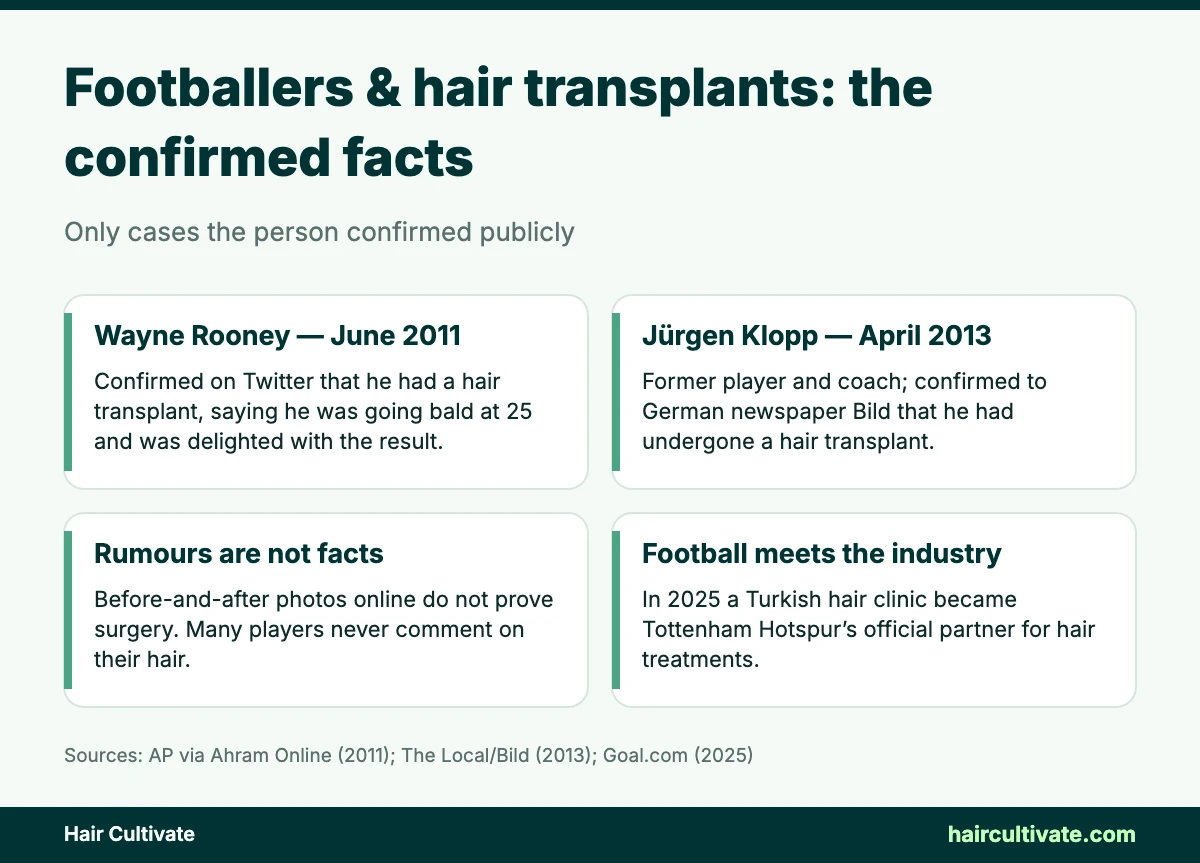
Wayne Rooney (England, Manchester United)
In early June 2011, after photographers spotted him leaving a private clinic in London, Rooney posted on Twitter to confirm that he had undergone a hair transplant. In widely reported words, he explained that he was going bald at 25, asked “why not”, and said he was delighted with the result (as reported by the Associated Press). He later allowed photos of the procedure to be published — something the BMJ’s primary care editor noted at the time as an unusually open move that helped normalise the conversation about male hair loss.
What made the case important was not the celebrity itself but the honesty: a young, fit, world-famous athlete said publicly that hair loss bothered him and that he chose surgery. For many men in their twenties, that changed how the topic was discussed.
Jürgen Klopp (former player and coach)
Klopp played for Mainz in Germany before becoming one of the best-known coaches in Europe. In April 2013 he told Bild that it was true he had undergone a hair transplant and that he found the result “really cool”, according to reports in English by The Local. Like Rooney, he answered the question directly rather than avoiding it.
What about other players?
Lists of “footballers with hair transplants” often include dozens of names based only on photos. Changes in hairstyles, lighting, hair fibres, medical treatment or simply a new haircut can all look dramatic on camera. Unless a player has confirmed a procedure himself, we treat it as speculation and do not repeat it. For a wider look at public figures who did confirm surgery, see our guide to celebrities who had a hair transplant.
Why are footballers open about hair loss?
Androgenetic alopecia (male pattern hair loss) is common and largely genetic, and fitness does not protect against it. Footballers are photographed constantly, often in close-up and in high definition, which makes early thinning very visible. Several factors have made the subject less taboo:
- Public examples: once well-known players spoke openly, other men felt freer to discuss treatment.
- Better techniques: follicular unit excision (FUE) and implanter-pen methods leave small, scattered scars instead of a long linear scar, which suits short haircuts common in sport.
- The industry’s visibility in football: in November 2025, Goal.com reported that a Turkish hair clinic had become Tottenham Hotspur’s official partner for hair treatments — a sign of how mainstream the topic has become.
What procedure do footballers usually have?
Players rarely share technical details, so we cannot say which method any individual chose. In general, modern hair transplantation moves follicular units from the back and sides of the head (the donor area) to thinning areas. International practice guidelines describe two main harvesting approaches: strip surgery (FUT) and follicular unit excision (FUE), with FUE now very widely used.

| Method | How grafts are placed | Why active people consider it |
|---|---|---|
| DHI (Choi implanter pen) | Grafts are loaded into a pen and implanted directly | Precise angle control; no separate channel-opening step |
| Sapphire FUE | Channels opened with sapphire blades, then grafts placed | Fine incisions for dense packing |
| Manual FUE | Hand-held punches for extraction | Careful, slower extraction |
| Hybrid | Combines approaches in one session | Flexibility for larger areas |
You can compare these approaches in our guides to DHI hair transplant in Turkey, sapphire FUE and hybrid hair transplant, or read about needle-free anesthesia if you are worried about the injections.
How long before an athlete can train again?
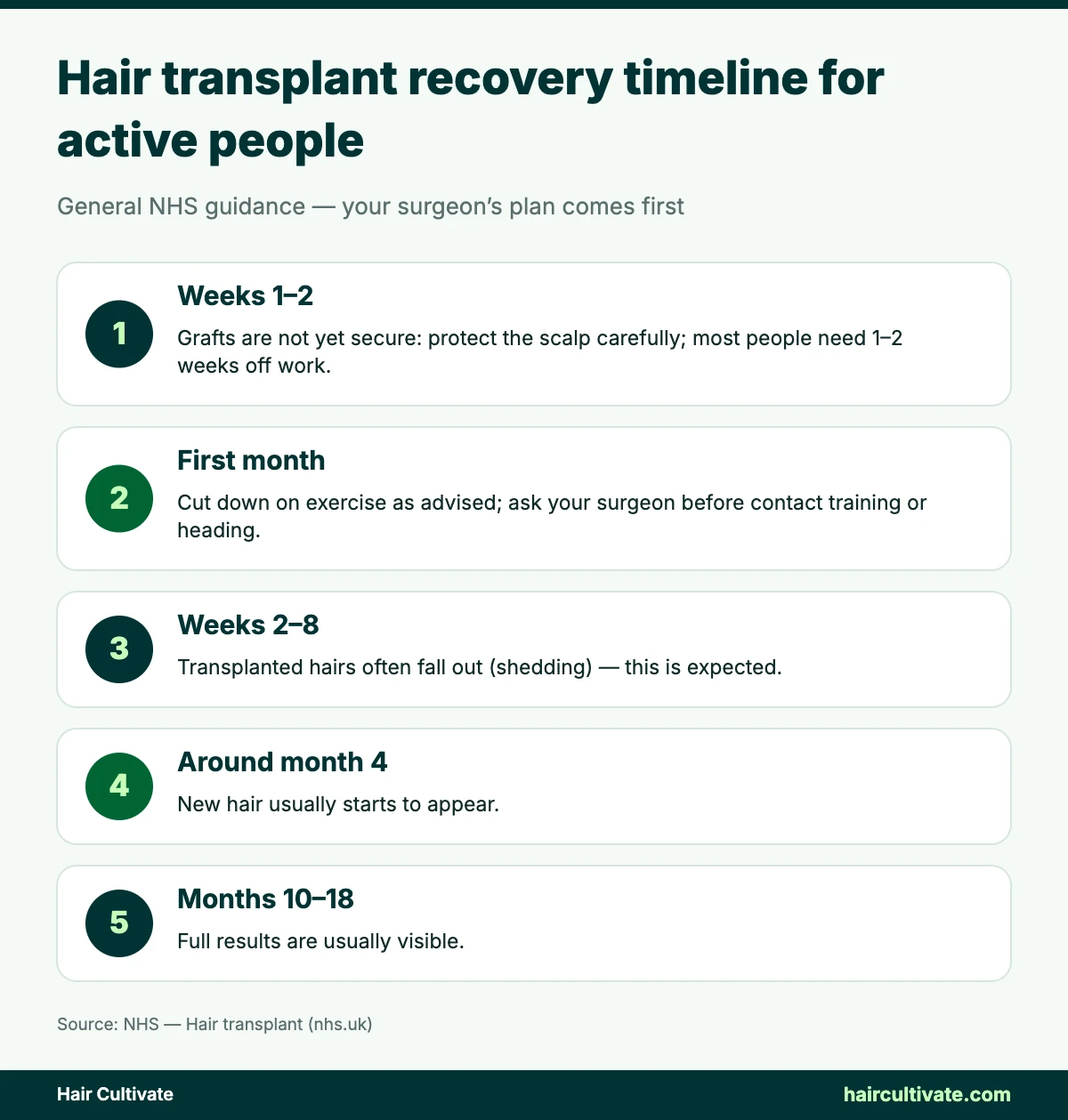
There is no football-specific rulebook, but the NHS gives a clear general timeline. Most people need one to two weeks off work, the grafts must be treated very carefully for the first two weeks because they are not yet secure, and exercise is usually reduced for about the first month. Transplanted hairs often shed after a few weeks; new growth usually appears at around four months, and the full result is typically seen at 10 to 18 months.
For someone who plays contact sport, three practical points follow:
- Plan around the calendar. An off-season or holiday period gives the scalp time to settle before heavy training.
- Ask about specific movements. Heading the ball, helmets, headbands, swimming pools and saunas should all be discussed with your surgeon before you resume them.
- Be patient with the result. Because shedding is normal, judging the outcome before month 10–12 is usually premature.
Graft survival depends on careful handling outside the body and good conditions in the recipient area, as reviews in the Journal of Cutaneous and Aesthetic Surgery explain. Following aftercare instructions is part of protecting that investment. Our patient guide covers preparation and aftercare step by step.
Limitations and risks to know
A celebrity result is not a promise. Every head of hair is different, and an honest assessment should cover:
- Limited donor supply: the number of grafts you can safely take is finite, so a clinic should plan for future hair loss, not just today’s.
- Ongoing thinning: the NHS notes that hair can keep thinning around the transplanted area, which is why some patients also discuss medical treatment with their doctor.
- Complications: bleeding, infection, swelling, numbness, folliculitis, poor growth or visible scarring can occur; reviews of complications stress that most are preventable with good planning and technique.
- Unrealistic comparisons: photos of public figures may be taken at their best angle, with styling, and years after surgery.
Getting a hair transplant in Istanbul
Turkey, and Istanbul in particular, has become a major destination for hair transplants. Quality varies widely, so choose a clinic based on who will treat you, not on celebrity names. Before you book anywhere, ask:
- Which doctor examines my donor area, plans the hairline and is responsible on the day?
- Who performs extraction and implantation, and how is the team supervised?
- Is local anesthesia given by an anesthesiologist?
- What is included in the price, and what follow-up is offered after I fly home?
- Can I see the facility’s licence from the Turkish Ministry of Health?
At Hair Cultivate in Istanbul, every plan uses the DHI Choi pen and includes a specialist doctor consultation, local anesthesia by an anesthesiologist, a post-operative medication package, PRP, 12-month follow-up, a guarantee certificate, VIP transfer and a translator. You can review the packages on our prices page and compare techniques on our methods page.
Thinking about timing your procedure around training or the season? Send us photos of your hair for a free assessment on WhatsApp (+90 544 476 83 87), email info@haircultivate.com, or use our contact page.
Frequently asked questions
Frequently asked questions
Which famous footballer had a hair transplant?
Wayne Rooney is the best-known example. He confirmed his hair transplant publicly on Twitter in June 2011. Former player and coach Jürgen Klopp confirmed his to Bild in 2013.
Did Wayne Rooney have his hair transplant in Turkey?
No. Reports at the time said he was seen at a clinic in London. His case predates the rise of Istanbul as a major hair transplant destination.
Can a footballer play soon after a hair transplant?
The NHS advises protecting the grafts for the first two weeks and reducing exercise for about a month. Contact training and heading should only resume when your surgeon agrees.
When do results become visible?
New hair usually appears around four months after surgery, and the full result is typically visible at 10 to 18 months.
Are online lists of footballers with hair transplants reliable?
Often not. Many are based on photos alone. Only treat a case as confirmed if the person has said so publicly.
Which technique is best for athletes?
There is no single best technique. The right choice depends on your donor area, degree of hair loss and goals, and should be decided in a doctor consultation.
References
- Associated Press. Rooney ‘delighted’ with hair transplant. Ahram Online. 4 June 2011. english.ahram.org.eg
- MacAuley D. Wayne Rooney’s hair transplant. The BMJ Opinion. 16 June 2011. blogs.bmj.com
- The Local. Klopp’s hair transplant sparks aesthetic debate. 13 April 2013. thelocal.de
- Goal.com. Tottenham and Turkish hair transplant partner. 21 November 2025. goal.com
- NHS. Hair transplant. nhs.uk
- Mysore V, Kumaresan M, Garg A, et al. Hair transplant practice guidelines. J Cutan Aesthet Surg. 2021;14(3):265–284. PMC8611706
- Parsley WM, Perez-Meza D. Review of factors affecting the growth and survival of follicular grafts. J Cutan Aesthet Surg. 2010;3(2):69–75. PMC2956960
- Kerure AS, Patwardhan N. Complications in hair transplantation. J Cutan Aesthet Surg. 2018;11(4):182–189. PMC6371733
This article is for general information and does not replace a consultation with a qualified doctor.


