 Italiano
 Türkçe
 Español
 Русский
 فارسی
 Français
 English
 العربية


Washing hair after hair transplant surgery worries many patients, because the new grafts look fragile and the scalp is covered in small crusts. Yet published research treats early, gentle cleansing as part of good healing, not a risk to it. This guide covers when the first wash happens, the step-by-step technique, shampoo choice, how scabs come off, and when normal washing, a hair dryer and hair dye are allowed. Clinics use different schedules, so one rule comes first: your own surgeon’s written instructions always take priority over any general guide, including this one.
Key takeaways
- A 2026 review recommends gentle cleansing with saline or a mild shampoo within 24–72 hours after FUE, and lists delayed washing (more than 3 days) as a risk factor for folliculitis (Romera de Blas et al., 2026).
- Schedules differ: Cleveland Clinic lists the first wash on day 2, while the NHS says you should be able to wash gently by hand from day 6. Follow your own surgeon.
- In the first week of washing hair after hair transplant, use light fingertip touches and avoid strong water pressure; do not rub, scratch or pick (Liu et al., 2024).
- Crusts normally clear in about 7–10 days with good care; crusts that remain beyond 2 weeks should be checked by your doctor (Romera de Blas et al., 2026).
- There is no research-based date for hair dryers or hair dye. The FDA advises never dyeing hair on an irritated or damaged scalp.
Table of contents
- Why washing matters after a hair transplant
- When is the first wash?
- What to prepare before the first wash
- Washing hair after hair transplant: 8 steps
- Choosing a shampoo
- How the scabs come off
- Timeline: normal washing, hair dryer and hair dye
- Common mistakes to avoid
- When to contact your doctor
- Frequently asked questions
- References
Why washing hair after hair transplant surgery matters
After a hair transplant, every graft sits in a tiny opening in the skin. Blood and fluid dry around these openings and form crusts. Crusting is normal, but crusts that stay too long are a problem. A 2026 pilot study notes that persistent scabs make cleansing harder, delay the healing of the skin surface and reduce patient comfort (Meyer et al., 2026).
Washing also protects against infection and inflammation. A 2026 review of FUE complications lists early cleansing within 48–72 hours as a way to help prevent folliculitis (inflamed hair follicles), and lists delayed postoperative washing of more than 3 days as a risk factor (Romera de Blas et al., 2026). Another review links a head wash from the third day, together with aloe vera or oil, to better control of itching, because drying and crusting cause much of the itch (Garg & Garg, 2021).
So the goal of washing hair after hair transplant surgery is simple: keep the scalp clean and help the crusts lift, without any force that could disturb the grafts. The same review stresses that avoiding scratching is essential to prevent graft dislodgement (Romera de Blas et al., 2026).
When is the first wash after a hair transplant?
There is no single international schedule. A 2026 pilot study points out that standardized protocols for care around surgery are still lacking, although immediate postoperative shampooing is generally advised (Meyer et al., 2026). In practice, most published sources place the first wash within the first few days:
- Review of FUE complications: gentle cleansing with saline or a mild shampoo within 24–72 hours, and early washing within the first three postoperative days (Romera de Blas et al., 2026).
- Cleveland Clinic: bandages removed on day 1 and hair washed on day 2 (Cleveland Clinic, 2021).
- Shampoo studies: patients started washing about 2 days after surgery in one study (Schweiger et al., 2015) and 48–72 hours after surgery in another, with the first wash supervised at the clinic on day 2 or 3 (Meyer et al., 2026).
- NHS: from day 6 you should be able to wash your hair gently by hand, and you need to be very careful with the transplanted hair for the first 2 weeks (NHS).
The timing of washing hair after hair transplant surgery therefore varies between clinics. If your clinic gives you a different day, follow your clinic. If you travelled for surgery, for example for a hair transplant in Turkey, ask whether the first wash will be done before your flight home.
What to prepare before the first wash
Before washing hair after hair transplant surgery for the first time, have these things ready:

- The written aftercare sheet from your clinic, and any instructional video they gave you.
- The shampoo, and the softening lotion, foam or oil, that your clinic recommended.
- A clean cup or small jug for pouring water, and a clean, soft towel or paper towels.
- Clean hands and short nails.
Instructional material helps: in a qualitative study, poor knowledge about shampooing led to improper scalp care, and the authors recommended sending patients instructional washing videos (Liu et al., 2024). Our patient guide and recovery timeline explains what else to expect during the first days.
Washing hair after hair transplant: 8 simple steps
The steps below follow the gentle technique for washing hair after hair transplant surgery described in published protocols: fingertip touches only, no strong water pressure and no rubbing in the first week (Liu et al., 2024; Meyer et al., 2026).
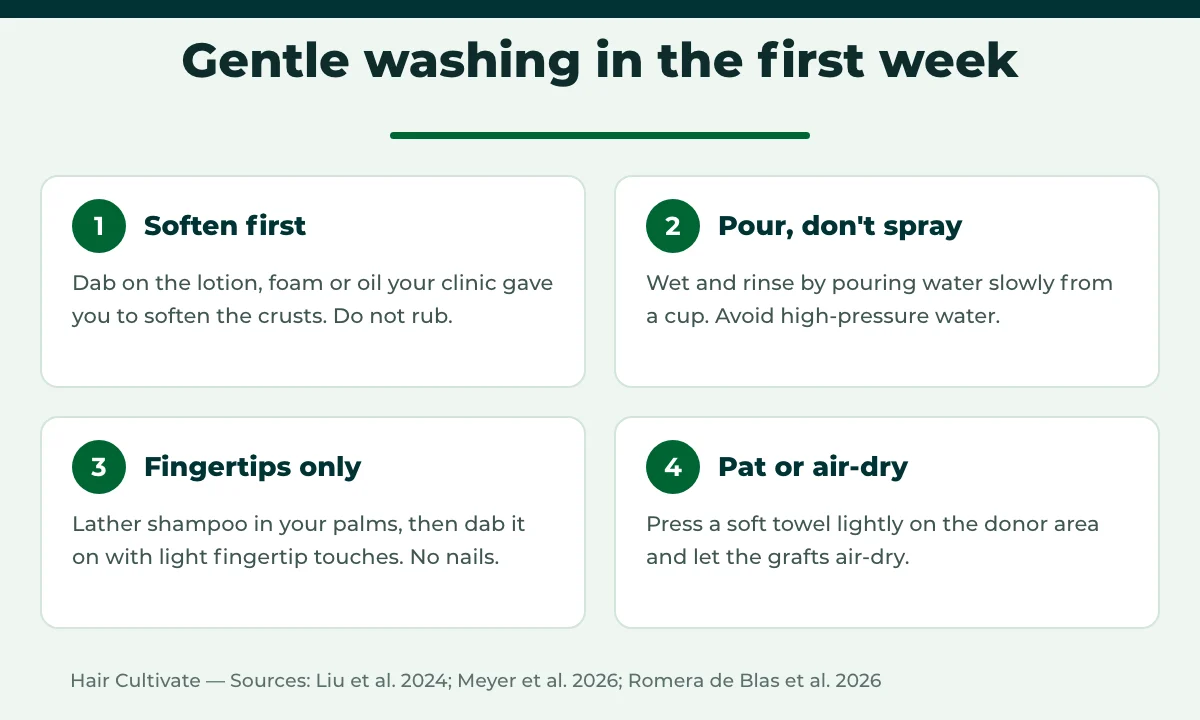
- Apply the softening product, if you have one. If your clinic gave you a lotion, foam or oil, apply it to the transplanted area by dabbing lightly, without spreading or rubbing. Published protocols use emollient oils or gels to soften crusts (Liu et al., 2024; Romera de Blas et al., 2026). Leave it on for the time your clinic states.
- Wet the scalp by pouring, not spraying. Pour water slowly from a cup over the head. Avoid direct contact with high-pressure water (Liu et al., 2024). If you use a shower, keep it on low pressure and do not aim it at the grafts.
- Lather the shampoo in your hands first. Make a light foam with a small amount of mild shampoo in your palms, not on the scalp.
- Dab the foam onto the transplanted area. Use the pads of your fingers, with light up-and-down touches. In the first week, gentle fingertip massage is the recommended way to work on the scabs (Liu et al., 2024). Never use your nails.
- Clean the donor area gently too. The donor area also needs cleaning. Ask your surgeon how much pressure is allowed there and whether any stitches need special care.
- Rinse by pouring again. Pour water slowly until the foam is gone. Low-pressure rinsing is part of the home routine in published protocols (Meyer et al., 2026).
- Pat dry, do not rub. Press a soft towel lightly on the donor area and let the transplanted area air-dry, unless your clinic says otherwise.
- Repeat on schedule. In published studies, patients washed at least once a day (Schweiger et al., 2015) or twice a day (Meyer et al., 2026). Mild shampoo is used daily until the scabs fall off (Liu et al., 2024).
The transplanted area should never be scratched, rubbed or picked during washing hair after hair transplant surgery. If anything looks wrong, stop and send a photo to your clinic.
Choosing a shampoo for washing hair after hair transplant
Most clinics give or name a specific product, and that is the one to use. If you have to choose, look for a mild, non-irritating shampoo, which is what a nursing study recommends for daily use until the scabs fall off (Liu et al., 2024).
Two small studies have tested shampoos after hair transplantation:
- A mild, fragrance-free shampoo (2015): 45 patients used a shampoo without perfumes, silicones or colorants from about day 2 until stitch removal. Scabbing and redness scores fell and no incompatibility reactions were seen. There was no control group, and the authors worked for the manufacturer (Schweiger et al., 2015).
- A 2% salicylic acid shampoo (2026): 21 men after FUE used it twice daily for 10 days from 48–72 hours after surgery. Scab scores fell and no product-related adverse events were recorded. The authors call the results preliminary, as part of the improvement may be normal healing (Meyer et al., 2026).
Neither study proves that one brand is better than another, so ask your surgeon before switching products. If you are also planning treatments such as PRP for hair after surgery, ask your doctor when they can start.
How the scabs come off after a hair transplant
Crusts form normally around the grafts, and regular washing hair after hair transplant surgery is what helps them lift. In a 2026 review, crusting is listed as occurring between days 2 and 10 after surgery, and crusts normally resolve by 7–10 days with appropriate care (Romera de Blas et al., 2026). They should not be pulled off.
Published protocols describe a gradual approach:
- First week: only gentle fingertip massage during washing (Liu et al., 2024).
- After about a week: if scabs remain, an emollient oil can be applied with slightly more pressure (Liu et al., 2024). In one protocol, a more vigorous wash was done at the clinic between days 7 and 10, and home washing then continued with gradually more pressure until the scabs disappeared (Meyer et al., 2026).
- Stubborn scabs: these should be handled in a clinical setting to prevent graft loss or infection (Liu et al., 2024; Meyer et al., 2026).
- Beyond 2 weeks: persistent crusts should be evaluated by a doctor. Thick crusts with increased discharge may be a sign of a circulation problem rather than normal healing (Romera de Blas et al., 2026).
The transplanted hairs themselves usually shed later: the American Academy of Dermatology explains that between two and eight weeks after surgery the transplanted hair falls out, and that this is normal (AAD). Most patients see results between six and nine months after surgery (AAD).
Timeline: normal washing, hair dryer and hair dye
An international expert group of 38 hair transplant specialists from 17 countries recommended a gradual return to the normal haircare routine after a transplant, with close follow-up in the first year (Vañó-Galván et al., 2023). The table shows what the sources say.

| Activity | What sources say | Source |
|---|---|---|
| First gentle wash | Within 24–72 hours (review); day 2 (Cleveland Clinic); gently by hand from day 6 (NHS) | Romera de Blas et al., 2026; Cleveland Clinic; NHS |
| Fingertip washing only | First week after surgery | Liu et al., 2024 |
| Slightly firmer washing | After about a week, if scabs remain | Liu et al., 2024; Meyer et al., 2026 |
| Crusts gone | Normally by 7–10 days; check with a doctor if still present after 2 weeks | Romera de Blas et al., 2026 |
| Extra care of the grafts | Be very careful for the first 2 weeks | NHS |
| Exercise and sports | After 3 weeks | Cleveland Clinic |
| Hair dryer | No research-based date; ask your surgeon | — |
| Hair dye | No research-based date; never dye on an irritated or damaged scalp | FDA |
Returning to normal hair washing
Normal washing usually returns step by step once the crusts are gone and the skin has closed; there is no fixed day for everyone. Ask your clinic at your follow-up when you may use your usual shampoo, shower and washing pressure.
Hair dryer
We found no published study or guideline that sets a safe day for a hair dryer after a hair transplant. Until your surgeon allows it, let the transplanted area air-dry. When you start again, follow your own clinic’s advice on heat and distance.
Hair dye
There is also no research-based date for hair colouring after a transplant. The general safety advice from the US Food and Drug Administration applies: do not dye your hair if your scalp is irritated, sunburned or damaged, and do a patch test before every dye use (FDA). After a transplant, the scalp is healing skin, so wait until your surgeon confirms it has fully healed.
Common mistakes when washing hair after hair transplant
Most problems with washing hair after hair transplant surgery come from doing too much or too little. Avoid these mistakes:

- Waiting too long for the first wash. Delayed washing of more than 3 days is linked to folliculitis, unless your surgeon has a specific reason for a later wash (Romera de Blas et al., 2026).
- Scratching or picking. Avoiding scratching is essential to prevent graft dislodgement (Romera de Blas et al., 2026).
- Using a strong shower jet. Direct, high-pressure water should be avoided (Liu et al., 2024).
- Forcing stubborn scabs off at home. Difficult scabs should be handled in a clinical setting (Liu et al., 2024).
The same rules apply whatever technique was used, including DHI hair transplant and FUE. Aftercare products and follow-up visits are often part of the package, so check what is included when you compare hair transplant costs in Turkey.
When to contact your doctor
Some side effects are expected after surgery, such as crusts, itching and swelling, which are usually temporary (Cleveland Clinic, 2021). Contact your clinic as soon as possible if you notice any of the following:
- Signs of infection, such as green or yellow pus coming from the small cuts in the scalp (Cleveland Clinic, 2021).
- Severe pain or unexpected symptoms (NHS).
- Redness with scattered pustules, which can indicate infection (Garg & Garg, 2021).
- Crusts that are still present after 2 weeks, or thick crusts with increased discharge (Romera de Blas et al., 2026).
- Bleeding that does not stop with light pressure, or a graft that seems to have come out.
If you have questions about washing hair after hair transplant surgery or about your recovery, you can send your photos for a free hair analysis on WhatsApp (+905444768387) or through our contact form.
Frequently asked questions
When can I start washing hair after hair transplant surgery?
Most published sources place the first gentle wash within the first 1–3 days, but the NHS gives day 6 for gentle hand washing. Follow the day your surgeon gives you.
Can washing hair after hair transplant damage the grafts?
Gentle washing is recommended, not harmful. The risk comes from force: scratching, rubbing, picking scabs and strong water pressure. Use fingertip touches and pour the water slowly.
How often is washing hair after hair transplant needed in the first weeks?
In published studies, patients washed once or twice a day with a mild shampoo until the scabs fell off. Your clinic will tell you how often to wash.
How long do scabs last when washing hair after hair transplant?
Crusts normally clear by about 7–10 days with good care. If they are still present after 2 weeks, ask your doctor to check them.
Is it normal for hair to come off with the scabs?
Yes. The transplanted hair usually sheds between two and eight weeks after surgery, which is normal. New growth follows over the next months.
When can I use a hair dryer or dye my hair?
No study sets a fixed date for either. Air-dry until your surgeon allows a dryer, and never dye your hair on an irritated or damaged scalp.
Are the washing rules different for women?
The principles of washing hair after hair transplant surgery are the same for women: gentle, regular washing without force.
References
- Romera de Blas C, Vega Díez D, Ricart Vayá JM, Gómez Zubiaur A. Complications in follicular unit excision hair transplantation: current evidence and practical approaches. Front Med (Lausanne). 2026;13:1750989. PMC12909172
- Meyer T, Fernández-González P, Shafiq-Sánchez A, Gómez-Zubiaur A. Early removal of post-operative scabs after follicular unit extraction using a 2% salicylic acid keratolytic shampoo: a multicentre descriptive pilot study. Front Med (Lausanne). 2026;13:1741064. PMC13175871
- Liu S, Zhang J, Yang X, Wu Y, Li N. Self-management in the post-hair transplantation recovery period among patients with androgenetic alopecia: a qualitative study. Int J Nurs Stud Adv. 2024;7:100234. PMC11401157
- Schweiger D, Schoelermann AM, Filbry A, Hamann T, Moser C, Rippke F. Highly efficient and compatible shampoo for use after hair transplant. Clin Cosmet Investig Dermatol. 2015;8:355–360. PMC4517519
- Garg AK, Garg S. Complications of hair transplant procedures—causes and management. Indian J Plast Surg. 2021;54(4):477–482. PMC8719980
- Vañó-Galván S, Bisanga CN, Bouhanna P, et al. An international expert consensus statement focusing on pre and post hair transplantation care. J Dermatolog Treat. 2023;34(1):2232065. PMID 37477225
- Cleveland Clinic. Hair Transplant: How Does It Work, Success Rates. 2021. clevelandclinic.org
- NHS. Hair transplant. nhs.uk
- American Academy of Dermatology. Hair loss: hair transplant. aad.org
- U.S. Food and Drug Administration. Hair Dyes. fda.gov
This article is for general information and does not replace a consultation with a qualified doctor.


