 Italiano
 Türkçe
 Español
 Русский
 فارسی
 Français
 English
 العربية


Is hair transplant in Turkey safe? For most healthy people treated by a qualified surgeon in a licensed clinic, it can be, because the procedure itself is generally safe and serious complications are uncommon. The real risk lies in where and by whom the surgery is done. Turkey, and Istanbul in particular, has a very large hair transplant industry, and it includes both well-run medical clinics and unlicensed operations where technicians work without proper supervision. This guide explains what the evidence says, which red flags to avoid, and what a safe clinic should do before, during and after your surgery.
Key takeaways
- A hair transplant is generally a safe procedure, with a small risk of bleeding, infection, an allergic reaction to the anaesthetic, poor growth or a noticeable scar (NHS).
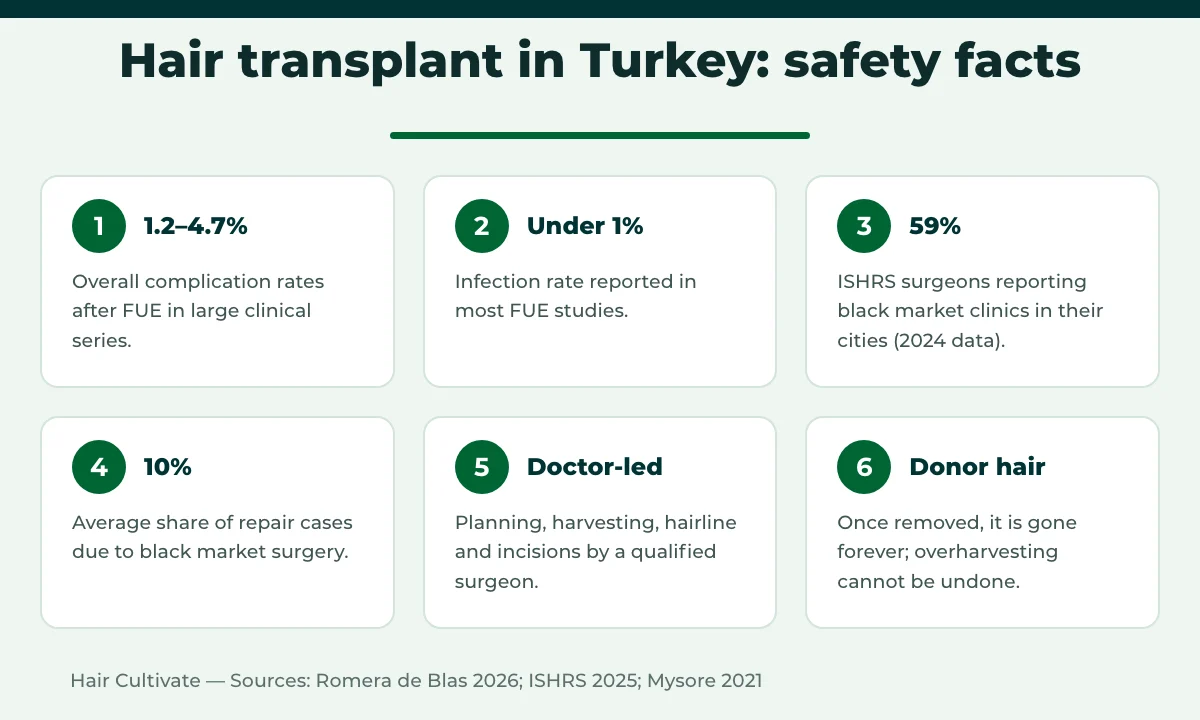
- Large clinical series estimate overall complication rates after FUE between 1.2% and 4.7%, and infection is reported in under 1% of cases (Romera de Blas et al., 2026).
- A 2025 review describes Turkey, especially Istanbul, as the epicentre of hair transplant tourism, with effective centres but also unsupervised technicians and weak oversight (Haider et al., 2025).
- 59% of ISHRS member surgeons reported black market hair transplant clinics in their cities, up from 51% in 2021 (ISHRS, 2025).
- The safest choice is a clinic where a qualified doctor examines you, plans the surgery and performs the steps that involve incisions (Mysore et al., 2021).
Table of contents
- Is hair transplant in Turkey safe? The short answer
- Why Turkey became a hair transplant hub
- The real risks of hair transplant surgery
- Black market clinics: the main danger
- Who should perform your hair transplant
- Red flags when you compare clinics
- What a safe clinic does: a step-by-step check
- Is hair transplant in Turkey safe when you travel? Aftercare and insurance
- How Hair Cultivate approaches safety in Istanbul
- Frequently asked questions
- References
Is hair transplant in Turkey safe? The short answer
The answer depends less on the country and more on the clinic, the doctor and your own health. The NHS describes a hair transplant as generally safe, although, as with any operation, there is a small risk of bleeding, infection and an allergic reaction to the anaesthetic. There is also a small risk that the transplant will not take or that a noticeable scar will form (NHS).
Published data on FUE, the method used in most Turkish clinics, are reassuring when the surgery is done properly. A 2026 review of complications after follicular unit excision reports that large clinical series estimate overall complication rates between 1.2% and 4.7%, with major adverse events being uncommon (Romera de Blas et al., 2026).
So is hair transplant in Turkey safe for you? It can be, if three things are true: you are a suitable candidate, a qualified doctor leads your treatment, and the clinic gives you clear aftercare and follow-up. The rest of this guide shows you how to check each of these points.
Why Turkey became a hair transplant hub
A 2025 review in Aesthetic Plastic Surgery describes Turkey, and especially Istanbul, as the epicentre of hair transplant tourism, generating about US$1 billion a year. The authors link this growth to much lower costs and appealing all-inclusive packages (Haider et al., 2025).
The same review gives a balanced picture. It notes that the industry can offer effective treatment and high graft survival in some centres. However, it also documents aggressive digital marketing, an expanded role for unsupervised technicians, bait-and-switch practices, and a lack of standards and consistent reporting (Haider et al., 2025).
The authors also warn that big price differences may reflect differences in resources, surgeon experience, technology and safety protocols (Haider et al., 2025). In other words, a very low price is not just a bargain; it can tell you something about how the clinic works. This is why the question “is hair transplant in Turkey safe?” has no single answer that fits every clinic. Our guide to hair transplant cost in Turkey explains what a realistic price includes.
The real risks of hair transplant surgery
To answer “is hair transplant in Turkey safe?” honestly, you first need to know the risks of the surgery itself. Every surgical procedure has risks, wherever it is done. Cleveland Clinic lists usually temporary side effects such as crusting or scabs, itching, numbness, pain or throbbing, swelling and tightness (Cleveland Clinic). These are part of normal healing and usually settle in the first days and weeks.

Less common problems are more important to recognise. The 2026 FUE review groups complications into general events such as pain, swelling, bleeding and infection; donor area problems such as scarring and donor depletion; and recipient area problems such as necrosis, folliculitis, shedding and unnatural results (Romera de Blas et al., 2026).
- Infection: reported in under 1% of cases in most studies, usually in the first one to four weeks (Romera de Blas et al., 2026).
- Overharvesting: taking too many grafts or using large punches can leave a thin, “moth-eaten” donor area or permanent donor depletion (Romera de Blas et al., 2026).
- Recipient-site necrosis: rare, but it can cause graft loss and scarring (Romera de Blas et al., 2026).
- Poor growth: linked to graft injury, long out-of-body time, dehydration of grafts and smoking (Romera de Blas et al., 2026).
The review also lists risk factors such as diabetes, high blood pressure, smoking, a tendency to abnormal scarring, poor planning, poor graft handling, overharvesting and excessive density (Romera de Blas et al., 2026). Many of these depend on the skill and judgement of the team, which is why the answer to “is hair transplant in Turkey safe?” depends so much on the clinic you choose. For a deeper look at the two main harvesting methods, see our comparison of FUE vs FUT.
Black market clinics: the main danger
When people ask “is hair transplant in Turkey safe?”, they are usually worried about black market clinics. The International Society of Hair Restoration Surgery (ISHRS) uses this term for unlicensed technicians who perform surgery that should be done by doctors (ISHRS, FUE).
This is a worldwide problem, not only a Turkish one. In the ISHRS 2025 Practice Census, 59% of member surgeons reported black market hair transplant clinics in their cities, up from 51% in 2021. On average, 10% of their repair cases were due to a previous black market hair transplant, up from 6% in 2021 (ISHRS, 2025).
The ISHRS “Fight the FIGHT” campaign states that unscrupulous clinics in Turkey, Iran and several European countries attract patients from around the world. It warns about misleading advertising that promises low prices and guaranteed results, and it lists reported problems such as scarring, unnatural hairlines, poor growth, wrong hair direction, depleted donor areas and infections (ISHRS, Fight the FIGHT).
Damage to the donor area is especially serious. The ISHRS explains that donor hair, once removed, is gone forever, and that ruining the donor area is an irreversible problem (ISHRS, FUE). A poor first surgery can therefore limit what any surgeon can do for you later. For anyone asking “is hair transplant in Turkey safe?”, protecting the donor area should be a top priority.
Who should perform your hair transplant
Most of the question “is hair transplant in Turkey safe?” comes down to who holds the instruments. The ISHRS position is that any procedure that removes tissue from the scalp or body, by any means, must be performed by a licensed physician (Kumaresan & Mysore, 2018).

Hair transplant practice guidelines go further. They recommend that a qualified hair transplant surgeon, not a technician, performs the diagnostic consultation, surgery planning, donor harvesting, hairline design, recipient site creation and postoperative care (Mysore et al., 2021).
Assistants still play an important role. According to the same guidelines, trained assistants may extract grafts after the doctor has scored them, sort grafts, place grafts into premade slits and apply dressings, but only under a physician’s supervision and never in steps that involve an incision (Mysore et al., 2021). Ask the clinic to tell you, in writing, who will do each step. A clear answer is one of the best signs when you are deciding “is hair transplant in Turkey safe with this team?”.
Red flags when you compare clinics
If you are still asking “is hair transplant in Turkey safe with this clinic?”, look for these warning signs. Each one is based on official or professional advice:
- Guaranteed results or very low prices. The ISHRS lists both as typical features of misleading advertising (ISHRS, Fight the FIGHT).
- You never speak to the doctor. TravelHealthPro advises speaking directly to the doctor who will carry out your treatment before you book, and not accepting advice from sales representatives or administrators (TravelHealthPro).
- Surgery sold as a holiday. TravelHealthPro advises caution with any hospital that markets cosmetic surgery as a holiday package (TravelHealthPro).
- No clear answer about who operates. Guidelines say the patient should be told who will perform the surgery and what the assistants will do (Mysore et al., 2021).
- Pressure to take “as many grafts as possible”. Overharvesting can permanently damage the donor area (Romera de Blas et al., 2026).
- No written plan. Guidelines recommend documenting the planned and actual number of grafts, the area covered and the agreed hairline with images (Mysore et al., 2021).
The AAD adds that results depend largely on the surgeon, and advises choosing a doctor who understands hair loss and performs hair transplants regularly (AAD).
What a safe clinic does: a step-by-step check
A safe clinic follows a clear process. The steps below summarise what guidelines and official travel-health advice expect, and they turn the general question “is hair transplant in Turkey safe?” into checks you can actually make.

- Before booking. A doctor assesses your hair loss, donor area and health. The guidelines recommend documenting allergies, medicines and previous surgery, and checking donor density at several points (Mysore et al., 2021).
- Verify the clinic. TravelHealthPro advises checking that the clinic is registered with the local health authorities and fully insured (TravelHealthPro). The UK Foreign Office notes that the Turkish Ministry of Health lists approved medical providers on its HealthTurkiye website, but that this list is not an endorsement of any provider (FCDO).
- On surgery day. You should meet the doctor face to face before the procedure and still be able to change your mind (TravelHealthPro). Costs should be explained in advance and recorded in the consent form (Mysore et al., 2021).
- Before you fly home. Confirm aftercare, ask what happens if there are complications, and take copies of all treatment records and prescriptions (TravelHealthPro).
A good surgeon will also tell you “no” when a transplant is not right for you (ISHRS, FUE). For example, the AAD explains that a man in his 20s may be advised to wait and start medicine first, because hair loss can continue (AAD).
Is hair transplant in Turkey safe when you travel? Aftercare and insurance
Travel is the part of the question “is hair transplant in Turkey safe?” that people often forget. Travelling for surgery adds practical risks. UK government guidance advises discussing your plans with your own doctor first, doing your own research, and remembering that private companies have a financial interest in arranging treatment abroad (GOV.UK).
The same guidance warns that aftercare in another country may be limited and that you should check what your insurance covers (GOV.UK). TravelHealthPro advises telling your insurer about the planned treatment and checking that the policy covers complications (TravelHealthPro). If something goes wrong after you return, follow-up care may not be easy to get or covered at home (TravelHealthPro).
Before flying, your doctor should check that you are well enough to travel (TravelHealthPro). The NHS says a hair transplant usually takes a day without an overnight stay, and that you may need one to two weeks off work (NHS). Our hair transplant recovery guide explains what to expect week by week.
Most of the common side effects are short-lived. Cleveland Clinic advises contacting your provider straight away for a fever that does not go away, heavy bleeding, severe redness or pain, or green or yellow pus (Cleveland Clinic). Make sure you know how to reach your clinic quickly from home, because good follow-up is part of what makes a hair transplant in Turkey safe.
How Hair Cultivate approaches safety in Istanbul
Hair Cultivate is a hair transplant clinic in Istanbul. Every plan includes a consultation with a specialist doctor, local anaesthesia given by an anaesthesiologist, a post-operative medication package and 12 months of follow-up. Packages start from $3,400 (plans of $3,400, $4,200 and $4,900), and the price rises with the plan and the needs of your case. You can see what each plan contains on our prices page.
The answer to “is hair transplant in Turkey safe for me?” is personal. If you want to know whether a hair transplant in Turkey is a safe and suitable option for you, a practical first step is a free hair analysis. Send clear photos of your hairline, crown, top and donor area to our team on WhatsApp (+905444768387). You can then ask who will examine you, who will perform each step and what follow-up you will receive, before you decide anything.
Frequently asked questions
Is hair transplant in Turkey safe for most people?
A hair transplant in Turkey can be safe for healthy people treated by a qualified doctor in a licensed clinic. The NHS describes hair transplant surgery as generally safe, with a small risk of bleeding, infection, allergic reaction, poor growth or scarring (NHS).
How common are complications after a hair transplant?
Complications after FUE hair transplant surgery are uncommon. Large clinical series estimate overall complication rates between 1.2% and 4.7%, and most studies report infection in under 1% of cases (Romera de Blas et al., 2026).
What is a black market hair transplant clinic?
A black market hair transplant clinic is one where unlicensed technicians perform surgical steps that should be done by a licensed doctor (ISHRS, FUE). In 2024 data, 59% of ISHRS member surgeons reported such clinics in their cities (ISHRS, 2025).
Should a doctor perform my hair transplant in Turkey?
Yes. The answer to “is hair transplant in Turkey safe?” depends heavily on a doctor leading the surgery. Guidelines say a qualified hair transplant surgeon should do the consultation, planning, donor harvesting, hairline design and recipient site creation, while assistants work only under supervision and never make incisions (Mysore et al., 2021).
How can I check a hair transplant clinic in Turkey?
To check a hair transplant clinic in Turkey, confirm that it is registered with the local health authorities and insured, and speak directly to the treating doctor before booking (TravelHealthPro). The Turkish Ministry of Health lists approved providers on the HealthTurkiye website (FCDO).
Is it safe to fly home after a hair transplant in Turkey?
Before flying home after a hair transplant in Turkey, your doctor should confirm that you are fit to fly, and you should take copies of your records and prescriptions (TravelHealthPro). A hair transplant usually takes one day and does not need an overnight hospital stay (NHS).
Does a cheap price mean a hair transplant in Turkey is unsafe?
Not always, but a 2025 review warns that large price differences in hair transplant tourism may reflect differences in surgeon experience, resources, technology and safety protocols (Haider et al., 2025). Compare what is included and who operates, not only the price.
References
- NHS. Hair transplant. nhs.uk
- Romera de Blas C, Vega Díez D, Ricart Vayá JM, Gómez Zubiaur A. Complications in follicular unit excision hair transplantation: current evidence and practical approaches. Front Med (Lausanne). 2026;13:1750989. PMC12909172
- Haider SA, Hasanzade S, Borna S, et al. The allures and the alarms of the hair transplant tourism industry. Aesthetic Plast Surg. 2025;49:4745–4753. PubMed 40660034
- International Society of Hair Restoration Surgery. 2025 Practice Census results. ishrs.org
- International Society of Hair Restoration Surgery. Fight the FIGHT: illegal hair transplants. ishrs.org
- International Society of Hair Restoration Surgery. FUE: what is it? ishrs.org
- Mysore V, Kumaresan M, Garg A, et al. Hair transplant practice guidelines. J Cutan Aesthet Surg. 2021;14(3):265–284. PMC8611706
- Kumaresan M, Mysore V. Controversies in hair transplantation. J Cutan Aesthet Surg. 2018;11(4):173–181. PMC6371731
- TravelHealthPro. Travelling abroad for treatment. travelhealthpro.org.uk
- Foreign, Commonwealth & Development Office (FCDO). Turkey travel advice: health. gov.uk
- GOV.UK. Planning to go into hospital abroad. gov.uk
- American Academy of Dermatology. Hair loss: hair transplant. aad.org
- Cleveland Clinic. Hair transplant. clevelandclinic.org
This article is for general information and does not replace a consultation with a qualified doctor.