 Italiano
 Türkçe
 Español
 Русский
 فارسی
 Français
 English
 العربية


A female hair transplant in Turkey can restore density along the parting, the hairline or the temples, but it is not the right answer for every woman with thinning hair. Hair loss in women has many causes, and some of them are temporary or need medical treatment rather than surgery. This guide explains who is a good candidate, which causes should be ruled out first, how unshaven techniques work, what results and risks to expect, and how to plan the cost and the trip.
Key takeaways
- Female pattern hair loss is the most common cause of hair loss in women; it usually shows as a widening part or a thinner ponytail (AAD).
- A transplant may suit some women, but if hair is sparse all over the scalp, there may not be enough healthy donor hair (AAD).
- Guidelines advise a general examination of every female patient for underlying medical conditions and nutritional deficiencies (Mysore et al., 2021).
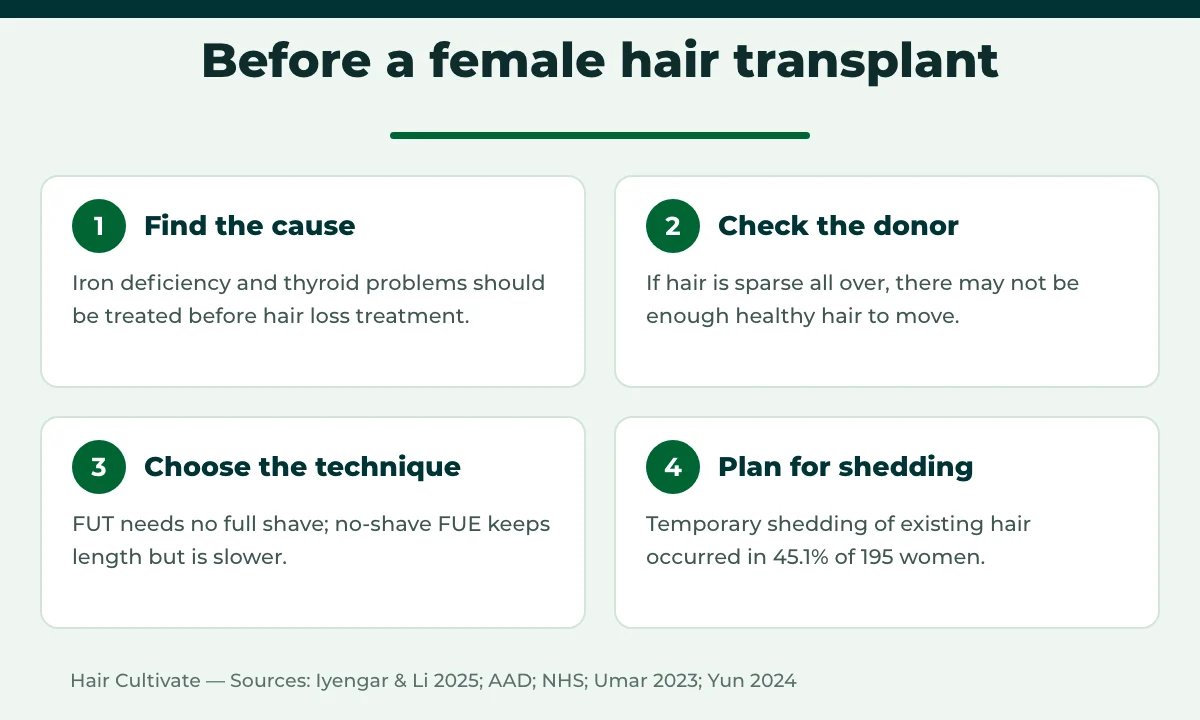
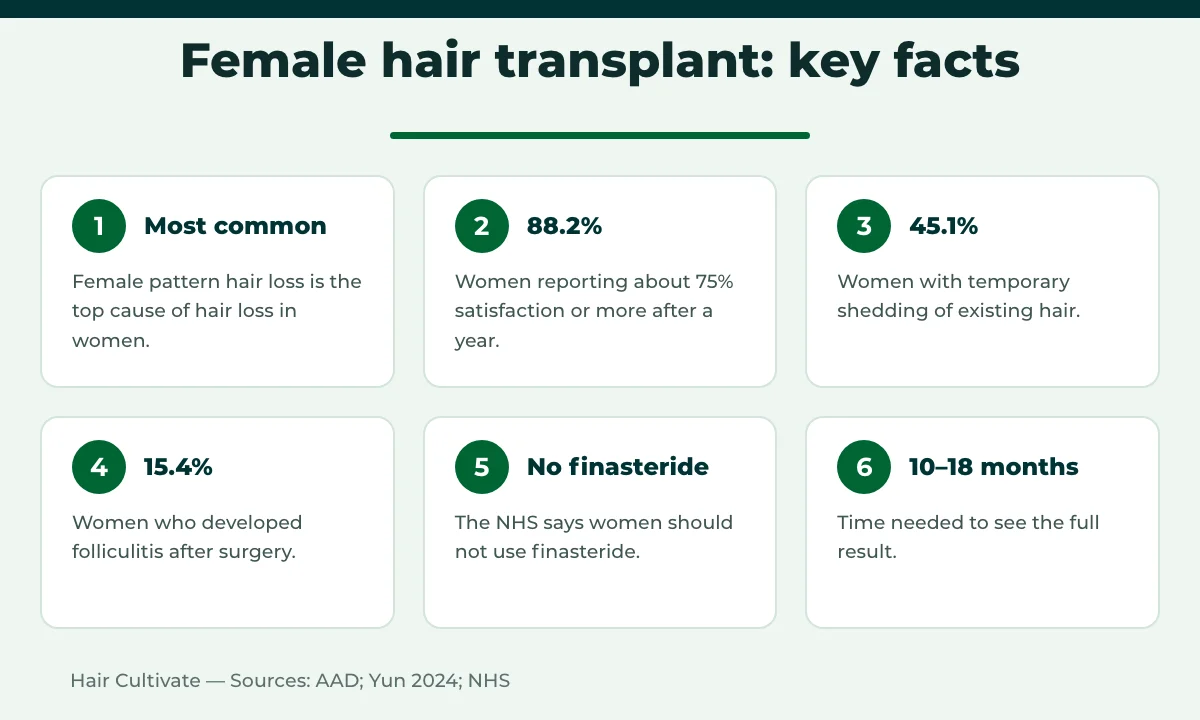
- In 195 women who had a hair transplant, 88.2% reported satisfaction of about 75% or more at least a year later, and 45.1% had temporary shedding of existing hair (Yun et al., 2024).
- No-shave long-hair FUE keeps hair length and helps hide the surgery, but it is slower and technically harder (Umar et al., 2023).
Table of contents
- Why women’s hair loss needs a different approach
- Causes to rule out before surgery
- Who is a good candidate for a female hair transplant in Turkey
- Unshaven and long-hair techniques
- Hairline design for women
- Results and risks: what research shows
- Medical treatment alongside surgery
- Recovery timeline
- Female hair transplant in Turkey: cost and next step
- Frequently asked questions
- References
Why women’s hair loss needs a different approach
Hair loss in women usually looks different from hair loss in men. The AAD describes female pattern hair loss as the most common cause of hair loss in women, affecting millions. Typical signs are a widening part, a thinner ponytail and thinning near the temples, and unlike men, women rarely lose all their hair (AAD).
Female pattern hair loss is largely inherited, and because it becomes more common after menopause, hormones may also play a role (AAD). The thinning is often spread over the top of the head rather than limited to one bald patch. This matters for surgery, because the donor area at the back of the head may also be thinner.
For these reasons, a female hair transplant in Turkey or anywhere else should start with a diagnosis, not with a graft number. Our service page on female hair transplant in Turkey describes the procedure at Hair Cultivate; this article focuses on the decisions you should make before booking.
Causes to rule out before surgery
Not all hair loss is permanent. The NHS lists illness, stress, cancer treatment, weight loss and iron deficiency among the causes of hair loss that may be temporary (NHS, hair loss). The NHS also says a hair transplant is suitable for permanent baldness that runs in families, and usually not for alopecia areata, which causes bald patches (NHS).
A 2025 review for doctors states that nutritional deficiencies such as iron deficiency, and metabolic disorders such as thyroid dysfunction, must be treated before starting hair loss treatment (Iyengar & Li, 2025). It also notes a possible association with polycystic ovary syndrome, and warns that scarring alopecias need early referral to a dermatologist because they can cause permanent hair loss (Iyengar & Li, 2025).
Hair transplant practice guidelines say that a general physical examination to look for underlying medical conditions, nutritional deficiencies and other systemic diseases should be done in all female patients, together with a detailed examination of the donor and recipient areas for diffuse thinning (Mysore et al., 2021). In practice, this means your doctor may ask for blood tests, a scalp examination with a dermatoscope, or both.
Who is a good candidate for a female hair transplant in Turkey
The AAD says men and women of all races can be good candidates for a hair transplant, as long as they have enough healthy hair that can be moved (AAD). For women specifically, the AAD adds a key warning: if the hair on your scalp is sparse all over, you may not have enough healthy hair to transplant (AAD).
Women who are more often suitable include those with:
- Stable female pattern thinning concentrated at the front or along the parting, with a dense donor area.
- A high or receding hairline, or thinning at the temples.
- Temporary causes, such as iron deficiency or thyroid problems, already ruled out or treated.
- Realistic expectations: the goal is more density, not a full head of hair.
Guidelines also stress counselling, because some women have an unrealistic expectation of achieving a full head of hair after the transplant (Mysore et al., 2021). A good plan adds density where it matters most; it does not recreate the hair you had at 18.
Unshaven and long-hair techniques
Many women planning a female hair transplant in Turkey worry about shaving. The technique decides what is shaved. In FUT, a strip of skin is removed from the back of the head and the head does not need to be shaved; only the area where the skin is removed is trimmed. In FUE, the back of the head is shaved and hairs are removed one at a time (NHS).

A newer option is no-shave or long-hair FUE, in which grafts are taken without shaving the donor area. A 2023 study of 152 patients, 45 of them women, described advantages such as preserving the natural length of the hair, camouflaging the donor and recipient areas, and seeing the expected result immediately (Umar et al., 2023). The same authors note that long-hair FUE is time-consuming and technically challenging, and that the special tools can raise the cost. The mean number of grafts in that study was 842 per patient (Umar et al., 2023).
| Technique | Shaving | Points to consider |
|---|---|---|
| FUT (strip) | No full shave; strip area trimmed | Linear scar at the back, usually hidden unless hair is very short (NHS) |
| Standard FUE | Back of the head shaved | Many tiny scars, usually not very noticeable (NHS) |
| No-shave / long-hair FUE | Donor not shaved | Slower, harder and can cost more; mean of 842 grafts per patient in one study (Umar et al., 2023) |
Ask your doctor which option fits your hair length, the number of grafts you need and your return-to-work plans. You can read about implanter pens in our guide to DHI hair transplant in Turkey.
Hairline design for women
When planning a female hair transplant in Turkey, remember that a female hairline is shaped differently from a male one. Practice guidelines describe the planned female hairline as placed lower on the forehead, with an obtuse and rounded angle at the temples (Mysore et al., 2021). Copying a male pattern with sharp temple angles would look unnatural on a woman.
Most women still have hair in the thinning area, so new grafts must be placed carefully between existing hairs. This is one reason guidelines ask for a detailed examination of the recipient area for diffuse thinning before surgery (Mysore et al., 2021).
Results and risks: what research shows
Evidence on results comes mainly from studies outside Turkey, and they are useful when you plan a female hair transplant in Turkey. A recent study included 195 Korean women with female pattern hair loss who had a hair transplant (Yun et al., 2024). Key findings:

- The mean number of hairs implanted was 2,930.
- 88.2% reported satisfaction of about 75% or more, assessed at least one year after surgery.
- Satisfaction was significantly higher in the group with the highest number of implanted hairs.
- Temporary shedding of existing hair in the recipient area occurred in 45.1%.
- Folliculitis occurred in 15.4%, and facial swelling in 15.9%.
Shedding of existing hair after surgery, often called shock loss, is a known issue in women. A 2026 review identifies female sex as a major risk factor and advises informing women about this possible temporary shedding before surgery (Romera de Blas et al., 2026). Read more in our article on shock loss after hair transplant.
General risks of any hair transplant include bleeding, infection, an allergic reaction to the anaesthetic, grafts that do not take and a noticeable scar (NHS).
Medical treatment alongside surgery
A transplant does not stop female pattern hair loss, so medical treatment usually continues. Minoxidil is FDA-approved for women and is the most-recommended treatment for female pattern hair loss (AAD). The AAD notes that shedding may increase for the first two to eight weeks, that it can take six to 12 months to judge the effect, and that the benefit is lost if you stop (AAD).
Minoxidil should be avoided in pregnancy, when planning pregnancy and during breastfeeding (AAD). The NHS states that women should not use finasteride (NHS, hair loss). Your doctor will advise which treatment suits you before and after a female hair transplant in Turkey.
Recovery timeline
Recovery after a female hair transplant in Turkey follows the same steps as any hair transplant. The procedure is usually done under local anaesthetic and sedation, so you are awake but should not feel pain, and it usually takes a day without an overnight stay (NHS). Typical milestones are:
- First days: a tight, achy and swollen scalp, with temporary scabbing (NHS).
- Days 3–5: many people return to work and light activities (Cleveland Clinic).
- Weeks 2–8: the transplanted hair falls out, which is normal (AAD).
- Month 4: new hair usually starts to appear (NHS).
- Months 10–18: the full result should be seen (NHS).
Female hair transplant in Turkey: cost and next step
The cost of a female hair transplant in Turkey depends on the number of grafts, the technique, whether the procedure is unshaven and what the package includes. As a reference, the NHS says a hair transplant in the UK can cost between £1,000 and £30,000 (NHS). Our guide to hair transplant cost in Turkey explains the main price factors.
At Hair Cultivate in Istanbul, packages start from $3,400, with plans at $3,400, $4,200 and $4,900; the price rises with the plan and with your case. Every plan includes a specialist doctor consultation, local anaesthesia by an anaesthesiologist, a post-operative medication package and 12 months of follow-up. You can compare them on our prices page.
Before travelling for surgery, the NHS advises meeting the surgeon rather than only sales staff, and checking how follow-up and complications will be handled (NHS, cosmetic surgery abroad). A simple first step is a free hair analysis: send photos of your parting, hairline, top and the back of your head to WhatsApp +905444768387, and mention any blood tests or diagnosis you already have. The doctor can then tell you whether a female hair transplant in Turkey is suitable, or whether medical treatment should come first.
Frequently asked questions
Is a female hair transplant in Turkey suitable for every woman?
A female hair transplant in Turkey is not suitable for every woman. The AAD says that if the hair is sparse all over the scalp, there may not be enough healthy donor hair to transplant (AAD).
Do women have to shave their head for a female hair transplant in Turkey?
Women do not always have to shave. FUT needs only a trimmed strip at the back, and no-shave long-hair FUE avoids shaving the donor area, although it is slower and harder (NHS; Umar et al., 2023).
Which tests are needed before a female hair transplant?
Guidelines advise a general examination of all women before a hair transplant to look for medical conditions and nutritional deficiencies (Mysore et al., 2021). Iron deficiency and thyroid problems should be treated first (Iyengar & Li, 2025).
Is shock loss common after a female hair transplant?
Temporary shedding of existing hair is common after a female hair transplant; it occurred in 45.1% of 195 women in one study (Yun et al., 2024), and female sex is a major risk factor (Romera de Blas et al., 2026).
Can women use finasteride after a hair transplant?
The NHS states that women should not use finasteride (NHS, hair loss). Minoxidil is the most-recommended medicine for female pattern hair loss, but it should be avoided in pregnancy and breastfeeding (AAD).
How long does a female hair transplant in Turkey take to show results?
After a female hair transplant in Turkey, new hair usually appears after about 4 months, and the full result takes 10–18 months (NHS).
References
- American Academy of Dermatology. Female pattern hair loss. aad.org
- American Academy of Dermatology. Hair loss: hair transplant. aad.org
- Mysore V, Kumaresan M, Garg A, et al. Hair transplant practice guidelines. J Cutan Aesthet Surg. 2021;14(3):265–284. PMC8611706
- Yun D, Kim D, Chung J, et al. Clinical features of patients treated with hair transplants in female pattern hair loss. Ann Dermatol. 2024;36(6):341–347. PMC11621641
- Umar S, Khanna R, Gonzalez A, et al. No-shave long hair follicular unit excision using an all-purpose skin-responsive device. Clin Cosmet Investig Dermatol. 2023;16:3681–3691. PMC10746190
- Iyengar L, Li J. Male and female pattern hair loss. Aust Prescr. 2025;48:93. PMC12187474
- Romera de Blas C, Vega Díez D, Ricart Vayá JM, Gómez Zubiaur A. Complications in follicular unit excision hair transplantation: current evidence and practical approaches. Front Med (Lausanne). 2026;13:1750989. PMC12909172
- NHS. Hair loss. nhs.uk
- NHS. Hair transplant. nhs.uk
- NHS. Cosmetic surgery abroad. nhs.uk
- Cleveland Clinic. Hair transplant. clevelandclinic.org
This article is for general information and does not replace a consultation with a qualified doctor.