 Italiano
 Türkçe
 Español
 Русский
 فارسی
 Français
 English
 العربية


A 5000 grafts hair transplant is a large session, often called a megasession, that aims to cover a big bald area in one visit. It can work well for the right person, but it is not suitable for everyone. Whether it is safe depends mainly on your donor area, the size of the bald area and the way the team plans the surgery. This guide explains who may need about 5,000 grafts, how many grafts a scalp can usually give, what the research says about risks, and what results and recovery look like.
Key takeaways
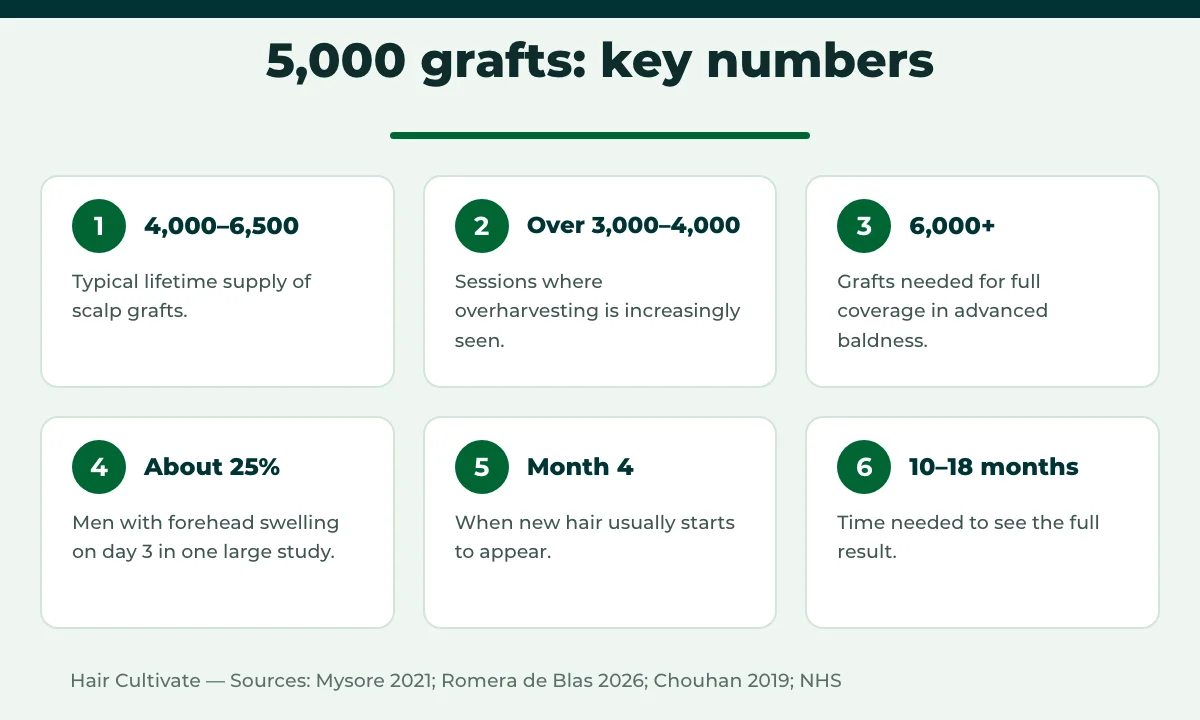
- Practice guidelines put the lifetime scalp supply at about 4,000–6,500 grafts and the optimum upper limit at 2,500–3,000 grafts per session (Mysore et al., 2021).
- Many surgeons reach about 5,000 grafts by combining scalp and beard or chest grafts, sometimes over two consecutive days (Garg & Garg, 2020).
- Overharvesting, folliculitis and swelling are reported more often in sessions above about 3,000–4,000 grafts (Romera de Blas et al., 2026).
- In a study of 820 men with advanced baldness, full coverage in one sitting was not possible in most cases (Chouhan et al., 2019a).
- New hair usually appears after about 4 months, and the full result takes 10–18 months (NHS).
Table of contents
- What a 5000 grafts hair transplant means
- Who may need a 5000 grafts hair transplant
- Can your donor area supply 5,000 grafts?
- Combining scalp and body hair
- Is a 5000 grafts hair transplant safe?
- One session or two?
- Results and timeline after 5,000 grafts
- Protecting your result after surgery
- 5000 grafts hair transplant in Turkey: cost and next step
- Frequently asked questions
- References
What a 5000 grafts hair transplant means
A graft, or follicular unit, is a small natural group of hairs that grows together. In one large study, 2,956 scalp grafts contained 6,320 hairs, a little over two hairs per graft (Chouhan et al., 2019a). A session of 5,000 grafts can therefore move roughly 10,000 hairs, depending on how many hairs each graft holds. In hair restoration, sessions of this size are usually called megasessions.
The number on its own says little about quality. What matters is whether 5,000 healthy grafts can be taken without thinning the donor area, and whether they are placed in the right pattern, angle and density. A 5000 grafts hair transplant that empties the back of the head can leave a patient worse off than a smaller, well-planned session.
For this reason, hair transplant guidelines ask clinics to tell patients how many grafts are planned and how many were actually transplanted, and to charge only for viable follicles that are transplanted (Mysore et al., 2021). Ask for both numbers in writing.
Who may need a 5000 grafts hair transplant
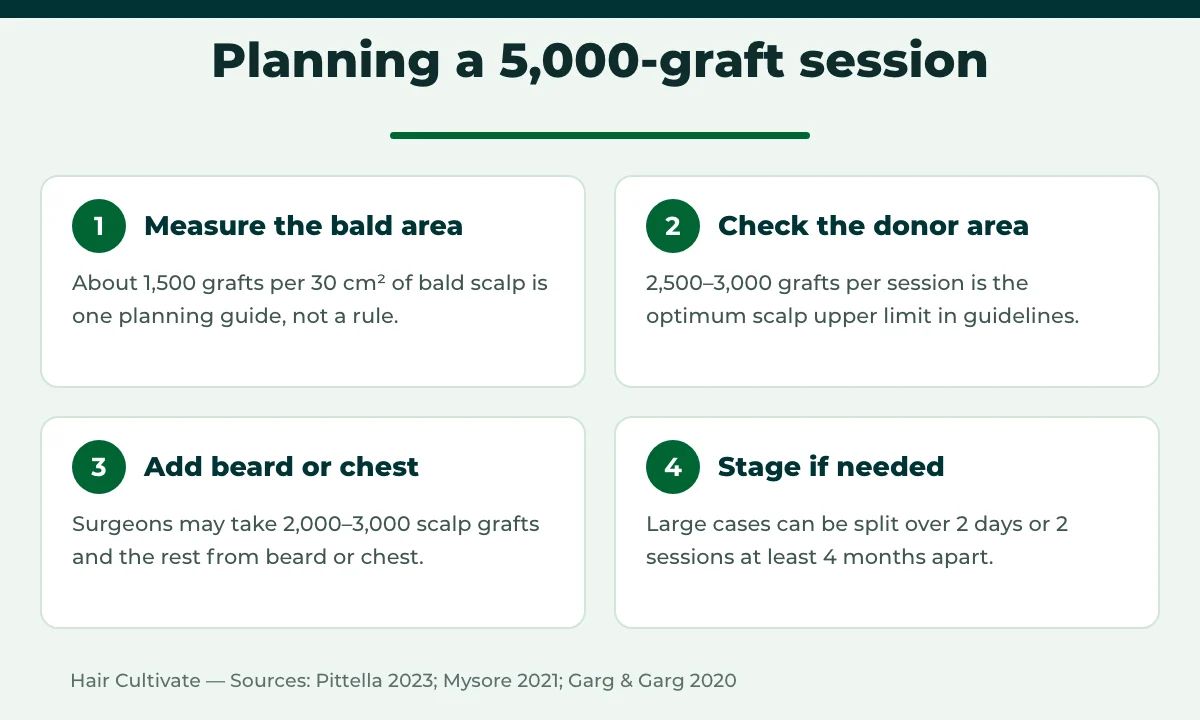
The graft count depends on the size of the bald area and the density the surgeon plans. One quantitative method, the PRECISE scale, gives one point for every 30 cm² of bald scalp and suggests about 1,500 grafts per point, based on a filling density of 50 grafts per cm². The authors stress that this is guidance only (Pittella et al., 2023).
Real studies show how wide the range is. In 158 men treated with FUE, the planned graft amount was 1,500–3,300 for Norwood stage IV and 1,500–4,000 for stage V (Wang et al., 2024). In a larger study of 820 men with Norwood 5–7 baldness, the authors estimated the following needs (Chouhan et al., 2019a):
- Frontal forelock: about 1,500–2,000 grafts.
- Frontal area: about 3,000–3,500 grafts.
- Frontal plus mid-front area: about 4,500–5,000 grafts.
- Full coverage: at least 6,000 grafts.
So a 5000 grafts hair transplant usually fits a man with advanced loss who wants the front and mid-scalp rebuilt. A man with early recession rarely needs it. Our page on hair transplant in Turkey gives an overview of the procedure and the techniques used.
Can your donor area supply 5,000 grafts?
The donor area is the band of hair at the back and sides of the head that is usually resistant to balding. It is limited. Hair transplant practice guidelines state that a scalp can usually give about 4,000 to 6,500 grafts over a lifetime, and that 2,500 to 3,000 grafts per session is considered the optimum upper limit without visible donor depletion (Mysore et al., 2021).
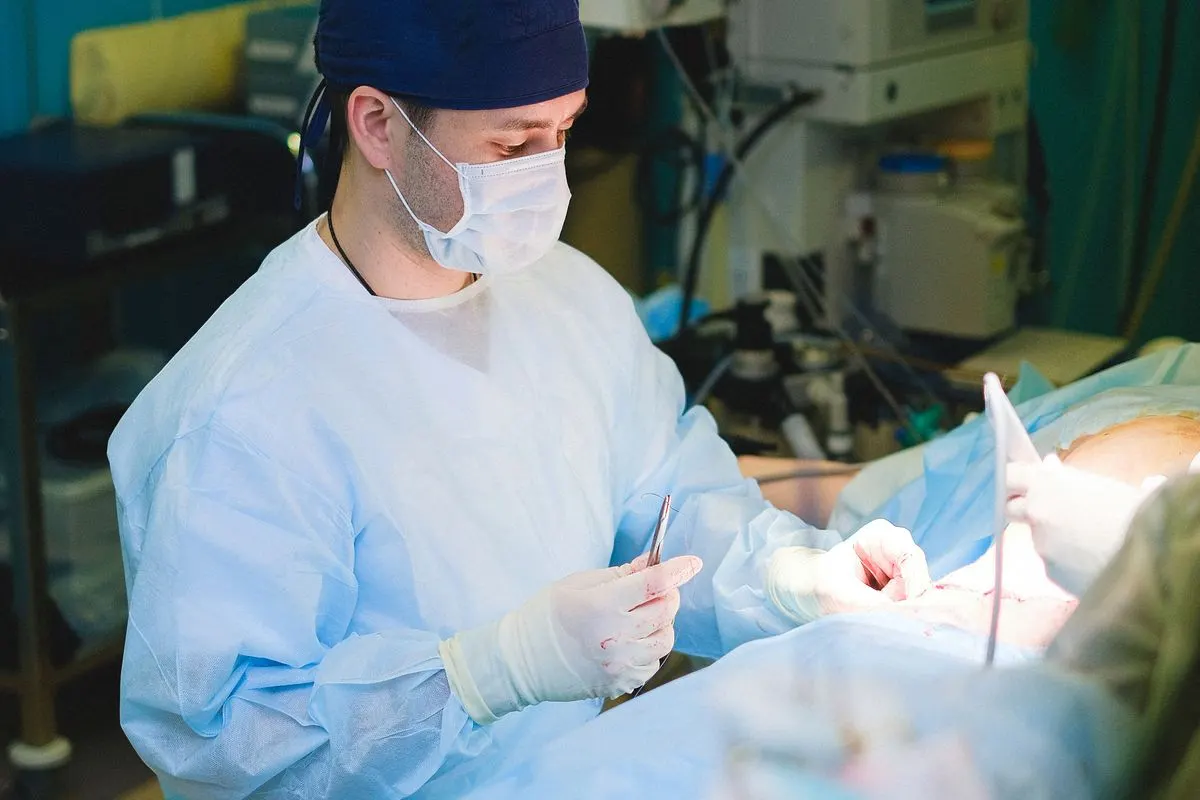
A study of 580 men measured how many grafts could be removed if one in four follicular units was taken. The result was about 2,064 grafts in a limited donor area, 3,097 in a standard area and 3,612 in an extended area. The authors advised taking 25% in the first sitting and 25% of the remaining hair in a second sitting at least six months later, because taking 50% in one sitting can cause extensive damage to small blood vessels (Chouhan et al., 2019b).
These numbers explain why a 5000 grafts hair transplant from the scalp alone is not realistic for many people. Donor density, hair thickness, curl, colour and age all change the answer, which is why the donor area must be examined before any number is promised (Mysore et al., 2021).
Combining scalp and body hair
When the scalp cannot safely give 5,000 grafts, surgeons may add grafts from the beard or chest. The guidelines recommend evaluating non-scalp donor areas, because too much extraction from the safe donor area might destroy the donor area’s appearance (Mysore et al., 2021).
In one published series, surgeons planned 4,000–5,000 grafts for Norwood grade V baldness. They harvested 2,000–3,000 grafts from the scalp and took the rest from the beard and/or chest, over two consecutive days (Garg & Garg, 2020). In the 820-man study, the average scalp harvest was 2,956 grafts, and beard and body grafts were added in the groups that needed more coverage (Chouhan et al., 2019a).
Beard hair is thicker and can add visual density in the middle of the scalp, but other body hair is usually thinner (Garg & Garg, 2020). Your surgeon should explain which grafts go where and why.
Is a 5000 grafts hair transplant safe?
Hair transplant is generally a safe procedure, with a small risk of bleeding, infection, an allergic reaction to the anaesthetic, grafts that do not take and a noticeable scar (NHS). The question is whether size adds risk, and the evidence says it can.
A 2026 review of FUE complications reports the following (Romera de Blas et al., 2026):
- Overharvesting of the donor area is increasingly seen in high-volume sessions above 3,000–4,000 grafts.
- The risk of folliculitis was significantly higher in megasessions above 4,000 grafts.
- Megasessions above about 3,500–4,000 grafts are listed as a technical risk factor for skin necrosis in the recipient area.
- Swelling tends to be more marked in megasessions and with dense packing.
- Many authors recommend taking no more than 10%–20% of the donor follicular unit density per session, although no standard limit exists.
Once the donor area is depleted, repair options are limited (Romera de Blas et al., 2026). For this reason, guidelines say that when a large number of grafts is needed, it is preferable to repeat the surgery rather than perform very long surgeries in one session (Mysore et al., 2021). A responsible 5000 grafts hair transplant plan therefore always includes an honest donor assessment and, when needed, a staged approach.
One session or two?
Many people want everything done in one trip. The NHS notes that if a large area is treated, you may need two or more sessions on different days (NHS). Cleveland Clinic adds that several procedures may be needed, with a few months of healing between them (Cleveland Clinic).
In the series that used body hair, the large first stage was done on two consecutive days, and further stages were done after a gap of at least four months (Garg & Garg, 2020). In the 820-man study, 62% of patients chose a second sitting at 12 months to increase coverage or density (Chouhan et al., 2019a).
A useful way to think about it:
| Approach | When it may fit | Main trade-off |
|---|---|---|
| One day, about 2,500–3,000 grafts | Moderate loss, average donor | May need a second session later |
| About 5,000 grafts over 2 days | Advanced loss, strong donor, beard or chest available | Higher swelling and folliculitis risk; careful planning needed |
| Two staged sessions | Advanced loss, limited donor, or young patient | Two recoveries, but donor is protected |
The table summarises the studies above (Mysore et al., 2021; Garg & Garg, 2020; Romera de Blas et al., 2026). The right choice depends on your examination, not on a package number.
Results and timeline after 5,000 grafts
The timeline after a 5000 grafts hair transplant is the same as after a smaller session, but swelling can be more noticeable. In the 820-man study, forehead swelling occurred in about 25% of patients on day 3 (Chouhan et al., 2019a).
- First days: a tight, achy and swollen scalp is common, with temporary scabbing (NHS).
- Days 3–5: many people return to work and light activities (Cleveland Clinic).
- Weeks 2–8: the transplanted hair falls out, which is normal (AAD).
- Month 4: new hair usually starts to appear (NHS).
- Months 6–12: most patients see results at 6–9 months, and some need 12 months (AAD).
- Months 10–18: the full result should be seen (NHS).
Density will not match a teenage head of hair. Implant density in the 820-man study was 30–40 grafts per cm² at the front, falling to 20–25 at the crown (Chouhan et al., 2019a). At 12 months, 94% of those patients were satisfied overall (Chouhan et al., 2019a). Our hair transplant recovery guide explains each stage in detail, and our article on shock loss after hair transplant covers temporary shedding of existing hair.
Protecting your result after surgery
A hair transplant moves hair; it does not stop pattern hair loss. The NHS warns that your hair might continue to thin around the transplant (NHS). Guidelines state that surgery should not be seen as a single-step permanent solution and that patients should continue medical treatment afterwards; topical minoxidil 2–5% and oral finasteride 1 mg are the approved medicines (Mysore et al., 2021).
Age matters too. The guidelines do not recommend surgery under 21 and prefer waiting until at least 23–25 years of age (Mysore et al., 2021). A young man who uses 5,000 grafts early may have little donor hair left if his loss keeps progressing. Discuss medicines and their possible side effects with your doctor before you decide.
5000 grafts hair transplant in Turkey: cost and next step
Price is usually the main reason people search for a large session abroad. As a reference, the NHS says a hair transplant in the UK can cost between £1,000 and £30,000, depending on the extent of hair loss, the procedure and the clinic (NHS). Our guide to hair transplant cost in Turkey explains how packages are built.
At Hair Cultivate in Istanbul, packages start from $3,400, with plans at $3,400, $4,200 and $4,900; the price rises with the plan and with your case. Every plan includes a specialist doctor consultation, local anaesthesia by an anaesthesiologist, a post-operative medication package and 12 months of follow-up. You can compare the plans on our prices page.
Before you travel for any surgery abroad, the NHS advises meeting the surgeon rather than only sales staff and checking how follow-up and complications will be handled (NHS, cosmetic surgery abroad). The practical first step is simple: send clear photos of the front, top, crown and back of your head to WhatsApp +905444768387 for a free hair analysis. The doctor can then tell you whether a 5000 grafts hair transplant is realistic for your donor area, or whether a smaller or staged plan is safer.
Frequently asked questions
Is a 5000 grafts hair transplant possible in one day?
A 5000 grafts hair transplant is sometimes done in one long day, but many surgeons split it over two consecutive days or two sessions. Guidelines consider 2,500–3,000 grafts per session the optimum upper limit for the scalp (Mysore et al., 2021).
How many hairs are in 5,000 grafts?
In one large study, scalp grafts held a little over two hairs each on average, so 5,000 grafts contain roughly 10,000 hairs (Chouhan et al., 2019a). The exact number depends on the hairs per graft in your donor area.
Does a 5000 grafts hair transplant give full coverage?
A 5000 grafts hair transplant can rebuild the front and mid-scalp in many men with advanced loss. In a study of 820 men, full coverage needed at least 6,000 grafts and was not possible in one sitting in most cases (Chouhan et al., 2019a).
Is 5,000 grafts too many for the donor area?
For many people, 5,000 grafts from the scalp alone would exceed a safe single harvest. Surgeons may add beard or chest grafts or stage the surgery to protect the donor area (Garg & Garg, 2020; Mysore et al., 2021).
What are the main risks of a 5000 grafts hair transplant?
The main added risks of a 5000 grafts hair transplant are donor overharvesting, more swelling, folliculitis and, rarely, skin necrosis, all reported more often in sessions above 3,000–4,000 grafts (Romera de Blas et al., 2026).
When will I see the final result of 5,000 grafts?
New hair usually starts after about 4 months, most people see clear results at 6–12 months, and the full result of 5,000 grafts takes 10–18 months (AAD; NHS).
References
- Mysore V, Kumaresan M, Garg A, et al. Hair transplant practice guidelines. J Cutan Aesthet Surg. 2021;14(3):265–284. PMC8611706
- Chouhan K, Roga G, Kumar A, Gupta J. Approach to hair transplantation in advanced grade baldness by follicular unit extraction: a retrospective analysis of 820 cases (2019a). J Cutan Aesthet Surg. 2019;12(4):215–222. PMC6967160
- Chouhan K, Kota RS, Kumar A, Gupta J. Assessment of safe donor zone of scalp and beard for follicular unit extraction in Indian men: a study of 580 cases (2019b). J Cutan Aesthet Surg. 2019;12(1):31–35. PMC6484564
- Garg AK, Garg S. “Combination grafting” of scalp and body hair to enhance the visual density of hair transplant and coverage of higher grade of baldness. J Cutan Aesthet Surg. 2020;13(2):163–169. PMC7394114
- Romera de Blas C, Vega Díez D, Ricart Vayá JM, Gómez Zubiaur A. Complications in follicular unit excision hair transplantation: current evidence and practical approaches. Front Med (Lausanne). 2026;13:1750989. PMC12909172
- Pittella F, Castro CG, Trivellini R, et al. PRECISE scale: a quantitative classification for androgenetic alopecia and its application to hair transplantation. Aesthetic Plast Surg. 2023;48(5):775–784. PMC10980655
- Wang F, Chen Y, Yang C, et al. Using the follicular unit extraction technique in treatment of male androgenetic alopecia. BMC Surg. 2024;24:358. PMC11566358
- NHS. Hair transplant. nhs.uk
- NHS. Cosmetic surgery abroad. nhs.uk
- American Academy of Dermatology. Hair loss: hair transplant. aad.org
- Cleveland Clinic. Hair transplant. clevelandclinic.org
This article is for general information and does not replace a consultation with a qualified doctor.