 Italiano
 Türkçe
 Español
 Русский
 فارسی
 Français
 English
 العربية


A Norwood 3 hair transplant is one of the most common requests in hair restoration, because stage 3 is the point where a receding hairline starts to look like real hair loss. At this stage the temples are deeply recessed, but most of the top of the head still has hair. A transplant can rebuild the front well, yet timing, graft numbers and medicines matter as much as the surgery itself. This guide explains what Norwood 3 means, how many grafts it usually needs, how the hairline is designed, and why age and medical treatment change the plan.
Key takeaways
- Norwood stage 3 is the minimal extent of hair loss considered baldness: deep, symmetrical recession at the temples (Gupta & Mysore, 2016).
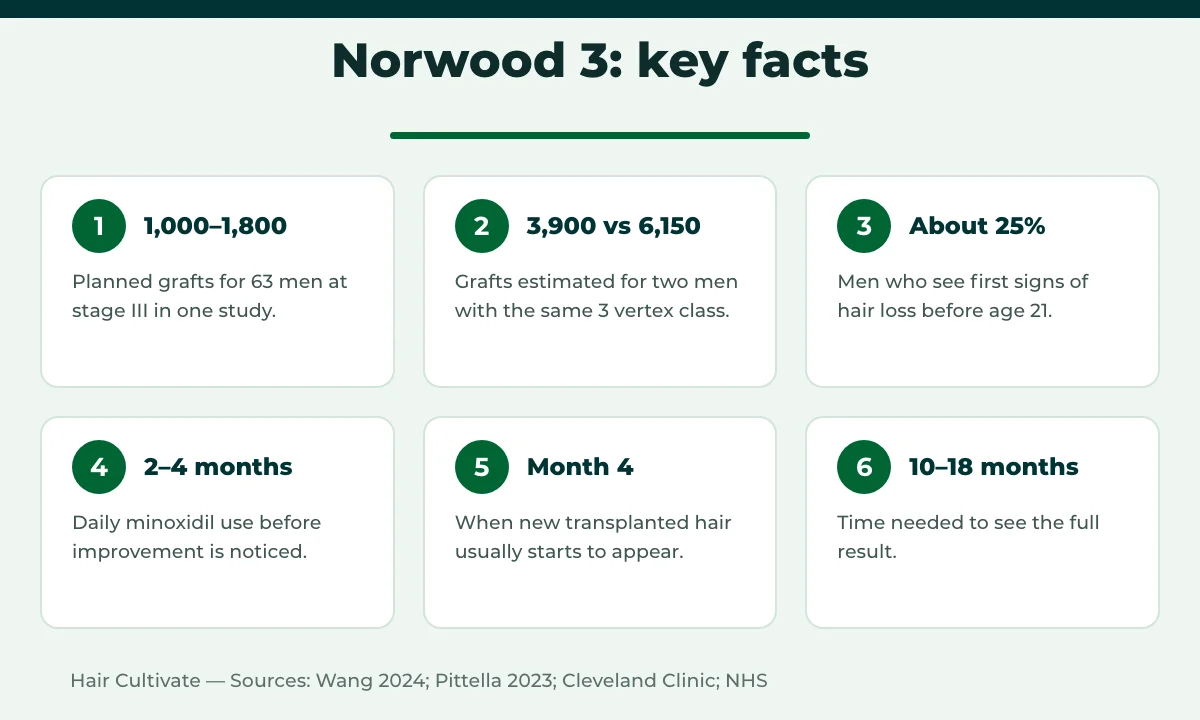
- In one study of 63 men at stage III, the planned graft amount was 1,000–1,800 (Wang et al., 2024), but head size and bald area change the number a lot (Pittella et al., 2023).
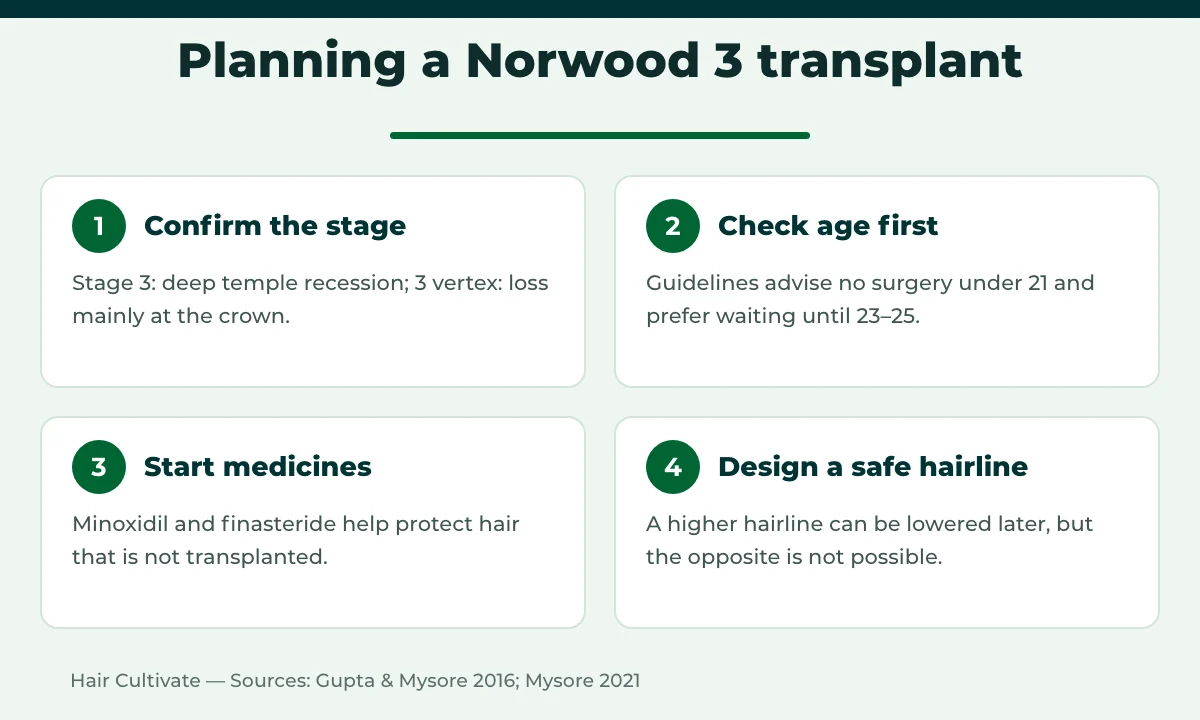
- Guidelines do not recommend surgery under 21 and prefer waiting until 23–25 (Mysore et al., 2021).
- A conservative, slightly higher hairline is safer, because a higher hairline can be lowered later but not the opposite (Mysore et al., 2021).
- Medicines such as minoxidil and finasteride help protect the hair that is not transplanted (Mysore et al., 2021; Cleveland Clinic).
Table of contents
- What Norwood 3 means
- Who is a good candidate for a Norwood 3 hair transplant
- How many grafts does Norwood 3 need?
- Hairline design for Norwood 3
- Age and timing
- Norwood 3 vertex: should the crown be treated?
- Medicines before and after a Norwood 3 hair transplant
- Technique, recovery and results
- Norwood 3 hair transplant in Turkey: cost and next step
- Frequently asked questions
- References
What Norwood 3 means
The Norwood scale describes male pattern hair loss in seven main stages. Norwood observed that thinning starts at the temples and the crown and slowly spreads over the top of the scalp (Gupta & Mysore, 2016). Stage 3 is described as the minimal extent of hair loss sufficient to be considered baldness, with deep, symmetrical recession at the temples that are bare or only sparsely covered by hair (Gupta & Mysore, 2016).
Cleveland Clinic describes stage 3 in simpler words: you have deep hairline recession around your temples, and your hairline may have an “M” or “U” shape (Cleveland Clinic).
There is also a variant called Norwood 3 vertex. In this type, hair loss is mainly at the vertex (crown), and the recession at the front does not go beyond that of stage 3 (Gupta & Mysore, 2016). The plan for a Norwood 3 hair transplant is different for the two types, as explained below.
Who is a good candidate for a Norwood 3 hair transplant
A good candidate has stable hair loss, enough healthy donor hair and realistic expectations. The AAD says candidates need enough healthy hair on the scalp that can be transplanted to the area that needs hair (AAD). Cleveland Clinic adds good general health and realistic expectations (Cleveland Clinic).
Stage 3 often appears young. About 25% of men see the first signs of hair loss before age 21, and by age 50 half experience hair loss (Cleveland Clinic). This is why the main question at stage 3 is not only “can it be done?” but “is this the right time?”.
A review on surgical candidacy warns that young men with rapidly progressing loss will often, without treatment, reach Norwood class 5–6 by age 30 (True, 2021). For these patients, the author advises deferring surgery for at least a year and monitoring medical therapy two to four times during that year (True, 2021).
How many grafts does Norwood 3 need?
There is no single number. In a study of 158 men treated with FUE, the 63 men at Hamilton-Norwood stage III had bald areas of 20–124 cm² and a planned graft amount of 1,000–1,800 follicular units (Wang et al., 2024). Planned density in that study ranged from 30 to 60 grafts per cm².
The stage alone does not predict the number. The authors of the PRECISE scale showed two patients with the same Norwood 3 vertex class: one was estimated to need about 3,900 grafts and the other about 6,150, because their heads and bald areas were different sizes (Pittella et al., 2023). Their method suggests about 1,500 grafts for every 30 cm² of bald scalp, as guidance only (Pittella et al., 2023).
In practice, a plan that treats only the temples needs fewer grafts than one that also lowers the whole hairline or adds density behind it. Ask for the planned number in writing; guidelines say the number planned and the number actually performed should be disclosed to the patient (Mysore et al., 2021).
| Area treated | What decides the graft number |
|---|---|
| Temple recession only | Depth of the temples and the density you want |
| Full hairline and front | Width of the forehead and how low the hairline is placed |
| Crown (Norwood 3 vertex) | Size of the crown; the vertex consumes more grafts than the front |
The last row reflects the guideline statement that the vertex consumes more grafts than the front of the head (Mysore et al., 2021).
Hairline design for Norwood 3
The hairline is the most visible part of a Norwood 3 hair transplant. Guidelines call the design of the front hairline the biggest challenge and most demanding step (Mysore et al., 2021). Many patients ask for their teenage hairline back, but a low hairline can look wrong as the face ages and usually uses more grafts (Mysore et al., 2021).
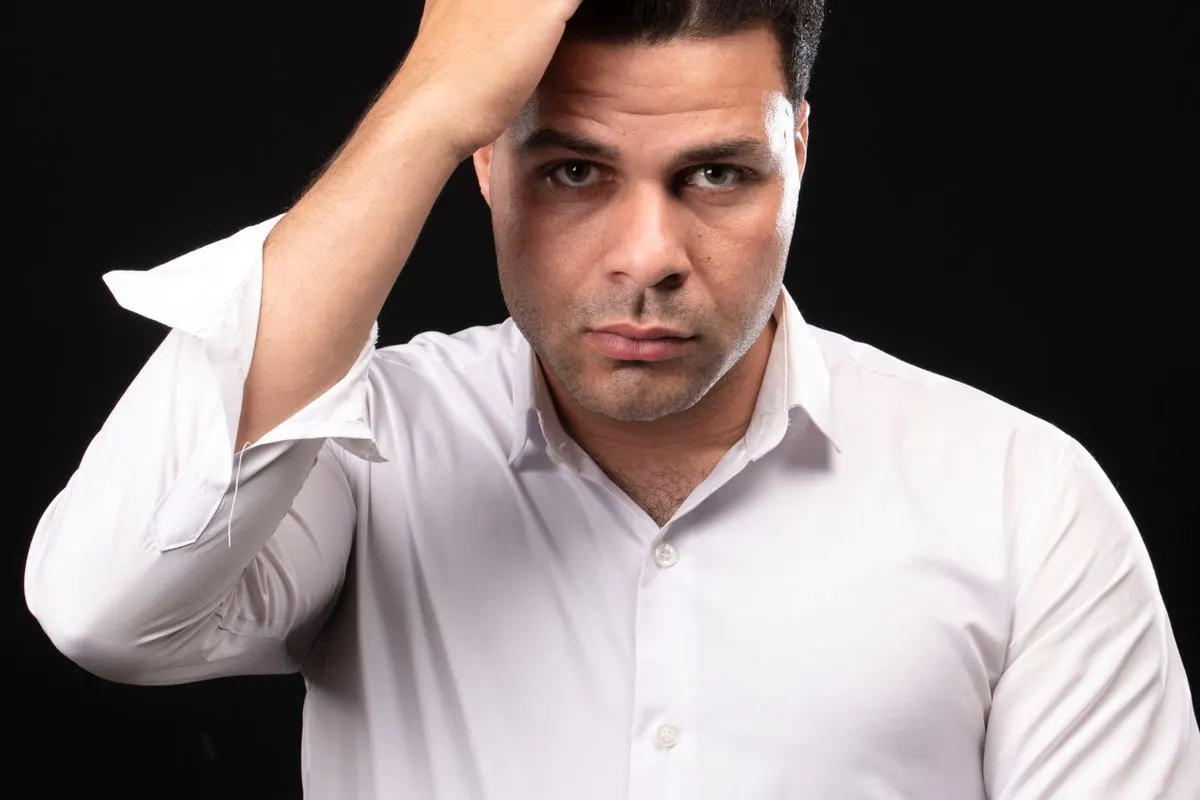
Key principles from the guidelines (Mysore et al., 2021):
- A hairline placed higher can be lowered in the future, but the opposite is not possible.
- The frontotemporal point should be at the same level as, or higher than, the midfrontal point.
- The frontotemporal angle should be in line with the vertical canthal line, a vertical line drawn up from the corner of the eye.
- Rounded, obtuse temple angles are typical of women and can look unnatural on men.
The guidelines also say that hairline design should be done by a qualified hair transplant surgeon, not a technician, and documented with an image once accepted (Mysore et al., 2021). A softer, slightly mature hairline protects your donor hair for the future.
Age and timing
Age is one of the most important factors when planning surgery at this stage. Practice guidelines do not recommend surgery in people younger than 21, and say it is preferable to wait until at least 23–25 years of age (Mysore et al., 2021). Exceptions for ages 21–23 include advanced loss at Hamilton–Norwood stages 4–6, which means a young man at stage 3 usually belongs in the “wait and treat” group (Mysore et al., 2021).
The AAD gives similar advice: a man in his 20s may be asked to wait and start a hair loss medicine first (AAD). If hair loss is progressing fast and many hairs in the recipient area are miniaturised, one review suggests 6 to 12 months of medical therapy before surgery to stabilise the hair and lessen shock loss (True, 2021). You can read more in our article on shock loss after hair transplant.
Norwood 3 vertex: should the crown be treated?
In Norwood 3 vertex, the crown is the main problem. Guidelines say vertex reconstruction is better avoided in young individuals, because the crown consumes more grafts than the front (Mysore et al., 2021). In one published series, surgeons did not cover the crown in the first stage for younger patients and advised them to take medicines instead (Garg & Garg, 2020).

For many men with Norwood 3 vertex, the usual order is: start medical treatment, rebuild or strengthen the front if needed, and treat the crown later only if loss is stable and donor hair allows. This protects the donor supply for future needs.
Medicines before and after a Norwood 3 hair transplant
A transplant moves hair from the back of the head; it does not stop pattern hair loss. The NHS warns that your hair might continue to thin around the transplant (NHS). Guidelines state that surgery should not be seen as a single-step permanent solution, and that every patient should continue medical management after surgery; topical minoxidil 2–5% and oral finasteride 1 mg a day are the approved medicines (Mysore et al., 2021).
- Minoxidil: may take two to four months of daily use before you notice any improvement (Cleveland Clinic).
- Finasteride: may take at least three months of daily use before you notice any improvement (Cleveland Clinic).
- Stopping: if you stop either medicine, the hair it helped to regrow falls out (Cleveland Clinic).
Finasteride can cause side effects such as erection problems, low sex drive and problems ejaculating, and depression or suicidal thoughts are listed as possible serious side effects (NHS, finasteride). Discuss any medicine with your doctor before starting it.
Technique, recovery and results
Both FUE and FUT can be used. In FUT, a strip of skin is removed from the back of the head; in FUE, individual hairs are removed one at a time, leaving lots of tiny scars that are not very noticeable (NHS). Our guides to DHI hair transplant and Sapphire FUE explain how these FUE-based methods differ.
The procedure usually takes four to eight hours (AAD). Typical milestones after a Norwood 3 hair transplant are:
- First days: a tight, achy and swollen scalp is common (NHS).
- Days 3–5: many people return to work and light activities (Cleveland Clinic).
- Weeks 2–8: the transplanted hair falls out, which is normal (AAD).
- Month 4: new hair usually starts to appear (NHS).
- Months 10–18: the full result should be seen (NHS).
Norwood 3 hair transplant in Turkey: cost and next step
For comparison, the NHS says a hair transplant in the UK can cost between £1,000 and £30,000, depending on the extent of hair loss, the type of procedure and the clinic (NHS). Our guide to hair transplant cost in Turkey explains what usually changes the price.
At Hair Cultivate in Istanbul, packages start from $3,400, with plans at $3,400, $4,200 and $4,900; the price rises with the plan and with your case. Every plan includes a specialist doctor consultation, local anaesthesia by an anaesthesiologist, a post-operative medication package and 12 months of follow-up. The details are on our prices page.
The next step does not require any commitment. Send photos of your hairline, temples, top, crown and the back of your head to WhatsApp +905444768387 for a free hair analysis. The doctor can tell you whether a Norwood 3 hair transplant makes sense now, or whether medicines and waiting would serve you better.
Frequently asked questions
Is Norwood 3 too early for a hair transplant?
Norwood 3 is the first stage considered baldness, so a Norwood 3 hair transplant can be reasonable for a man with stable loss and a good donor area. For men under 23–25 or with fast-progressing loss, guidelines favour waiting and medical treatment first (Mysore et al., 2021).
How many grafts does a Norwood 3 hair transplant need?
In one study of 63 men at stage III, the planned graft amount for a Norwood 3 hair transplant was 1,000–1,800 (Wang et al., 2024). Larger heads or a lower hairline can need much more (Pittella et al., 2023).
Do I need finasteride or minoxidil after a Norwood 3 hair transplant?
Guidelines advise every patient to continue medical treatment after surgery, because hair loss can continue around the transplanted area (Mysore et al., 2021; NHS). Your doctor will advise whether finasteride or minoxidil suits you.
Can the crown be treated in Norwood 3 vertex?
The crown can be treated in Norwood 3 vertex, but guidelines say vertex reconstruction is better avoided in young men because it consumes many grafts (Mysore et al., 2021).
Will a Norwood 3 hair transplant look natural?
A Norwood 3 hair transplant looks most natural when the hairline is age-appropriate and the grafts follow the direction of natural hair. Guidelines say a higher hairline can be lowered later, but not the opposite (Mysore et al., 2021).
How long until I see the result of a Norwood 3 hair transplant?
New hair usually appears after about 4 months, and the full result of a Norwood 3 hair transplant takes 10–18 months (NHS).
References
- Gupta M, Mysore V. Classifications of patterned hair loss: a review. J Cutan Aesthet Surg. 2016;9(1):3–12. PMC4812885
- Mysore V, Kumaresan M, Garg A, et al. Hair transplant practice guidelines. J Cutan Aesthet Surg. 2021;14(3):265–284. PMC8611706
- Wang F, Chen Y, Yang C, et al. Using the follicular unit extraction technique in treatment of male androgenetic alopecia. BMC Surg. 2024;24:358. PMC11566358
- Pittella F, Castro CG, Trivellini R, et al. PRECISE scale: a quantitative classification for androgenetic alopecia and its application to hair transplantation. Aesthetic Plast Surg. 2023;48(5):775–784. PMC10980655
- True RH. Is every patient of hair loss a candidate for hair transplant? Deciding surgical candidacy in pattern hair loss. Indian J Plast Surg. 2021;54(4):435–440. PMC8719975
- Garg AK, Garg S. “Combination grafting” of scalp and body hair to enhance the visual density of hair transplant and coverage of higher grade of baldness. J Cutan Aesthet Surg. 2020;13(2):163–169. PMC7394114
- Cleveland Clinic. Male pattern baldness (androgenic alopecia). clevelandclinic.org
- Cleveland Clinic. Hair transplant. clevelandclinic.org
- NHS. Hair transplant. nhs.uk
- NHS. Side effects of finasteride. nhs.uk
- American Academy of Dermatology. Hair loss: hair transplant. aad.org
This article is for general information and does not replace a consultation with a qualified doctor.