 Italiano
 Türkçe
 Español
 Русский
 فارسی
 Français
 English
 العربية


An eyebrow transplant in Turkey moves single hairs from the scalp to the brows to rebuild a shape that has been lost or never grew fully. It is a small operation compared with a scalp transplant, but it is one of the most detailed. Each graft must sit almost flat against the skin and point in the right direction, and the new hairs keep some of the habits of scalp hair, so they need regular trimming. This guide explains how many grafts are usually needed, how the angle is planned, how and when the hairs grow, and what results you can realistically expect.
Key takeaways
- Eyebrow transplants use follicular units, usually of one to two hairs, taken from a donor area with suitable texture and placed into small incisions (ISHRS).
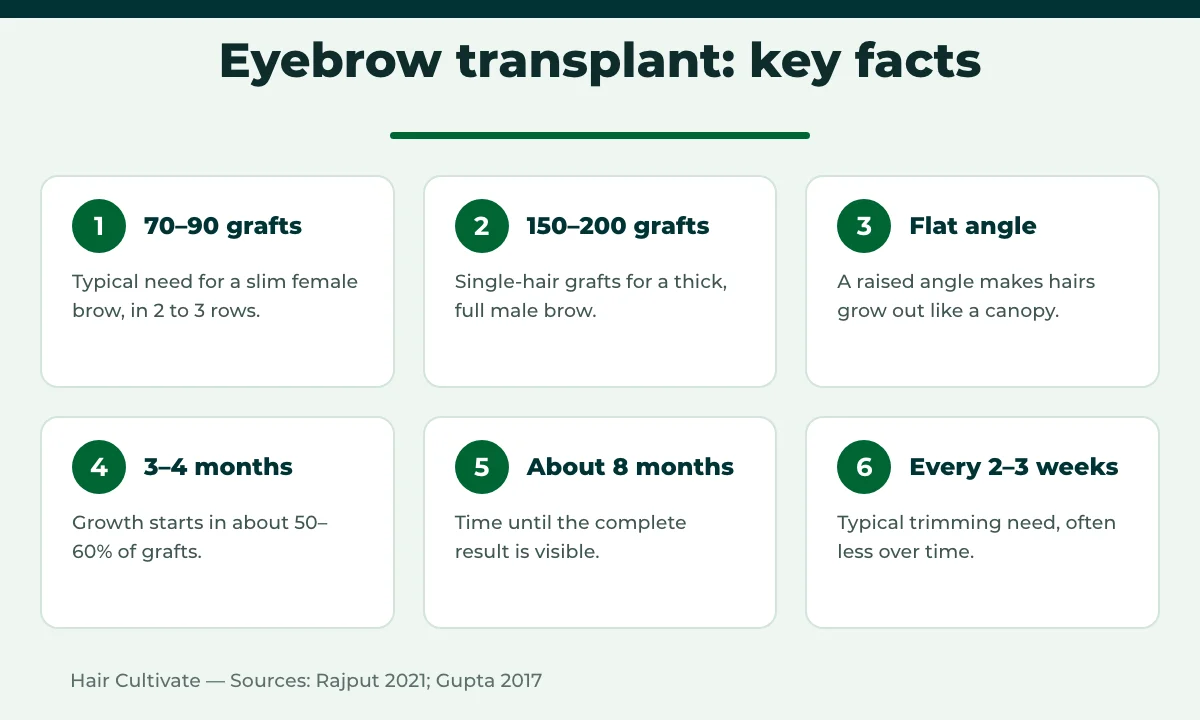
- A slimmer female brow usually needs about 70 to 90 grafts, while a thick, full male brow may need about 150 to 200 single-hair grafts (Rajput, 2021).
- Grafts must be placed flush to the skin; even a slightly raised angle can make hairs grow out like a canopy (Rajput, 2021).
- In one surgeon’s series, growth started in 50–60% of grafts at 3–4 months, and the complete result was visible by about 8 months (Rajput, 2021).
- Transplanted brow hairs often need trimming every 2 to 3 weeks, and a second session for density is common (Rajput, 2021; Gupta et al., 2017).
Table of contents
- What an eyebrow transplant in Turkey involves
- Who is a good candidate for an eyebrow transplant in Turkey?
- How many grafts does an eyebrow transplant in Turkey need?
- Angle and direction: the key to a natural eyebrow transplant in Turkey
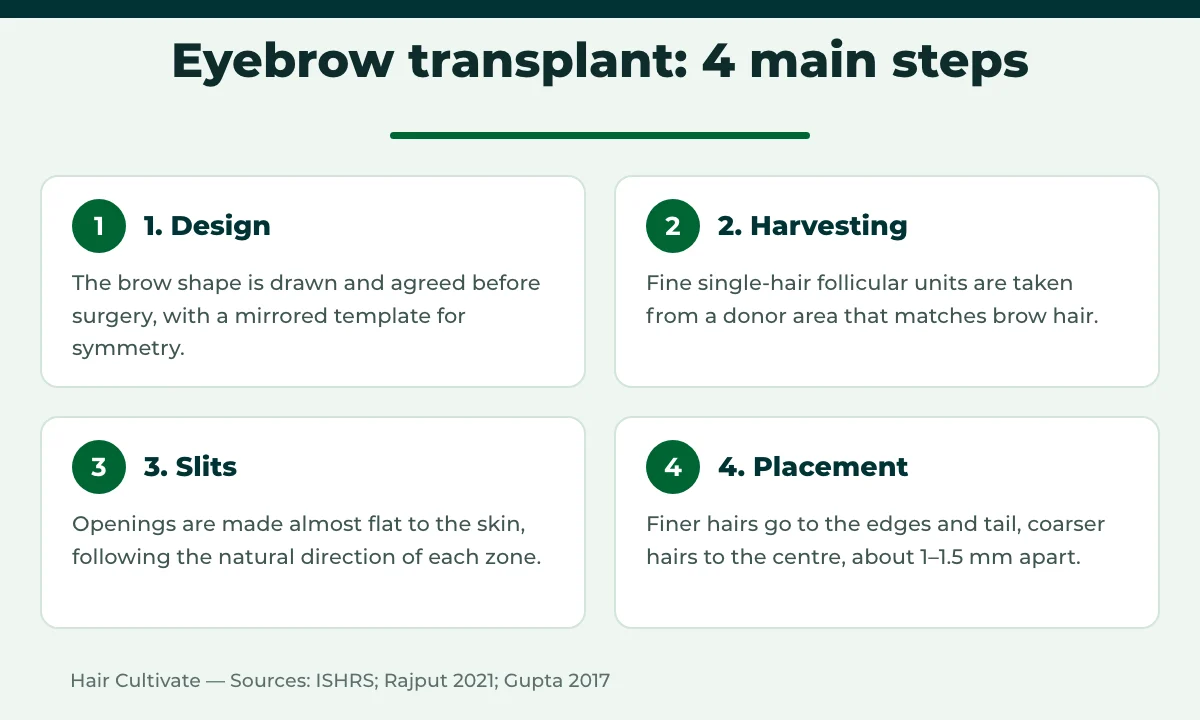
- Designing the shape before surgery
- The procedure day and the first days after
- Eyebrow transplant in Turkey: results timeline
- Trimming and training the new brow hairs
- Risks and realistic expectations
- Planning an eyebrow transplant in Turkey with Hair Cultivate
- Frequently asked questions
- References
What an eyebrow transplant in Turkey involves
An eyebrow transplant in Turkey is a form of hair transplant surgery. The International Society of Hair Restoration Surgery (ISHRS) explains that follicular units, usually of one to two hairs, are taken from a donor area whose hair has the right texture and orientation, and are placed into small incisions to create the desired shape or density (ISHRS). The procedure is usually done as an outpatient, and the ISHRS says complications are usually limited to minor pain and swelling (ISHRS).
The idea is not new. Hair transplantation for eyebrow loss was first described by Dr Okuda in 1939 (Gupta et al., 2017). Older methods, such as hair-bearing flaps from the temple and strip grafts, often produced brows that looked too wide, too narrow or unnatural, so modern practice relies on single follicular units (Rajput, 2021).
Most surgeons today harvest these units by follicular unit excision (FUE), one hair group at a time. FUE allows the team to select single-hair units, which is a major advantage for eyebrow work (Gupta et al., 2017). A strip method (FUT) is still used occasionally (Rajput, 2021). You can read more about donor safety in our guide to the hair transplant donor area.
Who is a good candidate for an eyebrow transplant in Turkey?
People seek eyebrow restoration for many reasons. The ISHRS lists trauma and burns, disease, a congenital inability to grow brows, over-plucking that leads to permanent loss, trichotillomania (compulsive hair pulling) and medical treatments such as radiotherapy or chemotherapy (ISHRS). Some people have no loss at all and simply want a fuller or different shape (ISHRS).
A systematic review of 67 articles covering 354 patients found that most patients were women, with an average age of 29, and that burns were the most common reason for surgery, in 57.6% of cases (Klingbeil & Fertig, 2018). Cosmetic requests are also common in practice, such as a missing outer third or uneven brows (Gupta et al., 2017).
The cause must be under control first. The ISHRS says that any disease causing the loss must be controlled, and that trichotillomania must be treated so the new hairs are not pulled out (ISHRS). In conditions such as alopecia areata or scarring alopecia, a surgeon may want a biopsy or an expert opinion to confirm the disease is inactive (Rajput, 2021). Before an eyebrow transplant in Turkey, ask whether medical treatment could help first; one review notes that thinning brows can sometimes respond to low-dose oral minoxidil, an off-label use (Rajput, 2021).
How many grafts does an eyebrow transplant in Turkey need?
Graft numbers depend on the shape, the thickness you want and how much of the brow is missing. Published figures give a useful range:
- Slim female brow: usually two to three rows of hair, with about 70 to 90 grafts per brow (Rajput, 2021).
- Thick, full male brow: about 150 to 200 single-hair grafts (Rajput, 2021).
- One surgical team’s average: about 200 single follicular units for each side, depending on the thickness and length of the brow (Gupta et al., 2017).
Density is limited on purpose. Gupta and colleagues place grafts at no more than 30–35 follicular units per cm², and warn that extreme densities may increase the risk of cysts, because more oil glands are moved with the grafts (Gupta et al., 2017). This is one reason why many patients need a second session rather than one very dense session.
The donor hair matters as much as the number. Surgeons choose fine, single hairs that are as close as possible to natural brow hair. Rajput prefers the area below the bump at the back of the head or the mid-side scalp (Rajput, 2021), while Gupta and colleagues often use the nape or the area in front of the ear for women, whose brow hair is finer (Gupta et al., 2017). Body hair is generally not preferred, because its regrowth is less reliable and its curl is hard to control (Rajput, 2021; Gupta et al., 2017). For more on that, see our article on body hair transplant.
Angle and direction: the key to a natural eyebrow transplant in Turkey
Eyebrow hairs grow at a very flat angle, and they change direction along the brow. An eyebrow transplant in Turkey only looks natural if every graft copies this pattern. Gupta and colleagues describe hairs that point straight up at the inner end, turn quickly towards a horizontal direction in the body, where upper and lower hairs meet in a herringbone pattern, and point mainly outwards in the tail (Gupta et al., 2017).
Placement must be flush with the skin. Rajput warns that grafts placed at even a slightly raised angle grow out like a canopy and look unacceptable (Rajput, 2021). Grafts are usually placed 1 to 1.5 mm apart in a staggered pattern (Rajput, 2021).
| Part of the brow | Approximate size | Hair direction |
|---|---|---|
| Head (inner end) | 10–15% of the brow, about 0.6–0.8 cm | Mostly vertical, pointing up |
| Body (middle) | About 60%, about 2.5–3 cm | Upper hairs point down and out, lower hairs point up; densest part |
| Tail (outer end) | 20–25%, about 1.2–1.7 cm | More horizontal and outward, less dense |
Surgeons also match graft size to each zone. Finer single hairs are placed along the upper border and tail for a soft look, and coarser hairs go into the centre of the brow (Rajput, 2021; Gupta et al., 2017).
Designing the shape before surgery
Brow design comes before any incision. Male brows are typically 5 to 6 cm long and 1 to 1.5 cm wide, while female brows are about 4.5 to 5 cm long (Rajput, 2021). Female brows are usually slimmer and more curved, and male brows are flatter and lie on the bony rim (Gupta et al., 2017).
Small changes alter the expression. Rajput notes that a brow slanting downward can give an older look, a high arch can look surprised, and a low inner end with a raised outer end can look angry (Rajput, 2021). Gupta and colleagues recommend asking the patient to draw the desired brow first, then agreeing on a final shape together and checking symmetry with a mirrored template (Gupta et al., 2017).
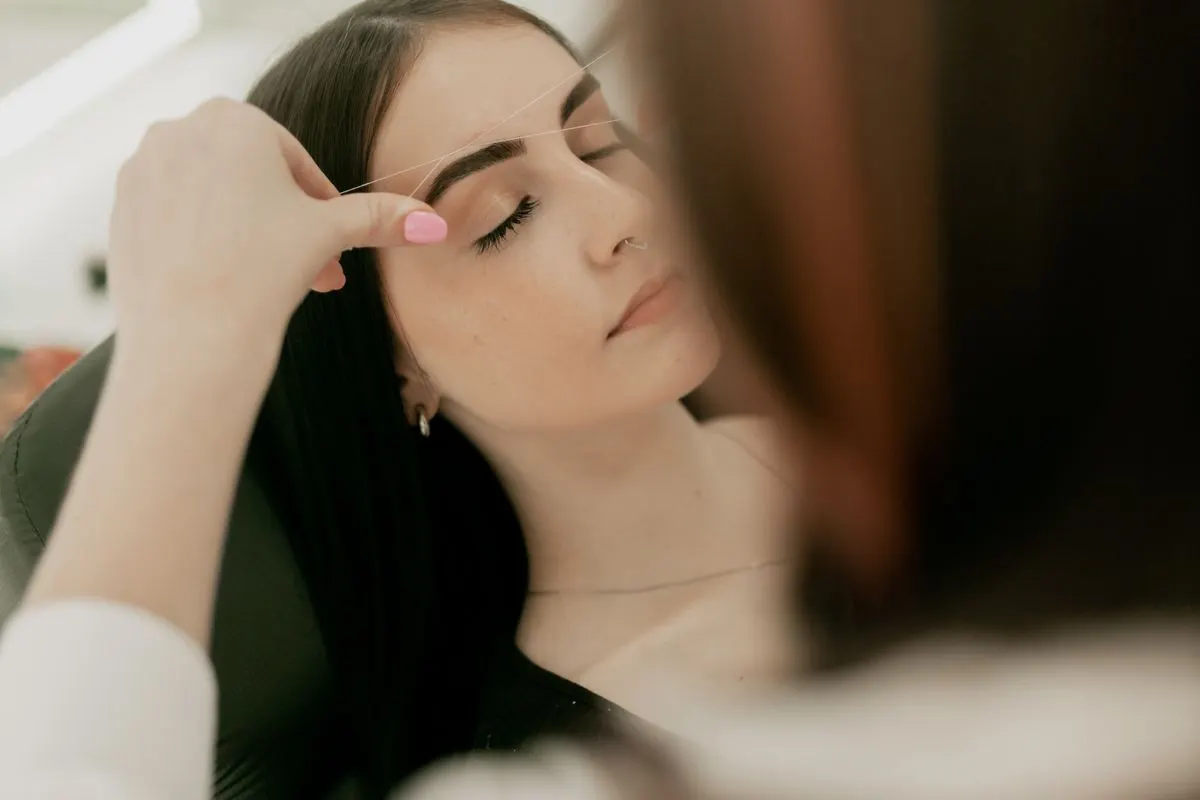
Women should know one limitation before an eyebrow transplant in Turkey: transplanted brow hairs come from thicker scalp follicles and are harder to reshape later by threading or plucking (Rajput, 2021). A clear, agreed design also matters for scalp work; our guide to hairline design explains similar principles.
The procedure day and the first days after
The brows are numbed with local anaesthetic. Because several nerves supply the brow, surgeons usually infiltrate around it rather than block a single nerve (Gupta et al., 2017). Before surgery, routine checks may include blood tests and a review of blood pressure and heart health (Rajput, 2021).
Typical aftercare steps described by surgeons include:
- No dressing on the brows, with an ointment or saline spray to keep the grafts moist (Rajput, 2021).
- Not touching the grafts for the first two days, and cold compresses around the eyes to limit swelling (Rajput, 2021).
- A gentle head wash from about the third day, without rubbing the brows (Rajput, 2021; Gupta et al., 2017).
- Make-up on the brows only after all crusts have fallen off (Gupta et al., 2017).
- Gentle rubbing to help crusts come off from about day 10 (Rajput, 2021).
Eyebrow transplant in Turkey: results timeline
Almost all transplanted brow hairs fall out in the first weeks. Surgeons describe this shedding as an expected part of healing (Gupta et al., 2017). Growth then returns in stages. In Rajput’s experience, hair grows from 50–60% of grafts at 3–4 months, from another 20–25% by 5–6 months, and from the last 10–15% at 7–8 months, with the complete result visible by about 8 months (Rajput, 2021).
| Time after surgery | What usually happens |
|---|---|
| First 2 days | Grafts kept moist; no touching |
| About day 3 | Gentle head wash allowed |
| About day 10 onwards | Crusts can be gently rubbed off; some hairs shed |
| 3–4 months | Growth from about 50–60% of grafts |
| 5–6 months | Another 20–25% begin to grow |
| 7–8 months | Last 10–15% grow; full result visible |
| 9–10 months | Earliest time to plan a second session |
If you want more density, a second sitting should be planned only after 9 to 10 months (Rajput, 2021). The ISHRS also notes that more than one session may be needed, depending on the size of the area (ISHRS).
Trimming and training the new brow hairs
Transplanted hairs come from the scalp, so they keep growing longer than normal brow hairs. Rajput advises counselling patients that trimming may be needed every 2 to 3 weeks (Rajput, 2021), and Gupta and colleagues describe trimming every two weeks in most patients (Gupta et al., 2017).
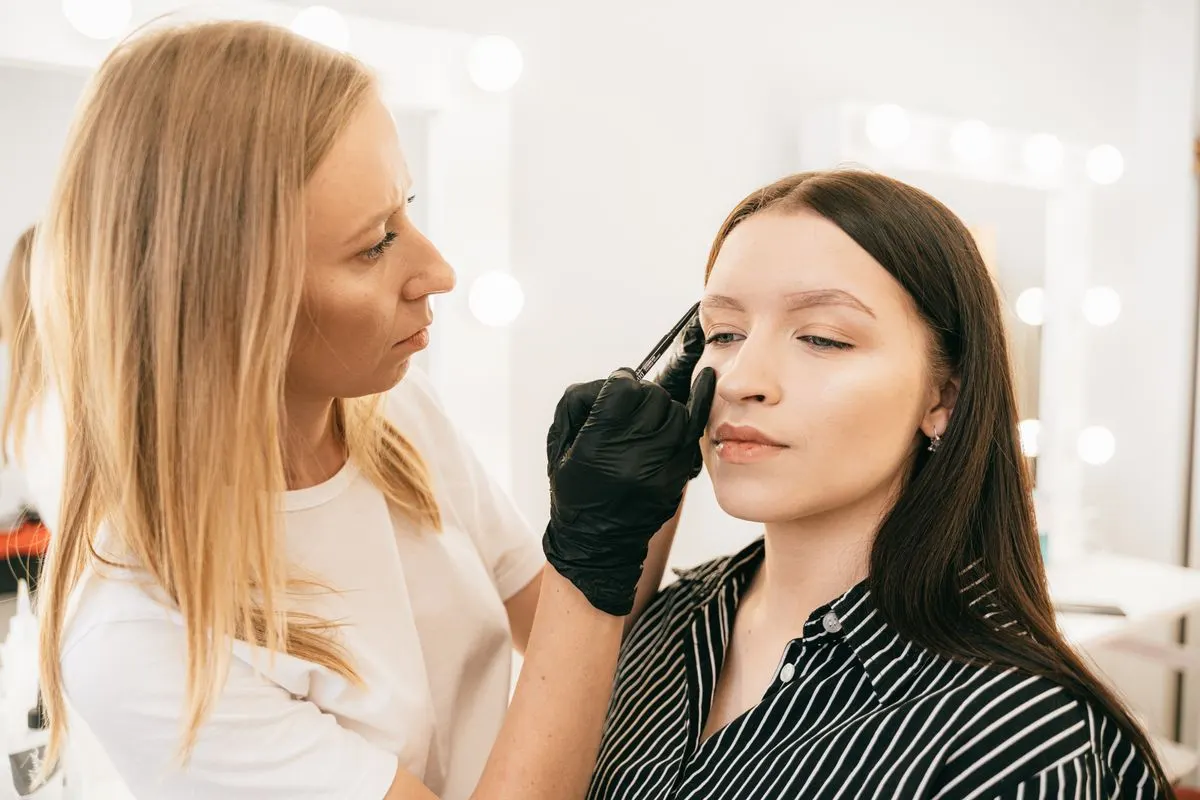
Direction can also need help. The ISHRS says that the hairs may have to be trained with gel or wax to lie flat, and that they will need occasional trimming (ISHRS). Rajput suggests using petroleum jelly or coconut oil on the fingertips to guide the hairs along the brow (Rajput, 2021).
There is some good news. Both papers describe a tendency for the growth rate to adapt over time to the new location, so trimming may be needed less often later (Rajput, 2021; Gupta et al., 2017). After an eyebrow transplant in Turkey, plan for regular grooming as part of daily life.
Risks and realistic expectations
An eyebrow transplant in Turkey can give natural, lasting results, but it has limits. Rajput counsels patients about a possible 5 to 10% loss of grafts, some misdirected hairs, and irregular or wavy growth in scar tissue (Rajput, 2021). Gupta and colleagues report misdirection in 10–15% of follicles (Gupta et al., 2017).
Density usually builds over more than one session. In Rajput’s review of 63 cases and later patients, 14% were corrected in one sitting, 77% needed two and 9% needed three (Rajput, 2021). Some people still use an eyebrow pencil to enhance the result (Rajput, 2021; Gupta et al., 2017).
Other points to discuss include:
- The original condition can return and damage transplanted hairs (Rajput, 2021).
- Very dense packing can raise the risk of cysts (Gupta et al., 2017).
- Grafts in scars may grow later and often need another session (Rajput, 2021).
- As with any hair transplant, there is a small risk of bleeding, infection and an allergic reaction to the anaesthetic (NHS).
Planning an eyebrow transplant in Turkey with Hair Cultivate
At Hair Cultivate in Istanbul, an eyebrow plan starts with the shape you want and a look at your donor hair. You can learn about the treatment on our eyebrow transplant service page, and if your eyelashes are also thin, see our page on eyelash transplant. A typical trip is about 3 nights in Istanbul with VIP transfers, and every patient has 12 months of follow-up. Our patient guide explains how to prepare for the trip.
Start with a free online hair analysis. Send clear, well-lit photos of both brows from the front and side, plus a photo of the back of your head, on WhatsApp (+905444768387). Ask how many grafts the doctor suggests, which donor area would match your brow hair, and whether a second session is likely. Current plans are listed on our prices page.
Frequently asked questions
How many grafts are needed for an eyebrow transplant in Turkey?
An eyebrow transplant in Turkey usually needs about 70 to 90 grafts per brow for a slim female shape, and about 150 to 200 single-hair grafts for a thick, full male brow (Rajput, 2021). The exact number depends on the shape and how much brow is missing.
When will I see results after an eyebrow transplant?
After an eyebrow transplant, growth usually starts at 3 to 4 months, and the complete result is visible by about 8 months in published experience (Rajput, 2021).
Do transplanted eyebrows need trimming?
Yes, transplanted eyebrows need trimming because they come from scalp hair that grows longer. Surgeons describe trimming every 2 to 3 weeks, often less as time passes (Rajput, 2021; Gupta et al., 2017).
Is one session of eyebrow transplant enough?
One session of eyebrow transplant is not always enough. In one surgeon’s series, 14% of patients needed one sitting, 77% needed two and 9% needed three (Rajput, 2021).
Can women shape transplanted eyebrows by threading?
Women can shape transplanted eyebrows, but the hairs come from thicker scalp follicles and are harder to reshape by threading or plucking (Rajput, 2021). This is why the shape is agreed carefully before surgery.
Is an eyebrow transplant painful?
An eyebrow transplant is done under local anaesthetic, and the ISHRS says complications are usually limited to minor pain and swelling (ISHRS).
References
- International Society of Hair Restoration Surgery. Eyebrow and eyelash hair restoration surgery. ishrs.org
- Rajput RJ. Hair transplant for eyebrow restoration. Indian J Plast Surg. 2021;54(4):489–494. PMC8719974
- Gupta J, Kumar A, Chouhan K, Ariganesh C, Nandal V. The science and art of eyebrow transplantation by follicular unit extraction. J Cutan Aesthet Surg. 2017;10(2):66–71. PMC5561712
- Klingbeil KD, Fertig R. Eyebrow and eyelash hair transplantation: a systematic review. J Clin Aesthet Dermatol. 2018;11(6):21–30. PMC6011870
- NHS. Hair transplant. nhs.uk
This article is for general information and does not replace a consultation with a qualified doctor.