 Italiano
 Türkçe
 Español
 Русский
 فارسی
 Français
 English
 العربية


The hair transplant donor area is the part of the scalp, usually the back and sides of the head, from which hair follicles are taken and moved to thinning or bald areas. Its size, density and long-term stability decide how many grafts a person can have in a lifetime. The supply of donor hair is limited, so careful planning matters. This guide explains the safe donor zone, donor assessment, graft limits and overharvesting.
Key takeaways
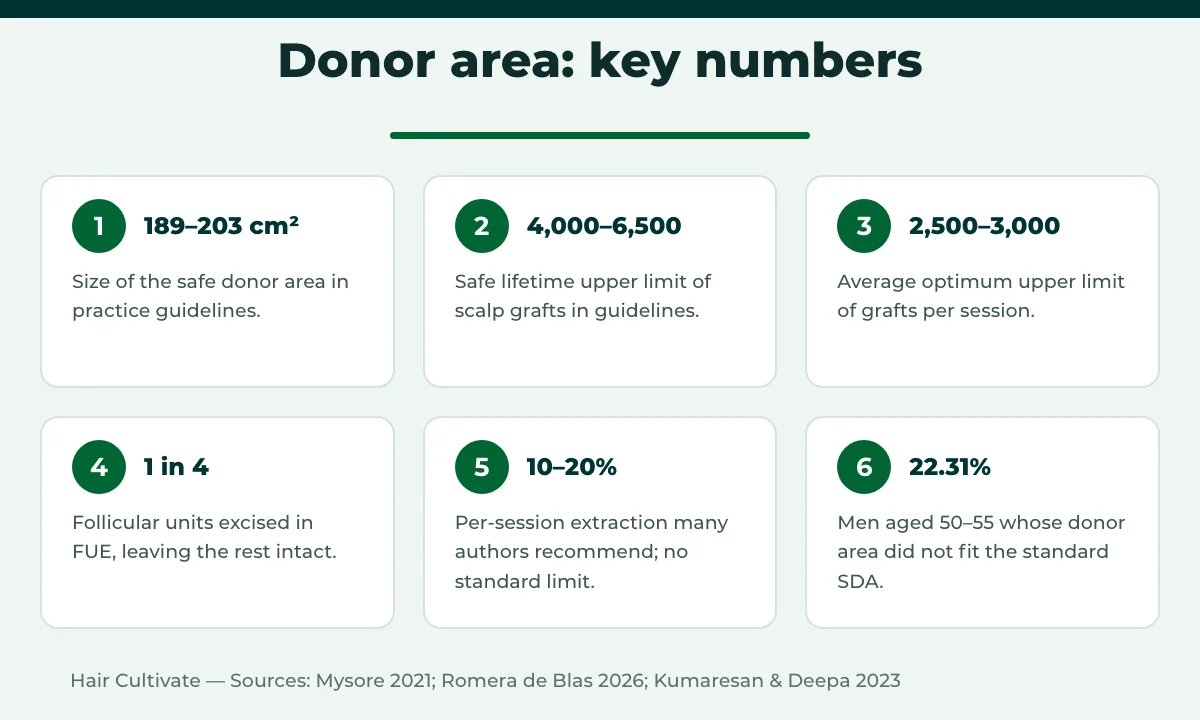
- Grafts should come from the safe donor area only, which measures about 189–203 cm² (Mysore et al., 2021).
- No single safe donor zone fits every patient; borders of the hair transplant donor area should be set individually (Mysore et al., 2021; Umar et al., 2026).
- Guidelines give a safe upper limit of about 4,000 to 6,500 scalp grafts over a lifetime, and about 2,500 to 3,000 grafts per session (Mysore et al., 2021).
- Overharvesting causes visible thinning, and once the donor area is depleted, repair options are limited (Romera de Blas et al., 2026).
- Beard and body hair can add grafts when scalp donor hair is limited (Mysore et al., 2021; Chouhan et al., 2019).
Table of contents
- What is the hair transplant donor area?
- The safe donor zone and its borders
- How the donor area is assessed
- How many grafts can the donor area give?
- Overharvesting: causes and signs
- FUE and FUT: effects on the donor area
- Other donor area problems after surgery
- When donor hair is limited
- How to protect your donor area
- Frequently asked questions
- References
What is the hair transplant donor area?
Hair transplantation is based on a principle called “donor dominance”. Follicles that resist androgens (male hormones) keep this property after they are moved to balding areas (Chouhan et al., 2019). This is why the hair transplant donor area is chosen from scalp regions that usually keep their hair.
In the strip method a thin strip of skin with hair is removed from the back of the head; in follicular unit excision (FUE) hairs are removed one at a time (NHS). The donor site is usually at the back of the scalp, where hair tends to be thickest (Cleveland Clinic).
According to the American Academy of Dermatology (AAD), a good candidate needs enough healthy hair on the scalp that can be transplanted to the area that needs it (AAD). The hair transplant donor area is therefore one of the first things checked before surgery.
The safe donor zone: where are the borders of the hair transplant donor area?
The safe donor area (SDA) is the region of the scalp where follicles are expected to resist androgenetic miniaturization for a lifetime, so that transplanted hair keeps its coverage over the long term (Umar et al., 2026). Several definitions exist:
- Unger (1994). Based on 328 men aged 65 years or older, this widely used template describes a band at the back and sides about 7 cm high at the midline, with an upper border about 2 cm above the top of the ear (Umar et al., 2026).
- Cole. A calculated template for FUE describes a safe area of 203 cm², divided into zones with different densities (Umar et al., 2026; Chouhan et al., 2019).
- Bernstein and Rassman. They estimated the donor region at roughly 25% of the total scalp area and suggested that about half of it could be harvested over time without visible thinning (Umar et al., 2026).
Practice guidelines give a size of 189–203 cm² for the SDA, depending on individual and ethnic variation, and say harvesting should be from this area only (Mysore et al., 2021). Hairs taken from unsafe areas can be lost over time (Mysore et al., 2021; Garg & Garg, 2021a).
No single safe donor area is valid for all patients (Mysore et al., 2021). A 2026 review describes a conservative core zone likely to stay permanent in most men, plus outer zones used only after careful assessment (Umar et al., 2026).
In a study of 681 men aged 50–55 years with androgenetic alopecia, 76.05% had donor patterns that fitted the standard SDA criteria, while 22.31% did not fit well; diffuse and reverse thinning of the occipital donor area was also observed (Kumaresan & Deepa, 2023).
How the hair transplant donor area is assessed before surgery
Guidelines recommend checking hair quality, density at several points, hair caliber and ethnicity, with a physical examination and trichoscopy (Mysore et al., 2021).
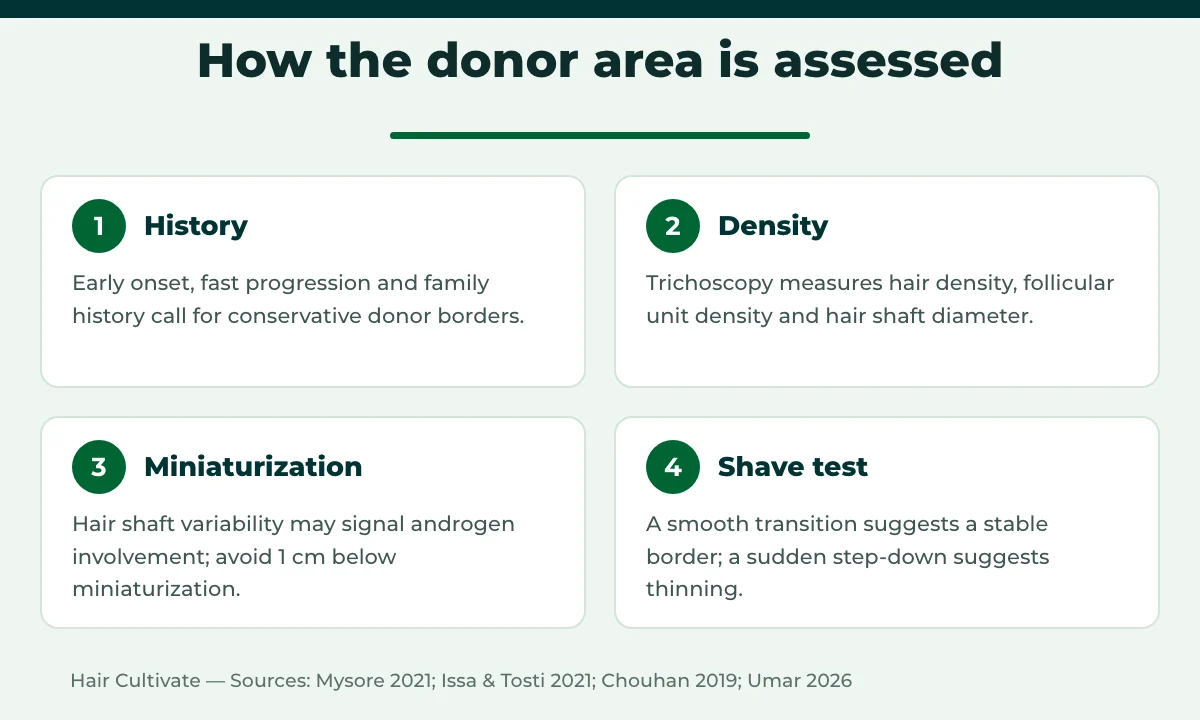
- History and family pattern. Early-onset androgenetic alopecia, rapid progression and a strong family history of extensive hair loss support a conservative approach to the donor borders (Umar et al., 2026).
- Density measurement. Trichoscopy can measure hair density, follicular unit density and hair shaft diameter (Issa & Tosti, 2021).
- Checking for miniaturization. Trichoscopy can show hair shaft variability (anisotrichosis), which may signal androgenetic involvement and make that area a poor choice for extraction (Issa & Tosti, 2021).
- The shave test. The lower back and sides are clipped short to compare density and hair thickness. A smooth, gradual transition suggests a stable donor area; a sudden step-down suggests retrograde thinning and an unstable lower border (Umar et al., 2026).
In a study of 580 Indian men, miniaturization extended into or 1 cm above the extended donor zone in 12% of patients, and into the standard donor zone in 3%; the authors advise avoiding an area at least 1 cm below any miniaturization (Chouhan et al., 2019). If miniaturization affects more than 25% of the hair transplant donor area, the risk of diffuse unpatterned alopecia is greater (Khanna, 2021).
How many grafts can the hair transplant donor area give?
No single number applies to everyone. The limit depends on SDA size, donor density, head size, technique, skin elasticity, patient age and the need for future sessions (Mysore et al., 2021).
- Lifetime limit: about 4,000 to 6,500 scalp grafts in total, over several sessions and techniques (Mysore et al., 2021).
- Per session: an average of 2,500 to 3,000 grafts is described as the optimum upper limit without visible depletion (Mysore et al., 2021).
- Extraction ratio in FUE: guidelines advise excising one out of four follicular units, and 10–15 excisions per cm² as a safe single-pass density when the baseline density is 65–75 follicles per cm² (Mysore et al., 2021).
- Per-session percentage: many authors recommend limiting extractions to 10–20% of the baseline follicular unit density per session, although no standard extraction limit has been established (Romera de Blas et al., 2026).
In the study of 580 men, mean scalp donor density was 78.2 follicular units per cm². At 25% extraction, the standard donor area (158.4 cm²) gave an estimated 3,097 follicular units (Chouhan et al., 2019). The authors recommend 25% in a first sitting and 25% of the remaining hairs in a second sitting at least 6 months later (Chouhan et al., 2019).
They warn that taking 50% of hairs in a single sitting can cause microvascular damage that reduces the quality of the remaining hairs, which is why a very large single session can harm the hair transplant donor area (Chouhan et al., 2019).
Overharvesting the hair transplant donor area: causes and signs
Overharvesting is the excessive extraction of follicular units from the donor area, leading to visible thinning (Romera de Blas et al., 2026). Overharvesting and harvesting beyond the safe donor area are described as common technical errors in FUE (Garg & Garg, 2021a).
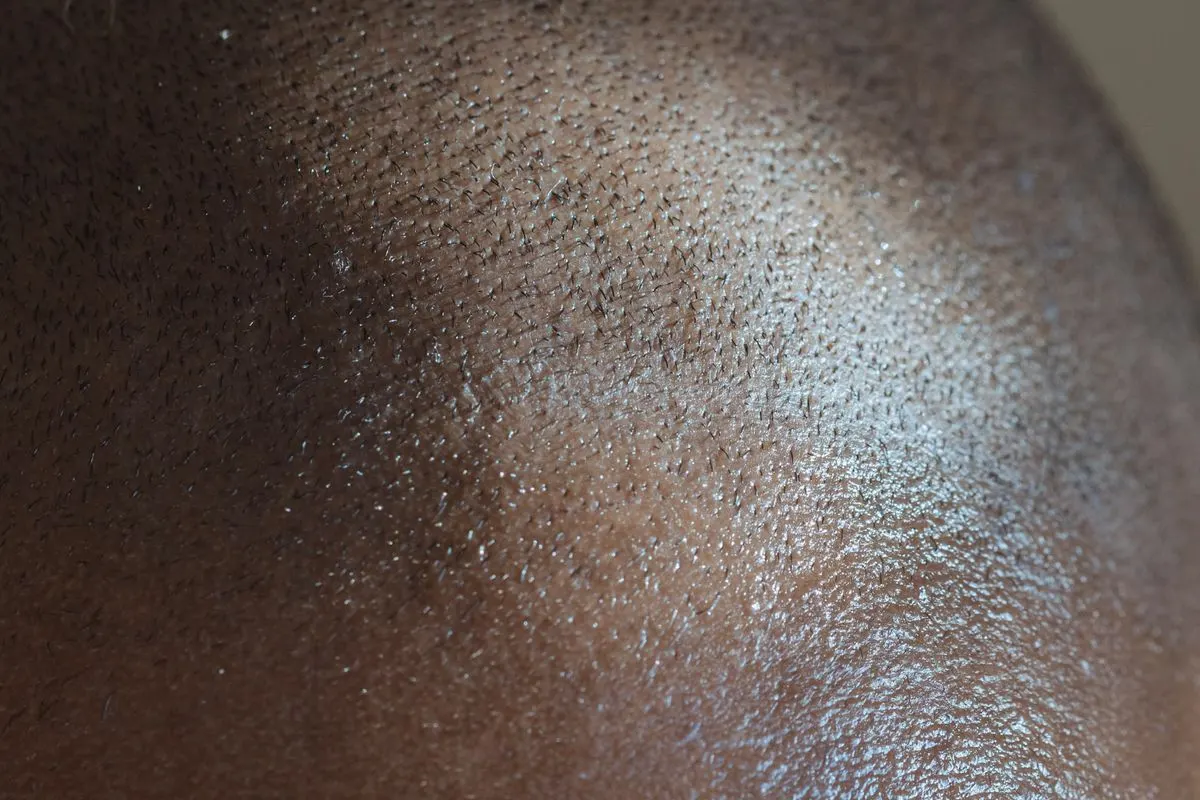
Reported risk factors and causes include:
- High-volume sessions of more than 3,000–4,000 grafts (Romera de Blas et al., 2026).
- Aggressive and non-uniform harvesting, whether with manual, motorized or robotic punches (Kerure & Patwardhan, 2018).
- Exceeding the usual extraction range in low-density scalps, which may compromise blood supply (Romera de Blas et al., 2026).
- High expectations for density and unregulated FUE practice, which increase harvesting beyond safe borders (Umar et al., 2026).
Overharvesting of the hair transplant donor area may cause permanent damage to the donor area, with thinning and patchy hair loss, and aggressive harvesting can create a “moth-eaten” appearance (Kerure & Patwardhan, 2018). Guidelines add that it can cause scarring and loss of pigment, especially in darker skin (Mysore et al., 2021).
Skin necrosis can develop if extractions are too close together or if large, poor-quality punches are used (Garg & Garg, 2021a). In a small study of 10 men, one FUE session removed on average 35.44% of the hairs in the measured boxes (Humayun Mohmand & Ahmad, 2018).
FUE and FUT: how each method affects the hair transplant donor area
Both methods reduce the hair transplant donor area in different ways. FUT decreases the height of the donor area, while the total surface of the many small FUE scars is many times larger than that of a strip scar (Humayun Mohmand & Ahmad, 2018). For a full comparison, see our guide on differences between FUE and FUT.
| Feature | FUE (follicular unit excision) | FUT (strip) |
|---|---|---|
| How hair is removed | Individual units with a small punch; back of the head is shaved | A thin strip of skin from the back of the head |
| Recommended size | Punches smaller than 1 mm; larger punches not recommended | Strip width preferably less than 1.3 cm |
| Scar | Many tiny scars that are not very noticeable | One linear scar, usually not visible unless hair is very short |
| Main donor risk | Overharvesting, pinpoint white scars, depigmentation | Wide scar, tension on the wound |
| Non-scalp donors | Can use beard, chest and other body hair | Scalp only |
Table sources: NHS; Mysore et al., 2021; Garg & Garg, 2021b. Common punch sizes are 0.9 to 1.0 mm for the scalp and 0.7 to 0.8 mm for body hair (Garg & Garg, 2021b). Larger punches cause more scar volume and more damage to blood supply (Garg & Garg, 2021b).
For FUT, scar width depends on strip width and wound tension, and strips wider than 1.2 cm must be closed in two layers (Mysore et al., 2021). A second strip should wait at least 9–12 months (Mysore et al., 2021).
FUE is not scar-free. Pinpoint white scars may be visible on close inspection with short hair, especially in darker skin types (Kerure & Patwardhan, 2018). Using smaller punches (0.8–0.9 mm), a uniform pattern and adequate spacing helps to limit visible scarring (Romera de Blas et al., 2026).
Other donor area problems after surgery
Most changes in the hair transplant donor area are mild and temporary. A tight, swollen scalp for a few days and temporary scabbing are common (NHS). Gentle care helps; our guide to washing hair after a transplant covers the first days.

- Pain: donor-site pain was the most frequently reported early complication, with a pooled incidence of 6% in FUE (Romera de Blas et al., 2026).
- Numbness: one large series reported long-term numbness or tingling in about 2% of patients, mainly in the temporal or occipital areas (Romera de Blas et al., 2026).
- Donor effluvium: temporary shedding of hairs in or near the extraction area usually develops 2–4 weeks after surgery and resolves on its own within 3–6 months (Romera de Blas et al., 2026). It is related to shock loss after hair transplant.
- Cysts and infection: epidermal inclusion cysts are uncommon after FUE (Romera de Blas et al., 2026), and infections are rare, occurring in less than 1% (Kerure & Patwardhan, 2018).
- Abnormal scars: abnormal donor scarring is rare, and keloids are exceedingly uncommon (Romera de Blas et al., 2026).
Contact your doctor right away if you have a fever that does not go away, heavy bleeding, severe redness or pain, or green or yellow pus from the incisions (Cleveland Clinic). The stages of hair transplant recovery explain what is normal.
When the hair transplant donor area is limited or depleted
Some people have a small or weak scalp donor area. Guidelines say that harvesting from the scalp, beard and body together may be needed in advanced alopecia, revision cases, diffuse loss or a limited donor area (Mysore et al., 2021).
Beard hair below the jawline is one option. In the study of 580 men, mean beard density was 49.7 follicular units per cm², and an estimated 824 units could be extracted at 25% (Chouhan et al., 2019). Body hair is usually harvested with smaller punches of 0.7 to 0.8 mm (Garg & Garg, 2021b).
Nape and periauricular hair has traditionally been avoided because of permanence concerns. In selected patients with a favorable shave test, a limited band may be used for soft hairlines, but large trials are still needed (Umar et al., 2026).
Once donor depletion has occurred, reconstructive options are limited. Scalp micropigmentation, longer hairstyles or carefully planned redistribution of grafts from peripheral or body donor areas may improve appearance (Romera de Blas et al., 2026).
How to protect your hair transplant donor area
Hair loss is an ongoing process (Humayun Mohmand & Ahmad, 2018), and hair might continue to thin around the transplant (NHS). A plan for the hair transplant donor area should therefore consider future needs. Prevention measures include thorough donor evaluation, long-term planning, limiting extraction density, uniform distribution of punches and tapering at the margins (Romera de Blas et al., 2026).
Before surgery, it is reasonable to ask:
- Where exactly are the borders of my hair transplant donor area, and was miniaturization checked with trichoscopy?
- How many grafts are planned, and what percentage of my donor density does this represent?
- Who will perform the harvesting? Guidelines say harvesting should be done by a qualified surgeon, not technicians (Mysore et al., 2021).
- Will donor adequacy and the planned graft number be recorded? Guidelines recommend this (Mysore et al., 2021).
A very high graft count in one day is not always better: sessions of more than 3,000–4,000 grafts are a reported risk factor for overharvesting (Romera de Blas et al., 2026). A 2023 study concluded that safe donor area selection should always be conservative and that overharvesting of the occipital donor region should be avoided (Kumaresan & Deepa, 2023).
If you are considering a hair transplant in Turkey and want to know how strong your donor area is, you can send clear scalp photos for a free hair analysis on WhatsApp (+905444768387) or through our contact page.
Frequently asked questions
Does the hair transplant donor area recover after surgery?
Scabs, swelling and tightness are usually temporary, and hair that sheds near the extraction sites (donor effluvium) usually returns within 3–6 months. Thinning caused by overharvesting, however, can be permanent.
Where is the safe donor zone?
It is mainly the back and sides of the scalp. Classical templates describe a band about 7 cm high at the midline, but the exact borders of the hair transplant donor area differ from person to person.
How many grafts can be taken from the hair transplant donor area?
Guidelines give about 2,500 to 3,000 grafts per session and 4,000 to 6,500 scalp grafts over a lifetime as upper limits. Your own number depends on donor size, density, age and future needs.
What does an overharvested donor area look like?
It shows visible thinning, patchy or “moth-eaten” areas and sometimes many white scars, especially when hair is cut short.
Can an overharvested donor area be repaired?
Options are limited. Scalp micropigmentation, longer hairstyles and carefully planned grafts from body or peripheral areas may improve appearance.
Can beard or body hair be used as donor hair?
Yes. Beard, chest and other body hair can be harvested with FUE when scalp donor hair is not enough, usually together with scalp grafts.
References
- Mysore V, Kumaresan M, Garg A, et al. Hair transplant practice guidelines. J Cutan Aesthet Surg. 2021;14(3):265–284. PMC8611706
- Umar S, Gupta AK, Economopoulos V, Talukder M. Redefining the safe donor area in follicular unit excision: toward dynamic, patient-specific zones. J Cosmet Dermatol. 2026;25(10):e71250. PMC13675507
- Romera de Blas C, Vega Díez D, Ricart Vayá JM, Gómez Zubiaur A. Complications in follicular unit excision hair transplantation: current evidence and practical approaches. Front Med (Lausanne). 2026;13:1750989. PMC12909172
- Chouhan K, Kota RS, Kumar A, Gupta J. Assessment of safe donor zone of scalp and beard for follicular unit extraction in Indian men: a study of 580 cases. J Cutan Aesthet Surg. 2019;12(1):31–35. PMC6484564
- Kumaresan M, Deepa MS. Occipital donor area grading and profile in Indian population. J Cutan Aesthet Surg. 2023;16(2):101–106. PMC10405541
- Issa NT, Tosti A. Trichoscopy for the hair transplant surgeon: assessing for mimickers of androgenetic alopecia and preoperative evaluation of donor site area. Indian J Plast Surg. 2021;54(4):393–398. PMC8719970
- Khanna M. Hair transplant with strip harvest: indications, contraindications, and technique. Indian J Plast Surg. 2021;54(4):451–455. PMC8719948
- Garg AK, Garg S. Complications of hair transplant procedures: causes and management. Indian J Plast Surg. 2021;54(4):477–482. (Garg & Garg, 2021a) PMC8719980
- Garg A, Garg S. Overview of follicular extraction. Indian J Plast Surg. 2021;54(4):456–462. (Garg & Garg, 2021b) PMC8719976
- Kerure AS, Patwardhan N. Complications in hair transplantation. J Cutan Aesthet Surg. 2018;11(4):182–189. PMC6371733
- Humayun Mohmand M, Ahmad M. Effect of follicular unit extraction on the donor area. World J Plast Surg. 2018;7(2):193–197. PMC6066700
- NHS. Hair transplant. nhs.uk
- Cleveland Clinic. Hair transplant. clevelandclinic.org
- American Academy of Dermatology. Hair loss: hair transplant. aad.org
This article is for general information and does not replace a consultation with a qualified doctor.