 Italiano
 Türkçe
 Español
 Русский
 فارسی
 Français
 English
 العربية


Shock loss after hair transplant is a temporary shedding of hair that starts a few weeks after surgery. It can affect the newly transplanted hairs, the existing (native) hairs around them, and sometimes the hair in the donor area. The scalp can look thinner than before the operation, which is why it worries many patients. In most cases the follicles are still alive and the hair grows back. This guide explains why it happens, how long it lasts, how to tell it from a failed transplant, and which treatments have evidence.
Key takeaways
- Between two and eight weeks after surgery, the transplanted hair falls out; this is a normal part of healing (AAD).
- Shock loss of native hair near the grafts usually appears 2–8 weeks after surgery, and regrowth usually begins around month 3 (Romera de Blas et al., 2026).
- Reported rates of native-hair shock loss vary widely, from 0.15% to 15%, and women are at higher risk (Romera de Blas et al., 2026; Okochi et al., 2024).
- New hair usually starts to appear after about 4 months, and full results can take 10 to 18 months (NHS).
- Minoxidil may help regrowth, and finasteride 1 mg improved hair around the transplant in men in a randomized trial (Romera de Blas et al., 2026; Leavitt et al., 2005).
Table of contents
- What is shock loss after hair transplant?
- Transplanted, native and donor hair shedding
- Why shock loss happens
- When it starts and how long it lasts
- How common is it, and who is at risk?
- Shock loss or a failed transplant?
- What helps: the evidence
- Can it be prevented?
- When to see your doctor
- Frequently asked questions
- References
What is shock loss after hair transplant?
In medical papers, shock loss after hair transplant is usually called “effluvium”, which simply means excessive shedding. A 2026 review describes recipient-site effluvium, commonly called shock loss, as the temporary shedding of native hairs around the area where grafts were implanted (Romera de Blas et al., 2026). Many patients and clinics also use the term for the expected fall of the transplanted hairs themselves.
The important word is “temporary”. In shock loss, the hair shaft falls out, but the follicle under the skin usually stays alive. After a resting period, the follicle starts a new growth cycle and produces a new hair. This is why doctors usually manage shock loss after hair transplant with reassurance and time (Romera de Blas et al., 2026). Rarely, the loss of already miniaturized native hairs can be permanent (Kerure & Patwardhan, 2018).
Patient information from the American Academy of Dermatology (AAD) and the NHS describes the same pattern: the transplanted hair falls out in the first weeks and later grows back (AAD; NHS).
Transplanted, native and donor hair: three kinds of shedding
Three different situations are often grouped under the same name:
- Transplanted hair. Almost every patient loses the hair shafts of the grafts in the first weeks. One review explains that implanted hair usually falls within 3 to 4 weeks, because the blood supply to the follicles is cut for a short time during transplantation (Garg & Garg, 2021). The follicle survives and regrows later.
- Native hair in the recipient area. This is shock loss in the strict sense: existing hairs between and around the grafts shed. It is seen to some degree in many patients who still have hair in the transplant zone (Kerure & Patwardhan, 2018).
- Donor area hair. Shedding can also happen where grafts were taken. Donor-site effluvium usually develops 2–4 weeks after surgery and resolves on its own within 3–6 months; it appears much less frequent than recipient-site shedding (Romera de Blas et al., 2026).
Shedding of transplanted hair is expected. Shock loss after hair transplant that affects native or donor hair is less predictable and should be discussed before surgery.
Why shock loss after hair transplant happens
Surgery can push some follicles out of their growth phase early, so they rest and shed together. Reviews describe the mechanism as multifactorial (Romera de Blas et al., 2026). The main proposed causes are:

- Surgical trauma: direct injury to existing follicles while the small slits for grafts are made (Garg & Garg, 2021).
- Swelling and inflammation: excessive edema and inflammation around the follicles (Garg & Garg, 2021; Romera de Blas et al., 2026).
- Reduced blood flow: short-term local ischemia, vascular trauma, or vasoconstrictive drugs such as epinephrine (adrenaline) in the local anesthetic. One review notes that the exact role of adrenaline is still not clear (Romera de Blas et al., 2026; Garg & Garg, 2021).
- Very dense packing: high implantation density (50–70 follicular units per cm²) and too much tumescent fluid have been proposed as contributing factors (Romera de Blas et al., 2026).
- Psychological stress has also been proposed as a contributing factor (Romera de Blas et al., 2026).
The shedding can be telogen effluvium (follicles enter the resting phase early), anagen effluvium (growing hairs are damaged and shed quickly), or a combination of the two (Kerure & Patwardhan, 2018).
When does shock loss after hair transplant start, and how long does it last?
Timing is one of the best clues that shedding is normal. Sources give slightly different windows but the same pattern:
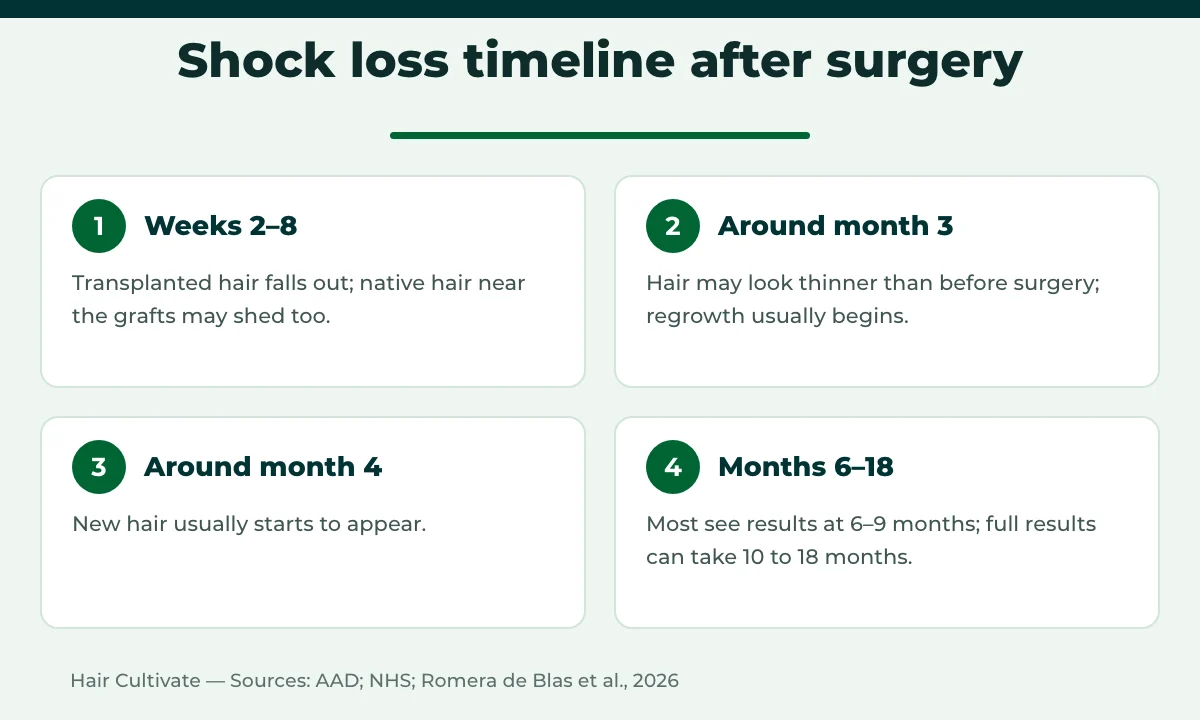
- Weeks 2 to 8: shedding. The transplanted hair falls out in this period (AAD). Shock loss of native hair typically begins 2–6 weeks after surgery according to one review, and within 2–8 weeks according to another (Kerure & Patwardhan, 2018; Romera de Blas et al., 2026).
- Around month 3: the thinnest point. The AAD warns that by the third month the hair may look thinner than before the transplant (AAD). Regrowth of shed native hair usually begins around this time (Romera de Blas et al., 2026).
- Around month 4: new hair appears. The NHS says new hair will usually start to appear after 4 months (NHS).
- Months 6 to 18: results. Most patients see results between six and nine months after surgery, and for some it takes 12 months (AAD). The NHS gives 10 to 18 months for the full result (NHS).
In short, shock loss after hair transplant is a phase of weeks to months, not a permanent state. It helps to take photos in the same light every month and to read a structured patient guide to recovery so you know what to expect at each stage.
How common is shock loss after hair transplant, and who is at risk?
Shock loss of native hair is much less frequent than shedding of transplanted hair, and the numbers depend on how each study records it. A 2026 review reports incidence figures from 0.15% to 15% and notes that these estimates come from mixed retrospective series, so the true rate is unknown (Romera de Blas et al., 2026).

A single-centre study of 621 patients who had follicular unit excision (FUE) found shock loss in 23 of them. Of these 23 patients, 9 were men (out of 554 men) and 14 were women (out of 67 women). Female sex was the only clear risk factor overall, and among women, older age increased the risk (Okochi et al., 2024).
Large personal series report low numbers for the more noticeable cases. In one surgeon’s records of 2,896 patients over 10 years, three patients had recipient-area effluvium and one had donor-area effluvium (Garg & Garg, 2021). These figures come from one practice only.
Factors linked to a higher risk include:
- Female sex, especially older women with female pattern hair loss (Okochi et al., 2024; Romera de Blas et al., 2026). If you are considering a hair transplant for women, ask about this risk before surgery.
- Advanced miniaturization of the native hair in the transplant zone (Kerure & Patwardhan, 2018).
- High implantation density, over-tumescence and local trauma (Romera de Blas et al., 2026).
- For donor shedding: high extraction density, vascular damage, smoking and diabetes (Romera de Blas et al., 2026; Garg & Garg, 2021).
Shock loss after hair transplant or a failed transplant?
Early shedding alone does not mean the grafts failed. The NHS lists a small risk that the transplant will not take and the hair falls out, but it also says the transplanted hair often falls out after a few weeks and then grows back (NHS). The difference is mainly timing and what happens next.
| Sign | Usual shock loss | Possible poor growth |
|---|---|---|
| When hair falls | 2–8 weeks after surgery | Hair is still missing many months later |
| Regrowth | Begins around month 3–4 | Sparse or uneven growth at 6–12 months |
| Likely cause | Temporary stress on follicles from surgery | Follicle injury, grafts drying or long time outside the body, smoking, vascular disease |
| Usual management | Reassurance, time, sometimes minoxidil | Medical review; further treatment if indicated |
The review by Romera de Blas et al. describes poor growth as a separate problem that shows itself 6–12 months after surgery, with sparse or uneven regrowth. Possible causes include injury to follicles during harvesting or implantation, long time outside the body, drying of grafts, smoking and vascular disease (Romera de Blas et al., 2026).
Judging the result at month 2 or 3 is too early. Most patients see results at six to nine months, and some at 12 months (AAD), so shock loss after hair transplant and true failure are usually told apart later in the first year.
What helps with shock loss after hair transplant: the evidence
No treatment is proven to stop shock loss after hair transplant in every patient. Most advice comes from reviews and expert opinion rather than large trials.
Reassurance and time
Management is mainly conservative, with patient reassurance and clear expectations; spontaneous regrowth is expected (Romera de Blas et al., 2026). Without treatment, shed native hair also tends to regrow after 3 to 4 months (Garg & Garg, 2021).
Minoxidil
Topical or oral minoxidil may help speed up regrowth after shock loss (Romera de Blas et al., 2026). A consensus of 11 international hair restoration experts concluded, based on their clinical experience, that approved hair-growth drugs can speed regrowth of transplanted follicles and slow further loss (Avram et al., 2002).
One review suggests starting minoxidil early, within 2 weeks of surgery, to reduce the risk and speed recovery (Kerure & Patwardhan, 2018). Practice guidelines, however, advise stopping minoxidil one week before surgery because it may increase bleeding (Mysore et al., 2021). Follow your surgeon’s advice on when to restart.
Finasteride (men)
In a randomized, double-blind trial, 79 men took finasteride 1 mg or placebo from 4 weeks before until 48 weeks after hair transplant. At week 48, the finasteride group had significantly better scalp hair and hair counts, and visible increases in frontal scalp hair were recorded in 94% of the finasteride group and 67% of the placebo group (Leavitt et al., 2005). It measured hair around the transplant, not shock loss itself.
The NHS lists erection problems, lower sex drive and ejaculation problems as common side effects, and depression and thoughts of self-harm as rare but serious ones. It also says common side effects can sometimes continue after stopping the medicine (NHS, finasteride). It is generally not recommended for women (NHS, finasteride). Discuss it with a doctor before you start.
Ongoing medical treatment
A transplant does not stop androgenetic alopecia. Practice guidelines recommend that every patient is told about continuing medical treatment after surgery, and name topical minoxidil 2–5% and oral finasteride 1 mg/day as the approved medicines (Mysore et al., 2021). The NHS also notes that your hair might continue to thin around the transplant (NHS).
Camouflage, PRP and other options
Fibre sprays or powder concealers can improve how the scalp looks while you wait (Romera de Blas et al., 2026). Some clinics offer PRP hair treatment after surgery. A 2026 review found moderate to strong evidence for PRP in androgenetic alopecia, but limited evidence specific to transplantation, with shock loss reported inconsistently (Balwi & Koldas, 2026).
Can shock loss be prevented?
It cannot be prevented completely, but the risk can be lowered. Preventive measures are mostly surgical: avoiding excessive implantation density and tumescence, using a gentle technique that limits trauma and ischemia, and avoiding deep or wide incisions that may damage native follicles (Romera de Blas et al., 2026).

As a patient, you can help by:
- Giving a full medical history, including smoking, diabetes and any recent illness. In one series, two of three men with recipient-area effluvium had a fever one week before surgery (Garg & Garg, 2021).
- Reducing or stopping smoking before surgery, as practice guidelines advise (Mysore et al., 2021).
- Asking your surgeon how dense the implantation will be and how they protect existing hair, whatever the technique, for example Sapphire FUE or DHI.
- Discussing medical treatment for native hair before and after surgery (Mysore et al., 2021).
Women in particular should be informed before surgery that this temporary shedding is possible (Romera de Blas et al., 2026). Knowing in advance makes shock loss after hair transplant less frightening.
When to see your doctor about shock loss after hair transplant
Shedding within the expected window, without other symptoms, is usually not urgent. Still, contact your surgeon or a doctor if:
- You have a fever that does not go away, heavy bleeding, severe redness or pain, or green or yellow pus from the incisions (Cleveland Clinic).
- You have severe pain or any unexpected symptoms (NHS).
- Crusts are still thick or present after about two weeks, which may need a clinical check (Romera de Blas et al., 2026).
- Hair loss spreads far beyond the treated areas, or there is no visible regrowth by 6 to 12 months.
- You have side effects from minoxidil or finasteride.
Rare late problems such as lichen planopilaris can appear months to years later with redness around follicles, itching and scarring hair loss, and may need a biopsy (Romera de Blas et al., 2026).
If you are planning a hair transplant in Turkey and want to know your personal risk of shock loss after hair transplant, you can send clear photos of your scalp for a free hair analysis on WhatsApp (+905444768387) or through our contact page.
Frequently asked questions
Is shock loss after hair transplant normal?
Yes. The transplanted hair falls out between two and eight weeks after surgery in most patients, and the AAD describes this as normal. Shedding of native hair is less common but is usually temporary.
How long does shock loss after hair transplant last?
Shedding usually starts 2–8 weeks after surgery, and regrowth usually begins around month 3. New hair is commonly visible after about 4 months, and full results take 10 to 18 months.
Can shock loss be permanent?
Usually not, but a permanent reduction of native hair can occur, mainly in hairs that were already miniaturized.
Does shock loss mean my grafts have died?
No. Losing the hair shafts in the first weeks is expected, and the follicles usually stay alive. Graft survival can only be judged once growth appears, usually from month 6 onwards.
Does minoxidil stop shock loss after hair transplant?
It is not proven to stop it, but reviews say it may help hair regrow faster. Ask your surgeon when it is safe to start or restart it on the healing scalp.
Are women more likely to get shock loss?
Yes. In a study of 621 FUE patients, shock loss occurred in 14 of 67 women and 9 of 554 men, and older age increased the risk among women.
References
- Romera de Blas C, Vega Díez D, Ricart Vayá JM, Gómez Zubiaur A. Complications in follicular unit excision hair transplantation: current evidence and practical approaches. Front Med (Lausanne). 2026;13:1750989. PMC12909172
- Okochi H, Onda M, Momosawa A, Okochi M. An analysis of risk factors of recipient site temporary effluvium after follicular unit excision: a single-center retrospective study. Aesthetic Plast Surg. 2024. PubMed 37816944
- Kerure AS, Patwardhan N. Complications in hair transplantation. J Cutan Aesthet Surg. 2018;11(4):182–189. PMC6371733
- Garg AK, Garg S. Complications of hair transplant procedures: causes and management. Indian J Plast Surg. 2021;54(4):477–482. PMC8719980
- Leavitt M, Perez-Meza D, Rao NA, Barusco M, Kaufman KD, Ziering C. Effects of finasteride (1 mg) on hair transplant. Dermatol Surg. 2005;31(10):1268–1276. PubMed 16188178
- Avram MR, Cole JP, Gandelman M, et al. The potential role of minoxidil in the hair transplantation setting. Dermatol Surg. 2002;28(10):894–900. PubMed 12410672
- Mysore V, Kumaresan M, Garg A, et al. Hair transplant practice guidelines. J Cutan Aesthet Surg. 2021;14(3):265–284. PMC8611706
- Balwi A, Koldas T. Adjunctive regenerative therapies in hair transplantation: a comprehensive review of platelet-rich plasma, exosomes, and emerging methods. Front Med (Lausanne). 2026;13:1820122. PMC13372975
- American Academy of Dermatology. Hair loss: hair transplant. aad.org
- NHS. Hair transplant. nhs.uk
- NHS. Side effects of finasteride; Who can and cannot take finasteride. nhs.uk
- Cleveland Clinic. Hair transplant. clevelandclinic.org
This article is for general information and does not replace a consultation with a qualified doctor.


