 Italiano
 Türkçe
 Español
 Русский
 فارسی
 Français
 English
 العربية


How many grafts do I need is one of the first questions people ask before a hair transplant. There is no single number that fits everyone. The answer depends on how large the bald or thinning area is, how dense you want the result to look, and how many follicles your donor area can safely give. Published studies report very different graft counts for the same Norwood stage. This guide explains the Norwood scale, shows source-based graft ranges, and explains why density and donor capacity matter as much as the stage itself.
Key takeaways
- In one study of 158 men, graft numbers ranged from 500–1000 at Norwood II to 1500–4000 at Norwood V (Wang et al., 2024).
- Two men with the same Norwood 3V pattern were estimated to need 3900 and 6150 grafts, because their bald areas were different sizes (Pittella et al., 2024).
- Practice guidelines give a lifetime safe upper limit of 4000 to 6500 scalp grafts, and 2500 to 3000 grafts per session as an optimum upper limit (Mysore et al., 2021).
- Most FUE experts recommend 10–15 excisions per cm² in a single pass, because over-harvesting can thin the donor area (Garg & Garg, 2018).
- Hair loss can continue after surgery, so the answer to how many grafts do I need should leave donor reserve for the future (AAD; NHS).
Table of contents
- What is a graft?
- How many grafts do I need for each Norwood stage?
- Why the same stage can need very different numbers
- Target density: how full should it look?
- Donor capacity: the real limit
- Advanced baldness: Norwood 5 to 7
- How surgeons estimate your graft number
- One session or more?
- Planning for future hair loss
- Frequently asked questions
- References
What is a graft?
Hair does not grow from the scalp one strand at a time. It grows in small natural groups called follicular units. In a hair transplant, each follicular unit that is moved is called a graft. Grafts contain one to four hairs (Khanna, 2008).
So when you ask how many grafts do I need, remember that a graft count is not a hair count. In a study of 580 men, each follicular unit in the scalp donor area held 1.81 hairs on average (Chouhan et al., 2019b). So 1000 grafts usually mean more than 1000 hairs.
Grafts are usually taken from the back of the head, where hair tends to be thickest (Cleveland Clinic; NHS). They can be harvested one by one (FUE) or from a strip of skin (FUT). The method affects scarring and recovery, as explained in our guide to FUE vs FUT differences.
How many grafts do I need for each Norwood stage?
Doctors often describe male pattern hair loss with the Norwood scale, which has seven stages (Khanna, 2008). Higher stages usually mean a larger bald area, and a larger area needs more grafts. So the stage gives a first rough idea.
A 2024 study of 158 men treated with FUE reported the graft numbers used at each stage (Wang et al., 2024). The table below shows these figures. They come from one hospital, and other centres may plan differently.
| Norwood stage | Patients | Mean bald area | Grafts used (range) |
|---|---|---|---|
| II | 15 | 28.8 cm² | 500–1000 |
| III | 63 | 101.5 cm² | 1000–1800 |
| IV | 67 | 128.7 cm² | 1500–3300 |
| V | 13 | 149.2 cm² | 1500–4000 |
In the same study, the mean number of grafts was 1902.3, and the overall range was 500 to 4000 (Wang et al., 2024). Another two-centre study reported an average of 1290 follicular units per patient (Vasudevan et al., 2020).
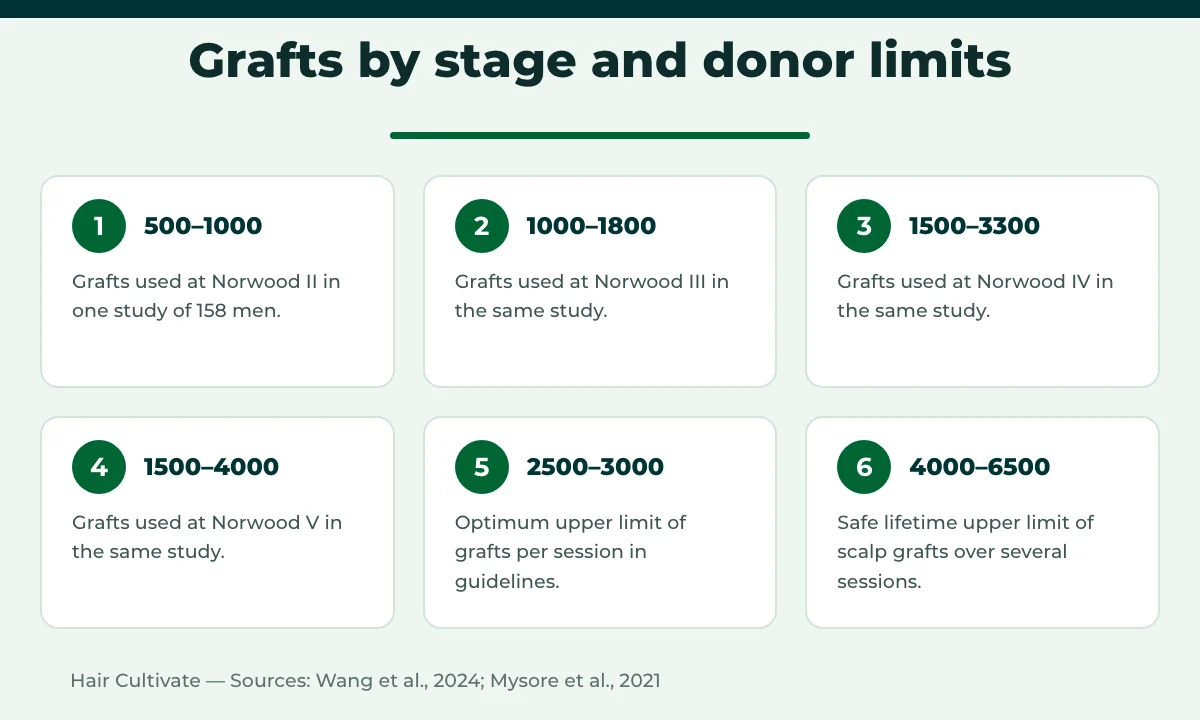
Notice how the ranges overlap. A man at Norwood IV may need fewer grafts than a man at Norwood V, or more. This is why the honest answer to “how many grafts do I need” starts with “it depends”, and why estimates vary so much between sources.
Why the same Norwood stage can need very different numbers
The Norwood scale describes the pattern of hair loss, not its exact size. Two people with the same pattern can have bald areas of very different sizes. In the study above, the bald area at Norwood III ranged from 20 to 124 cm² (Wang et al., 2024).
To address this, a group of surgeons proposed the PRECISE scale, which measures the bald and thinning area directly. Each 30 cm² of area scores one point, and the authors recommend 1500 grafts for each point as guidance (Pittella et al., 2024).
Their examples show why measuring matters:
- Two men both classified as Norwood 3V had a calculated restoration area of 80 cm² and 125 cm². The recommended graft numbers were 3900 and 6150 (Pittella et al., 2024).
- Two other men, one at Norwood 5 and one at Norwood 6, had the same area of 180 cm². Their recommended numbers were 9000 and 9300 grafts (Pittella et al., 2024).
These are calculated estimates for full coverage, not the number placed in one operation. The authors stress that the figure of 1500 grafts per point is only guidance, because surgeons may use different densities in different zones (Pittella et al., 2024). When you ask how many grafts do I need, the size of your area is often more useful than your stage.
Target density: how full should the result look?
The second factor is density, meaning how many grafts are placed in each square centimetre. In the 580-man study, the mean density in the donor area was 78.2 follicular units and 141.5 hairs per cm² (Chouhan et al., 2019b).
Transplant densities reported in studies are lower than this:
- In men with advanced baldness, one team placed 30–40 grafts per cm² at the front, reducing to 20–25 per cm² towards the crown (Chouhan et al., 2019a).
- Another team planned 30 to 60 grafts per cm², based on the design for each patient (Wang et al., 2024).
- The PRECISE authors used 50 grafts per cm² as a reasonable filling value for most regions, giving around 100 hairs per cm² (Pittella et al., 2024).
Target density changes the answer to how many grafts do I need: higher density means more grafts for the same area. Surgeons often put more grafts at the front, where the hairline frames the face, and fewer at the crown. One review notes that 250–300 single-hair grafts are usually needed to create a new hairline (Khanna, 2008).
In totally bald areas, the transplanted density is thinner, and a second session may be planned to add density (Khanna, 2008).
Donor capacity: the real limit on how many grafts you can have
How many grafts do I need is one side of the equation. Your supply is the other. Grafts should be taken only from the safe donor area, where hair is less likely to be lost later (Mysore et al., 2021). Guidelines describe this area as 189–203 cm², with individual and ethnic variation (Mysore et al., 2021).
The maximum number of grafts depends on the donor area, the donor density, head size, technique, skin elasticity, age and the chance of future sessions (Mysore et al., 2021). The guidelines give these upper limits:
- Over a lifetime: 4000 to 6500 scalp grafts, across several sessions and techniques (Mysore et al., 2021).
- Per session: an average of 2500 to 3000 grafts is considered the optimum upper limit without visible depletion of the donor area (Mysore et al., 2021).
Donor density varies a lot between people. In the 580-man study, the number of follicular units available at 25% extraction was 2064 in the limited donor zone, 3097 in the standard zone and 3612 in the extended zone (Chouhan et al., 2019b).
Why over-harvesting is a risk
Each graft removed lowers the density left behind. Most FUE experts recommend 10–15 excisions per cm² as a safe single pass in a person with a baseline density of 65–75 follicles per cm² (Garg & Garg, 2018).
The same review gives an example. With a starting density of 70 per cm², one pass leaves 55–60, a second pass 40–45, and a third 25–30. Visible thinning may be expected after the third pass, and it can appear at 40–50 per cm², especially with fine, straight hair, high contrast and short hairstyles (Garg & Garg, 2018).
Guidelines list “unlimited grafts” among claims that may mislead the public (Mysore et al., 2021). A plan that promises very high numbers without checking your donor area deserves careful questions.
Advanced baldness: how many grafts do I need at Norwood 5 to 7?
In advanced stages, the bald area can be larger than the donor area can cover. A study of 820 men at Norwood 5–7 treated with FUE described this donor–recipient mismatch (Chouhan et al., 2019a). The authors gave approximate graft needs by coverage area:

| Coverage goal | Approximate grafts required | Average grafts transplanted |
|---|---|---|
| Frontal forelock | At least 1500–2000 | 1240 |
| Frontal area | 3000–3500 | 2982 |
| Front and mid-front | 4500–5000 | 4164 |
| Crown (vertex) only | Not stated | 2770 |
| Full coverage | At least 6000 | 6237 |
On average, 2956 grafts were taken from the scalp in each case (Chouhan et al., 2019a). When the scalp could not supply enough, the team added beard and body hair. In most cases, 1000–1500 grafts could be taken from the beard (Chouhan et al., 2019a).
Most patients asked for full coverage in one sitting, but this was not possible in most cases because of the limited donor area (Chouhan et al., 2019a). At 12 months, 94% were satisfied, while 62% wanted another sitting for more coverage or density (Chouhan et al., 2019a).
In advanced stages, the front often matters most. The authors found that a mature hairline with a front-to-back density gradient helped achieve a satisfying result even in extensive baldness (Chouhan et al., 2019a).
How surgeons work out how many grafts do I need: step by step
An online answer to how many grafts do I need is only a starting point. A proper plan comes from an examination. The usual steps are:
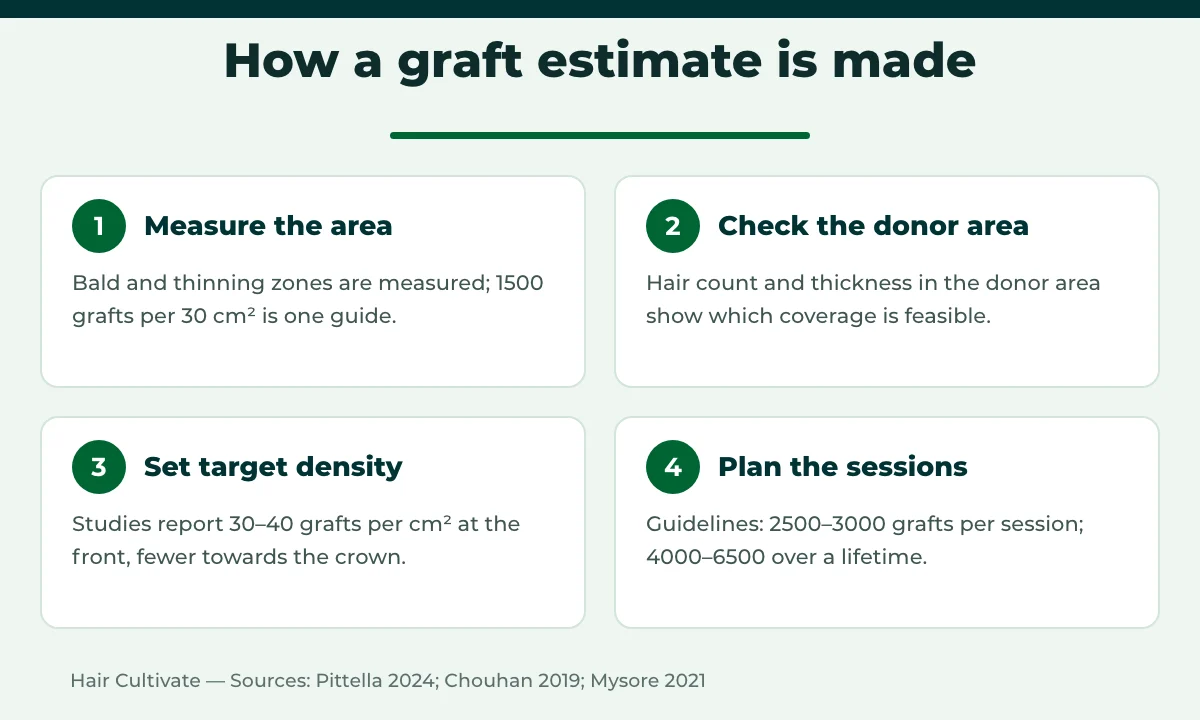
- Measure the area. The bald and thinning zones are measured, for example with a grid stamp or digital tools (Pittella et al., 2024).
- Assess the donor area. Hair count and hair thickness in the donor area help plan the surgery and decide which coverage is feasible (Chouhan et al., 2019a).
- Choose a target density. The surgeon decides how many grafts per cm² each zone needs, usually more at the front (Chouhan et al., 2019a).
- Plan the sessions. The total is matched to safe limits per session and over a lifetime (Mysore et al., 2021).
Guidelines also say that the number of grafts planned and actually performed should be disclosed to the patient and documented with images (Mysore et al., 2021).
Graft numbers can also affect the price. You can compare typical figures in our hair transplant cost guide. Guidelines advise that charging should be only for viable follicles that are transplanted (Mysore et al., 2021).
One session or more?
If a large area is treated, you may need 2 or more sessions on different days (NHS). You may need several procedures depending on how much hair needs to be moved, and the scalp needs a few months to heal between them (Cleveland Clinic).
One review notes that a session of five to six hours may transplant 2000–3000 grafts, and that a second procedure should be at least three to six months after the first (Khanna, 2008). This matches the guideline limit of 2500 to 3000 grafts per session (Mysore et al., 2021).
Results also take time. Most patients see results six to nine months after surgery, and some take 12 months (AAD). The full result can take 10 to 18 months (NHS). Judging the first result helps answer how many grafts do I need in a later session. Our article on hair transplant recovery stages explains what happens month by month.
Planning for future hair loss
Pattern hair loss usually continues after a transplant. The AAD says hair loss and thinning can continue even after surgery, and medicine may be advised to slow new loss (AAD). The NHS also warns that your hair might continue to thin around the transplant (NHS).
This changes the question. It is not only how many grafts do I need today, but also how many may be needed in ten or twenty years. Using too many grafts too early can leave little reserve for later loss.
- Age. Guidelines prefer waiting until at least 23–25 years of age and do not recommend surgery under 21 (Mysore et al., 2021). The AAD notes that younger men may be advised to delay surgery and start medication first (AAD).
- Results by stage. One study found a significantly greater gain in density in patients younger than 33 and in those below Norwood stage 4a (Vasudevan et al., 2020).
- Medical treatment. Guidelines recommend continuing medical treatment after surgery and name topical minoxidil 2–5% and oral finasteride 1 mg/day as the approved medicines (Mysore et al., 2021). Discuss side effects with a doctor first.
A careful plan places grafts so the result still looks natural if more hair is lost later (NHS). The patient guide lists what to ask before surgery.
If you are considering a hair transplant in Turkey and want a personal estimate of how many grafts do I need for your case, you can send clear photos of your scalp from the front, top, crown and back for a free hair analysis on WhatsApp (+905444768387) or through our contact page.
Frequently asked questions
How many grafts do I need for a receding hairline?
For early Norwood II recession, one study used 500–1000 grafts, and 1000–1800 at Norwood III. Rebuilding a hairline alone usually needs 250–300 single-hair grafts.
How many grafts do I need for Norwood 4 or 5?
In one study of 158 men, 1500–3300 grafts were used at Norwood IV and 1500–4000 at Norwood V. Estimates for full coverage can be higher, so a plan is often split into sessions.
Is a graft the same as a hair?
No. A graft is a follicular unit with one to four hairs. In one study, scalp units had 1.81 hairs on average, so the hair count is higher than the graft count.
How many grafts can be done in one session?
Practice guidelines consider an average of 2500 to 3000 grafts per session the optimum upper limit for avoiding visible donor depletion.
How many grafts can I have in my lifetime?
Guidelines give a safe upper limit of 4000 to 6500 scalp grafts over a lifetime, across several sessions.
Why do estimates of how many grafts do I need differ between doctors?
Doctors may measure the area differently, choose different target densities, and judge the donor area differently. The Norwood stage alone does not show the exact size of the bald area.
Will more grafts always give a better result?
Not always. The answer to how many grafts do I need is a balance. Taking too many grafts can thin the donor area, and hair loss may continue later. A balanced plan matches the number to your donor supply and future needs.
References
- Wang F, Chen Y, Yang C, et al. Using the follicular unit extraction technique in treatment of male androgenetic alopecia. BMC Surg. 2024;24(1):358. PMC11566358
- Pittella F, Castro CG, Trivellini R, et al. PRECISE Scale: a quantitative classification for androgenetic alopecia and its application to hair transplantation. Aesthetic Plast Surg. 2024;48(5):775–784. PMC10980655
- Chouhan K, Roga G, Kumar A, Gupta J. Approach to hair transplantation in advanced grade baldness by follicular unit extraction: a retrospective analysis of 820 cases. J Cutan Aesthet Surg. 2019;12(4):215–222. (Chouhan et al., 2019a) PMC6967160
- Chouhan K, Kota RS, Kumar A, Gupta J. Assessment of safe donor zone of scalp and beard for follicular unit extraction in Indian men: a study of 580 cases. J Cutan Aesthet Surg. 2019;12(1):31–35. (Chouhan et al., 2019b) PMC6484564
- Mysore V, Kumaresan M, Garg A, et al. Hair transplant practice guidelines. J Cutan Aesthet Surg. 2021;14(3):265–284. PMC8611706
- Garg AK, Garg S. Donor harvesting: follicular unit excision. J Cutan Aesthet Surg. 2018;11(4):195–201. PMC6371717
- Khanna M. Hair transplantation surgery. Indian J Plast Surg. 2008;41(Suppl):S56–S63. PMC2825128
- Vasudevan B, Neema S, Ghosh K, Singh S, Khera A. Hair transplantation by follicular unit extraction for male androgenetic alopecia: a retrospective observational study from two centers. Med J Armed Forces India. 2020;76(4):430–437. PubMed 33162652
- American Academy of Dermatology. Hair loss: hair transplant. aad.org
- NHS. Hair transplant. nhs.uk
- Cleveland Clinic. Hair transplant. clevelandclinic.org
This article is for general information and does not replace a consultation with a qualified doctor.


