 Italiano
 Türkçe
 Español
 Русский
 فارسی
 Français
 English
 العربية


Is a hair transplant permanent? The honest answer is: mostly, but not completely. Hair taken from the back and sides of the head is naturally resistant to pattern hair loss, and it usually keeps that resistance after it is moved. But the hair that was not moved can keep thinning, and long-term studies show that even transplanted hair may become less dense over the years in some people. This guide explains what lasts, what can change, and how good planning and medical treatment help results last as long as possible.
Key takeaways
- Modern hair transplants are based on “donor dominance”: transplanted hair keeps the nature of the area it came from (Punia et al., 2024).
- Pattern hair loss continues after surgery, so a hair transplant is not a one-time permanent fix; guidelines advise continuing medical treatment (Mysore et al., 2021).
- In one study of 112 men, 91.08% showed some reduction in transplanted hair density between year 1 and year 4, mostly slight or moderate (Kumaresan & Subburathinam, 2020).
- In advanced hair loss, the donor area itself can be affected, so it should be checked for miniaturization before surgery (Khunkhet et al., 2021).
- Hair loss medicine can prevent or slow new loss and help keep natural-looking results for years (AAD).
Table of contents
- The short answer
- Donor dominance
- Ongoing native hair loss
- The first months
- What studies show
- Factors that matter
- The role of medication
- Will you need another session?
- Protecting your result
- Frequently asked questions
- References
Is a hair transplant permanent? The short answer
A hair transplant moves hair; it does not create new hair. As one review puts it, transplantation redistributes existing hair (Sattur & Sattur, 2021). Whether the result lasts depends on two different groups of hair:
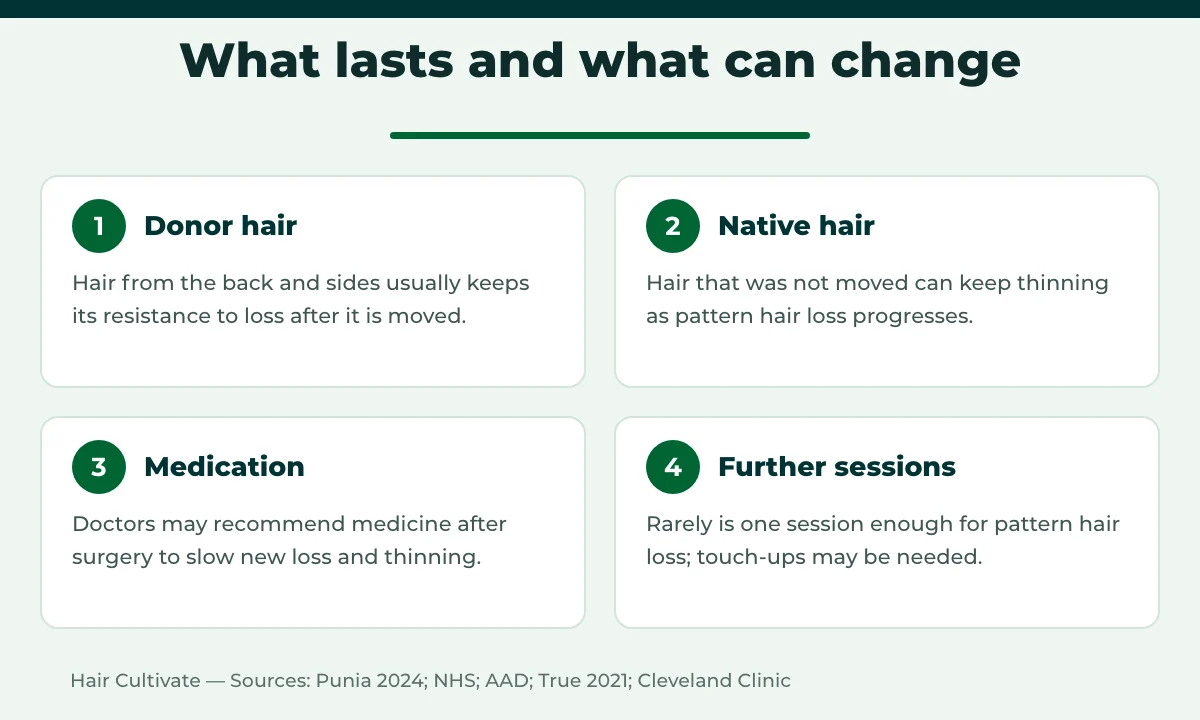
- Transplanted hair, taken from the donor area at the back and sides. This hair is usually resistant to pattern hair loss and usually keeps growing for many years.
- Native hair, the hair that was already in the treated area or nearby. This hair is still exposed to pattern hair loss and can keep thinning.
So, is a hair transplant permanent? In most cases the transplanted hair is usually long-lasting, but the overall look can change as the native hair thins. The NHS warns that hair may continue to thin around the transplanted area, and that a good surgeon should plan for this (NHS).
Donor dominance: why transplanted hair usually stays
The idea behind lasting results is called donor dominance. It was proposed by Orentreich in 1959. It means that transplanted hair keeps the original nature of the donor site even after it is moved (Punia et al., 2024). In practice, this is why hair moved from the back of the head usually behaves the same way in its new place.
Reviews describe the hairs at the back of the scalp as androgen resistant and therefore “thought to be permanent” (Kumaresan & Mysore, 2018). The area that stays stable over a lifetime is called the safe donor area. One definition places the total permanent donor area at about 203 cm² (Punia et al., 2024).
Note the words “usually” and “thought to be”. Experts agree that there can never be one valid safe donor area for all patients, and family history is part of the assessment (Kumaresan & Mysore, 2018). In one large series, partial loss of implanted hair was linked to harvesting from unsafe donor areas or to graft trauma (Garg & Garg, 2021).
Why is a hair transplant permanent only in part? Ongoing native loss
When people ask “is a hair transplant permanent?” years after surgery, the problem is usually not the grafts. It is the continued loss of the hair around them. Male pattern hair loss is permanent and usually runs in families (NHS), and it tends to worsen with age (Cortez et al., 2025).
A 2025 review states that surgery is not a cure and that treatment must continue afterwards, because native hairs in the transplanted area can keep miniaturizing (Cortez et al., 2025). The American Academy of Dermatology (AAD) says that hair loss and thinning can continue after a transplant (AAD).
This can create a visible problem. If the front was transplanted and the hair behind it later thins, an “island” of transplanted hair can appear. Good planning tries to prevent this by designing a hairline and distribution that will still look natural as you age (NHS).
Is a hair transplant permanent from the first months?
Many patients first ask “is a hair transplant permanent?” a few weeks after surgery, when the new hairs fall out. This early shedding is expected. The transplanted hair usually falls out between two and eight weeks after surgery, and by the third month the hair may look thinner than before; the AAD calls this normal (AAD).

The follicles stay under the skin and start a new growth cycle. New hair usually begins to appear after about 4 months, and full results should be visible after 10 to 18 months (NHS). Most patients see results six to nine months after surgery, while some need 12 months (AAD). Early shedding is therefore not a sign that the result will not last. Our article on shock loss after hair transplant explains the difference between normal shedding and loss of native hair.
| Part of the result | Usually | What can change it |
|---|---|---|
| Transplanted hair | Keeps growing for many years (donor dominance) | Some reduction in density in many patients over 4 years |
| Native hair around the grafts | Follows the course of pattern hair loss | Medicine may slow loss; it only works while used |
| Overall look | Depends on both groups of hair | Further thinning may need another session |
What long-term studies show
Few studies have followed transplanted hair for many years. One study from India looked at 112 men with Norwood grade 4 or higher who had one strip (FUT) session. A blinded dermatologist compared photos taken at 1 year and at 4 years (Kumaresan & Subburathinam, 2020).
- At 4 years, 8.92% of patients kept the same transplanted hair density.
- 91.08% showed some reduction.
- The reduction was slight in 27.67%, moderate in 55.35% and great in 8.03%.
The authors concluded that transplanted grafts may not last permanently for all patients, and that this should be discussed before surgery (Kumaresan & Subburathinam, 2020). The study has limits: it was retrospective, had no control group, and did not count hair density, so it relied on photo grading.
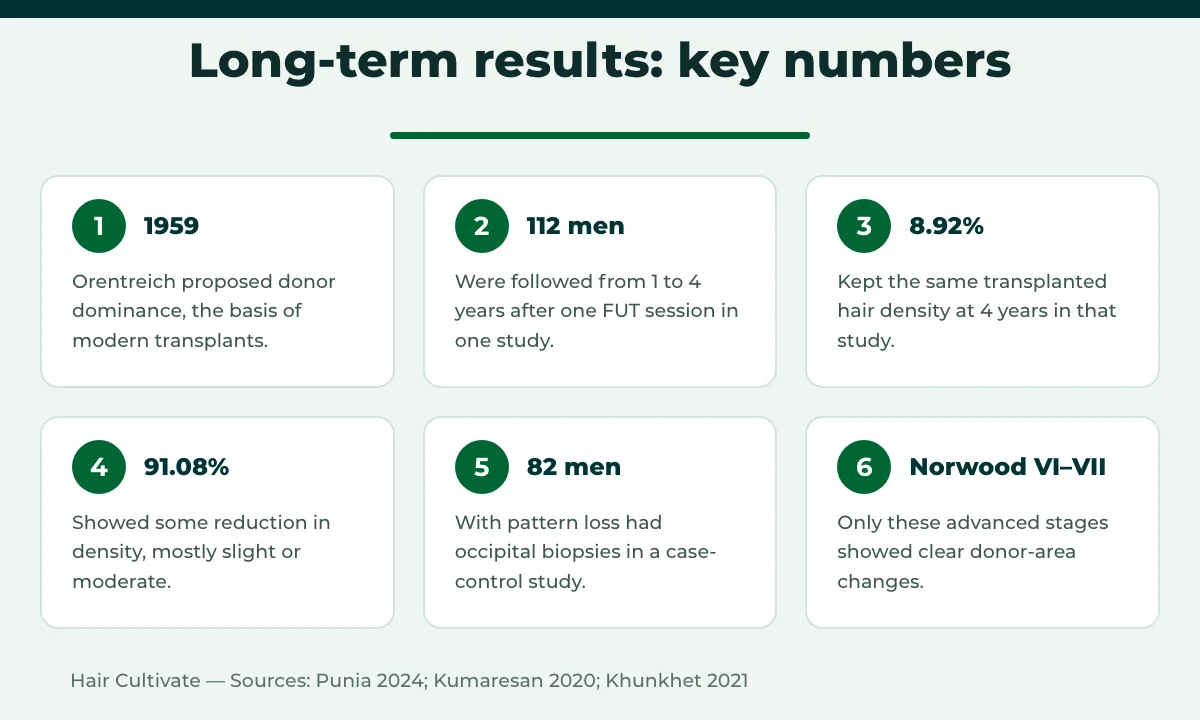
A second study looked at the donor area itself. Researchers took biopsies from the back of the scalp in 82 men with pattern hair loss and 82 men without hair loss. Men with hair loss had fewer follicles, but the differences were significant only at Hamilton–Norwood stages VI and VII. The authors concluded that pattern hair loss can involve the back of the scalp in advanced disease and recommended measuring miniaturization in the donor site before surgery (Khunkhet et al., 2021).
Is a hair transplant permanent for everyone? Factors that matter
The answer to “is a hair transplant permanent” depends on the person. These factors make a difference:
- Cause of hair loss. Transplants are aimed at permanent inherited baldness. Other types, such as patchy alopecia areata, are usually not suitable (NHS).
- Stability of hair loss. Unstable or very active hair loss is a reason to delay or avoid surgery (True, 2021).
- Donor quality. Miniaturization in the donor area should be checked and explained to the patient (Mysore et al., 2021).
- Age and future pattern. Younger patients usually have more future loss ahead, which affects the plan. See our guide to the hair transplant recovery timeline for what happens in the first 18 months.
- Graft survival. There is a small risk that grafts do not take and the hair falls out (NHS).
Scarring alopecia and alopecia areata
In some conditions, the question “is a hair transplant permanent” has a less certain answer. In primary scarring alopecias, outcomes are less predictable, and surgeons recommend waiting 2 to 5 years of complete disease stability before surgery. Relapse after surgery has been reported in lichen planopilaris, and frontal fibrosing alopecia had the worst outcomes in a review cited by the authors (Singh & Muthuvel, 2021). Active alopecia areata is generally considered a contraindication (True, 2021; Cortez et al., 2025).
Is a hair transplant permanent without medication?
Is a hair transplant permanent without medicine? The grafts usually are, but the native hair may not be. Because native hair loss continues, doctors often recommend medicine after surgery. The AAD notes that hair loss medicine can prevent or slow down new loss and thinning, and that with it, many people keep natural-looking results for years (AAD).

Indian practice guidelines state that topical minoxidil 2–5% and oral finasteride 1 mg per day are the approved drugs, and that patients should be advised to continue medical management after a transplant (Mysore et al., 2021). The NHS adds that these treatments do not work for everyone and only work for as long as they are used (NHS).
Women should not use finasteride (NHS), and men should discuss its possible side effects with a doctor before starting.
Will you need another transplant?
Even when the answer to “is a hair transplant permanent” is mostly yes, many people still need more surgery later. One expert review notes that pattern hair loss is progressive and that a single transplant session is rarely adequate (True, 2021). Patients may need several transplants over their lifetime, depending on how their hair loss progresses (Sattur & Sattur, 2021). Cleveland Clinic also notes that touch-up procedures may be needed for a natural look (Cleveland Clinic).
Guidelines recommend that the pre-operative plan should include the expected results and the possibility of a second surgery after a set period (Mysore et al., 2021). Because the donor supply is limited, guidelines note that the safe number of grafts depends partly on the plan for future sessions (Mysore et al., 2021). Our patient guide explains how planning works step by step, and the FUE vs FUT comparison explains how each method uses the donor area.
How to protect your result
You cannot fully control genetics, but you can improve the odds of a long-lasting result:
- Choose a long-term plan. Ask for a design that will still look natural as hair keeps thinning (NHS).
- Ask about donor miniaturization. Ask whether your donor area has been checked (Mysore et al., 2021; Khunkhet et al., 2021).
- Discuss medicine. Ask your doctor whether minoxidil or finasteride is suitable for you (AAD).
- Be patient. Full results take 10 to 18 months (NHS), so judge the result at the right time.
- Plan for the long term. Expect that native hair may change and that a further procedure may be needed.
Frequently asked questions
Is a hair transplant permanent if I stop taking finasteride?
The transplanted hair usually keeps growing, because it comes from resistant donor hair. But the native hair around it may thin faster, because medicines only work while they are used (NHS). The overall look can therefore change.
Can transplanted hair fall out years later?
It can become thinner in some people. In one study, most patients showed some reduction in transplanted hair density between years 1 and 4, mostly slight or moderate (Kumaresan & Subburathinam, 2020).
Is a hair transplant permanent for women?
Results depend on the cause and pattern of hair loss and on the stability of the donor area. Diffuse unpatterned hair loss is one reason a person may not be a suitable candidate (True, 2021). Our page on female hair transplant explains this in more detail.
Is a hair transplant permanent if it looks thinner after a few years?
Usually because the native hair around the grafts kept thinning, which can leave a gap or an island of transplanted hair (NHS; Cortez et al., 2025). Poor planning or harvesting from outside the safe donor area can also play a role (Kumaresan & Mysore, 2018).
Is a hair transplant permanent after the first year?
The first year is mainly about growth: new hair usually appears from around month 4 and full results take 10 to 18 months (NHS). After that, the transplanted hair usually stays, while native hair follows its own course.
If you want an honest opinion on how long a transplant could last in your case, you can send clear photos of your scalp for a free hair analysis on WhatsApp (+905444768387) or through our contact page.
References
- Punia S, Goel A, Gupta A. Patient-based ratio method for permanent zone donor area calculation in hair transplant. Indian J Plast Surg. 2024;57(6):474–478. PMC11679175
- Kumaresan M, Mysore V. Controversies in hair transplantation. J Cutan Aesthet Surg. 2018;11(4):173–181. PMC6371731
- Kumaresan M, Subburathinam DM. Longevity of hair follicles after follicular unit transplant surgery. J Cutan Aesthet Surg. 2020;13(4):292–297. PMC8061642
- Khunkhet S, Chanprapaph K, Rutnin S, Suchonwanit P. Histopathological evidence of occipital involvement in male androgenetic alopecia. Front Med (Lausanne). 2021;8:790597. PMC8645552
- Mysore V, Kumaresan M, Garg A, et al. Hair transplant practice guidelines. J Cutan Aesthet Surg. 2021;14(3):265–284. PMC8611706
- True RH. Is every patient of hair loss a candidate for hair transplant? Deciding surgical candidacy in pattern hair loss. Indian J Plast Surg. 2021;54(4):435–440. PMC8719975
- Sattur SS, Sattur IS. Patient counselling and medicolegal aspects of hair transplant surgery. Indian J Plast Surg. 2021;54(4):441–445. PMC8719947
- Singh S, Muthuvel K. Role of hair transplantation in scarring alopecia: to do or not to do. Indian J Plast Surg. 2021;54(4):501–506. PMC8719951
- Garg AK, Garg S. Complications of hair transplant procedures: causes and management. Indian J Plast Surg. 2021;54(4):477–482. PMC8719980
- Cortez GL, Hassun K, Linhares LRP, et al. Male androgenetic alopecia. An Bras Dermatol. 2025;100(2):308–321. PMC11962920
- NHS. Hair transplant; Hair loss. nhs.uk; nhs.uk
- American Academy of Dermatology. Hair loss: hair transplant. aad.org
- Cleveland Clinic. Hair transplant. clevelandclinic.org
This article is for general information and does not replace a consultation with a qualified doctor.


