 Italiano
 Türkçe
 Español
 Русский
 فارسی
 Français
 English
 العربية


Hair transplant side effects are usually mild and short-lived, but they are real, and every patient should know them before surgery. Most people have some swelling, tightness, scabs and itching in the first days. A smaller number have problems such as folliculitis, numbness or temporary shedding. Serious complications are rare. This guide explains what is normal, what is uncommon, which factors raise the risk, and which warning signs mean you should contact your surgeon.
Key takeaways
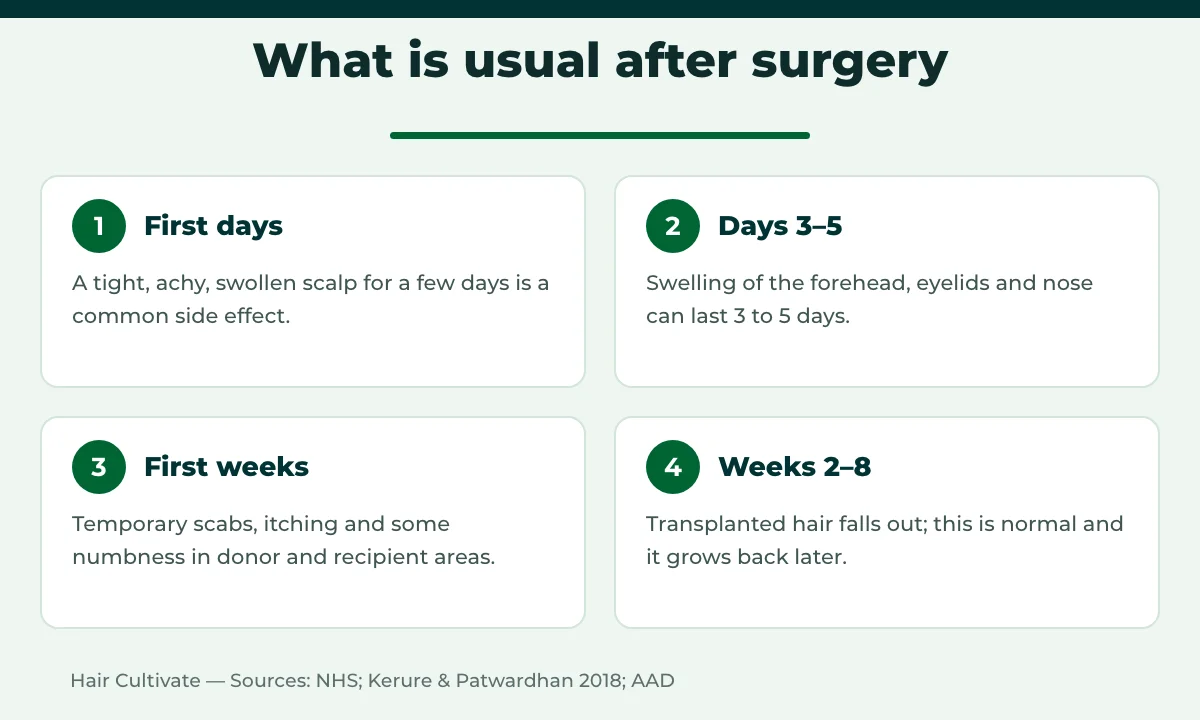
- The NHS lists a tight, achy and swollen scalp for a few days, temporary scabbing and very small scars as common side effects (NHS).
- Swelling of the forehead, eyelids and nose is common and can last 3 to 5 days; serious infection is rare, reported at under 1% (Kerure & Patwardhan, 2018).
- In one series of 2,896 patients, the most frequent problem was sterile folliculitis (203 patients); there were no major or life-threatening complications (Garg & Garg, 2021).
- The fall of transplanted hair 2–8 weeks after surgery is normal and is not a sign of failure (AAD).
- Smoking, diabetes, heavy drinking and blood-thinning medicines raise the risk of infection, bleeding and slow healing (ISHRS).
Table of contents
- How common are side effects?
- Common side effects
- Shedding and shock loss
- Uncommon side effects
- Rare complications
- Donor area and scars
- Poor growth and results
- Who is at higher risk?
- How to lower your risk
- When to contact your surgeon
- Frequently asked questions
- References
Are hair transplant side effects common?
A hair transplant is minor surgery under local anaesthetic, but it still creates many small wounds in the scalp. Some hair transplant side effects are therefore expected. The NHS describes the procedure as generally safe, with a small risk of bleeding, infection, or an allergic reaction to the anaesthetic, which surgeons can usually treat quickly (NHS).
It helps to separate three groups:
- Expected effects that almost everyone has, such as swelling, scabs and tightness.
- Uncommon side effects, such as folliculitis, numbness or shock loss, which usually settle with time or simple treatment.
- Rare complications, such as serious infection, skin necrosis or a keloid scar, which need medical care.
Surgeons are expected to explain all hair transplant side effects before the operation, even the rarest possible problems (Sattur & Sattur, 2021).
Common hair transplant side effects in the first weeks
These hair transplant side effects are the ones most patients notice. They are usually temporary.
Pain, tightness and soreness
A tight, achy scalp for a few days is common (NHS). Pain is described as a common complication both during and after the procedure (Kerure & Patwardhan, 2018).
Swelling of the forehead and eyes
Swelling (edema) is common. It can last 3 to 5 days and mostly affects the forehead, eyelids and nose (Kerure & Patwardhan, 2018). In the series of 2,896 patients, facial swelling peaked around day 3 and resolved on its own by day 6 or 7 (Garg & Garg, 2021).
Scabs and crusts
Small scabs form around each graft and in the donor area. The NHS describes this scabbing as temporary (NHS). Your clinic will explain when and how to wash. Our guide on washing hair after a transplant explains the usual steps.
Itching
Itching is common in both the donor and recipient areas as the skin heals (Kerure & Patwardhan, 2018). Ask your surgeon what is safe to use for relief.
Numbness
Cleveland Clinic lists numbness among the usually temporary side effects (Cleveland Clinic). In the large series, 18 patients had numbness; most cases resolved within 2–3 weeks, and one case after strip harvesting lasted about 4 months before recovering (Garg & Garg, 2021).
Minor bleeding
Bleeding is a possibility, as in any surgery, and is more likely in people taking antiplatelet or blood-thinning drugs (Kerure & Patwardhan, 2018).
Shedding and shock loss: a normal hair transplant side effect
The transplanted hairs usually fall out between two and eight weeks after surgery, and by the third month the hair may look thinner than before. The American Academy of Dermatology (AAD) calls this normal (AAD). The follicles stay under the skin and start growing new hair later.
Some patients also lose existing (native) hairs near the grafts, called shock loss. It is seen to some degree in most patients who still have hair in the transplant zone, usually starts 2–6 weeks after surgery and is usually temporary (Kerure & Patwardhan, 2018). Donor-area shedding is another temporary hair transplant side effect, and it usually recovers within 3–4 months (Kerure & Patwardhan, 2018). Read more in our article on shock loss after hair transplant.
Uncommon hair transplant side effects
The following hair transplant side effects are less frequent. Most respond to treatment.

- Folliculitis. Small, pimple-like bumps around hair follicles. In the 2,896-patient series, sterile folliculitis was the most frequent problem, seen in 203 patients and lasting from 3 weeks to 3 months. Warm compresses were used; signs of infection need urgent antibiotics (Garg & Garg, 2021).
- Hiccups. Rare but can last 2–3 days (Kerure & Patwardhan, 2018). Six patients in the large series had them (Garg & Garg, 2021).
- Fainting. Fainting (syncope) often happens at the end of long surgeries (Kerure & Patwardhan, 2018).
- Cysts. Small bumps can form when grafts slip under the skin or are placed on top of each other (Kerure & Patwardhan, 2018).
- Cobblestoning. A bumpy surface around grafts, linked to grafts placed too deep or into very small slits (Kerure & Patwardhan, 2018).
Rare but serious complications
Rare hair transplant side effects need prompt medical care. Knowing them helps you recognise a problem early.
- Infection. Serious infection is rare, with an incidence under 1%, while localized infection is more common (Kerure & Patwardhan, 2018). In the large series, the two infections were both in patients with diabetes (Garg & Garg, 2021).
- Skin necrosis. Areas of dead skin are rare. In the recipient area they are linked to vascular damage, dense packing, high adrenaline doses, uncontrolled diabetes and heavy smoking (Garg & Garg, 2021). Central scalp necrosis can follow large sessions in elderly or vascularly compromised patients (Kerure & Patwardhan, 2018).
- Keloid or hypertrophic scars. These are rare (Kerure & Patwardhan, 2018). One patient in the large series developed a keloid after strip harvesting (Garg & Garg, 2021).
- Allergic reaction. An allergic reaction to the anaesthetic is a small risk (NHS). Most reactions during anaesthesia are caused by fear rather than true allergy (Kerure & Patwardhan, 2018).
- Arteriovenous fistula. An abnormal connection between an artery and a vein is rare and was more frequent with older techniques (Kerure & Patwardhan, 2018).
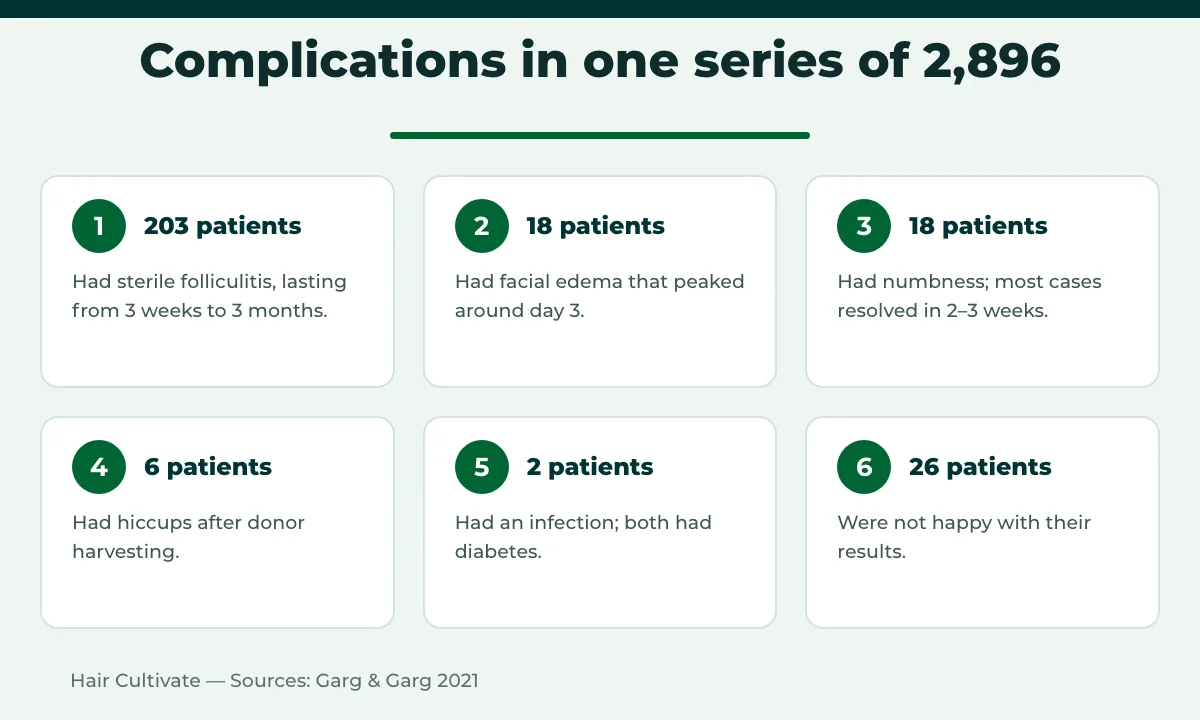
These figures on hair transplant side effects come from one surgeon’s practice over about 10 years, so they cannot be applied directly to every clinic (Garg & Garg, 2021).
Donor-area problems and scarring
Scarring is one of the hair transplant side effects that nobody fully avoids. The NHS notes that there will be one or more very small scars, and a small risk of a noticeable scar (NHS). The type of scar depends on the method:
| Issue | FUE (follicular unit excision) | FUT (strip method) |
|---|---|---|
| Usual scar | Many tiny dot scars, usually not visible in skilled hands | One linear scar, usually hidden unless hair is very short |
| Most common scar problem | White dots visible with very short hair, more relevant in darker skin | A visible scar |
| Main avoidable risk | Overharvesting: patchy, “moth-eaten” thinning | Scar problems from tight closure |
| Nerve-related effects | Numbness, usually temporary | Numbness; persistent pain if nerves are cut |
Overharvesting deserves special attention. Taking too many grafts can cause permanent thinning and patchy loss in the donor area; reviewers advise not to take more than about one in four follicular units (Kerure & Patwardhan, 2018). For more on the two methods, see our comparison of FUE vs FUT.
Poor growth and unsatisfying results
Not all hair transplant side effects are physical. There is a small risk that the grafts do not take and the hair falls out (NHS). Poor growth has been linked to graft trauma, poor donor hair quality, smoking, diabetes and sun damage (Kerure & Patwardhan, 2018).
The NHS also notes that hair may continue to thin around the transplanted area, because pattern hair loss keeps progressing (NHS). Practice guidelines say patients should be told about the chance of inadequate growth or thinning of grafted hair over time (Mysore et al., 2021).
In the large series, 26 patients were not happy with their results, mainly because of loss of non-transplanted hair and poor hairline design (Garg & Garg, 2021). An unnatural hairline is usually a design or execution problem, which is why surgeon experience matters. Remember that full results take 10 to 18 months (NHS), so early judgement is often premature. Our hair transplant recovery timeline shows what to expect month by month.
Who is at higher risk of hair transplant side effects?
The International Society of Hair Restoration Surgery (ISHRS) lists patient factors that raise the risk of infection, excessive bleeding and delayed healing. They include tobacco use, heavy drinking, obesity, malnutrition, diabetes or other chronic disease, immunosuppressive drugs or diseases, and medicines that reduce blood clotting. The more risk factors a patient has, the greater the chance of complications (ISHRS).
Practice guidelines add practical steps before surgery. These include stopping minoxidil one week before the operation, avoiding alcohol for seven days before and after, and reducing or stopping smoking. Patients on blood thinners need a risk-benefit assessment and clearance from their physician (Mysore et al., 2021).
To lower the chance of hair transplant side effects, always tell your surgeon about every medicine, supplement and medical condition. Hiding a medicine can be dangerous: in the large series, one patient who had not disclosed taking propranolol had a hypertensive crisis during surgery (Garg & Garg, 2021).
How to lower your risk
You cannot remove every risk, but you can reduce the chance of avoidable problems.
- Check who operates. In England, the NHS advises checking that the clinic is registered with the Care Quality Commission and that the surgeon is registered with the General Medical Council (NHS). Wherever you are, ask who will harvest grafts and make the recipient sites.
- Ask about complications. The NHS suggests asking how many transplants the surgeon has done and how many had complications (NHS).
- Be honest about your health. Share your full medical history and medicines.
- Stop smoking. Smoking is linked to necrosis and poor growth (Garg & Garg, 2021; Kerure & Patwardhan, 2018).
- Follow aftercare. The NHS advises being very careful for the first 2 weeks, when grafts are not secure (NHS).
When to contact your surgeon
Contact the clinic promptly if you have severe pain or unexpected symptoms (NHS). Cleveland Clinic advises calling your provider for:
- a fever that does not go away;
- heavy bleeding from the scalp;
- severe redness or pain;
- signs of infection, such as pus from the incisions (Cleveland Clinic).
Normal hair transplant side effects get better day by day, not worse. A problem that gets worse after the first few days should be checked.
Frequently asked questions
How long do hair transplant side effects last?
Most common effects last days to weeks. Tightness and swelling usually settle within a few days, numbness usually within weeks, and shedding of transplanted hair is followed by regrowth from around month 4 (NHS; Garg & Garg, 2021).
Is swelling one of the dangerous hair transplant side effects?
Usually not. Swelling of the forehead and eyelids is common and typically settles within about a week (Kerure & Patwardhan, 2018; Garg & Garg, 2021). Sudden, painful or one-sided swelling with fever should be checked.
Can a hair transplant cause permanent numbness?
Most numbness resolves within weeks. Persistent numbness or nerve pain can happen when nerves are cut, but it is uncommon (Kerure & Patwardhan, 2018; Garg & Garg, 2021).
Are pimples after a hair transplant normal?
Folliculitis is the most frequent problem in some series and is often sterile. Warm compresses may help, but red, painful bumps with pus need medical review (Garg & Garg, 2021).
Are there long-term hair transplant side effects?
Possible long-term effects include scars, donor thinning after overharvesting, and thinning of native hair around the grafts as pattern hair loss continues (NHS; Kerure & Patwardhan, 2018).
Does FUE have fewer hair transplant side effects than FUT?
The two methods have different scar patterns: FUE leaves many tiny dot scars, while FUT leaves one linear scar (NHS). Each has its own risks, so the choice depends on your hair and goals.
If you have questions about hair transplant side effects or your personal risk before a hair transplant in Turkey, you can send clear photos of your scalp for a free hair analysis on WhatsApp (+905444768387) or through our contact page.
References
- Kerure AS, Patwardhan N. Complications in hair transplantation. J Cutan Aesthet Surg. 2018;11(4):182–189. PMC6371733
- Garg AK, Garg S. Complications of hair transplant procedures: causes and management. Indian J Plast Surg. 2021;54(4):477–482. PMC8719980
- Mysore V, Kumaresan M, Garg A, et al. Hair transplant practice guidelines. J Cutan Aesthet Surg. 2021;14(3):265–284. PMC8611706
- Sattur SS, Sattur IS. Patient counselling and medicolegal aspects of hair transplant surgery. Indian J Plast Surg. 2021;54(4):441–445. PMC8719947
- NHS. Hair transplant. nhs.uk
- Cleveland Clinic. Hair transplant. clevelandclinic.org
- American Academy of Dermatology. Hair loss: hair transplant. aad.org
- International Society of Hair Restoration Surgery. Hair restoration surgery risk factors. ishrs.org
This article is for general information and does not replace a consultation with a qualified doctor.


