 Italiano
 Türkçe
 Español
 Русский
 فارسی
 Français
 English
 العربية


There is no single best age for a hair transplant, but there is a clear medical reason why doctors often ask very young men to wait. Pattern hair loss usually keeps progressing for years, and a transplant done too early can look unnatural once more hair is lost. This guide explains what practice guidelines say about age, why patients in their late teens and early twenties are usually advised to wait, what changes for older patients, and which factors matter more than the number on your birth certificate.
Key takeaways
- Indian hair transplant practice guidelines do not recommend surgery for people younger than 21, and prefer waiting until at least 23–25 years of age (Mysore et al., 2021).
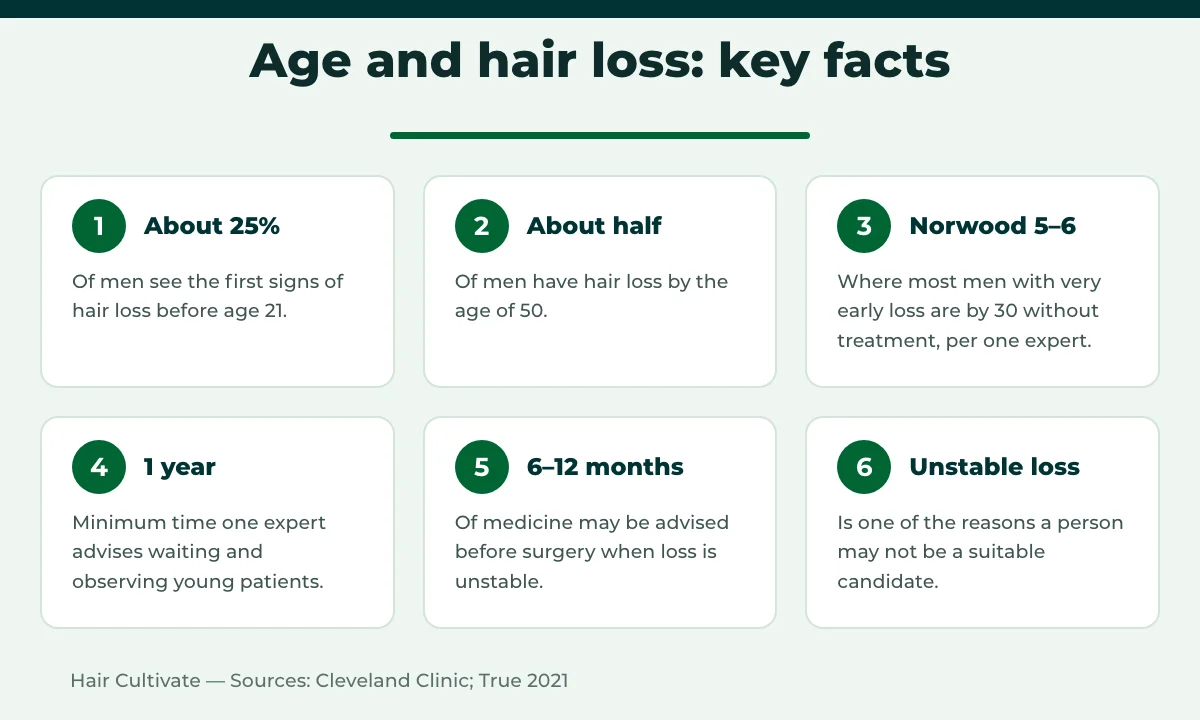
- About 25% of men see the first signs of hair loss before age 21, and about half have hair loss by 50 (Cleveland Clinic).
- One expert review warns that most men with hair loss in their late teens or early twenties reach Norwood class 5–6 by 30 without treatment (True, 2021).
- The American Academy of Dermatology (AAD) notes that a man in his 20s may be asked to wait and start hair loss medicine first (AAD).
- Age is important but not the only criterion: stability of hair loss, donor supply and general health also decide (Mysore et al., 2021).
Table of contents
- Is there a best age?
- How hair loss changes with age
- Why young patients wait
- What guidelines say
- Medication first
- How doctors judge readiness
- Older patients
- What matters more than age
- Planning for the future
- Frequently asked questions
- References
Is there a best age for a hair transplant?
Many people search for the best age for a hair transplant hoping for one simple number. In reality, guidelines describe a minimum age and a preferred age, not an ideal one. Indian practice guidelines state that age is important but not the only criterion for surgery (Mysore et al., 2021).
What doctors really want to know is whether your hair loss pattern is predictable. A transplant moves a limited number of hairs from the back and sides to the front and top. If the final pattern of your hair loss is still unclear, it is hard to place those hairs where they will look natural for the rest of your life.
That is why the best age for a hair transplant is usually the age at which your hair loss has become clearer and more stable, your expectations are realistic, and you understand that treatment is long term.
How hair loss changes with age
Male pattern hair loss is common and progressive. Cleveland Clinic states that about 25% of men see the first signs before age 21, and by age 50 about half experience hair loss (Cleveland Clinic). A 2025 review reports that it usually starts in the second decade of life, affects about 30% of men around age 30 and 50% at age 50, and tends to worsen with age (Cortez et al., 2025).
The process is slow and uneven. Hair follicles that are sensitive to the hormone dihydrotestosterone (DHT) gradually shrink, and their hairs become shorter and thinner (Cortez et al., 2025). The speed differs from person to person, which is why a young man’s current hairline tells only part of the story. Your doctor can classify your current stage and follow how it changes.
Why very young patients are asked to wait
Doctors are most careful with men in their late teens and early twenties. One expert review states that most of these men will, without treatment, end up with Norwood class 5–6 balding by age 30, if not before. The author advises deferring surgery for at least a year and seeing the patient two to four times during that period (True, 2021).
There are several reasons for this caution:
- The final pattern is unknown. A low, dense hairline at 20 may look out of place if the hair behind it is lost at 30 or 40.
- The donor supply is limited. Grafts used too early cannot be used later, when the bald area may be much larger.
- Expectations. Younger patients may have unrealistic expectations and may not stick to long-term medication (Mysore et al., 2021).
- Very young patients with limited loss should usually be dissuaded from surgery, according to a review on patient counselling (Sattur & Sattur, 2021).
The AAD gives similar advice to the public: a man in his 20s with hair loss may be asked to wait before having a transplant and to start hair loss medicine first (AAD). The same guidelines say that rebuilding the crown is better avoided in young individuals (Mysore et al., 2021).
What guidelines say about the best age for a hair transplant
On the best age for a hair transplant, the most specific advice comes from the hair transplant practice guidelines of a task force in India. They state that the task force does not recommend surgery in those younger than 21 years of age, and that waiting until at least 23–25 years is preferred (Mysore et al., 2021).
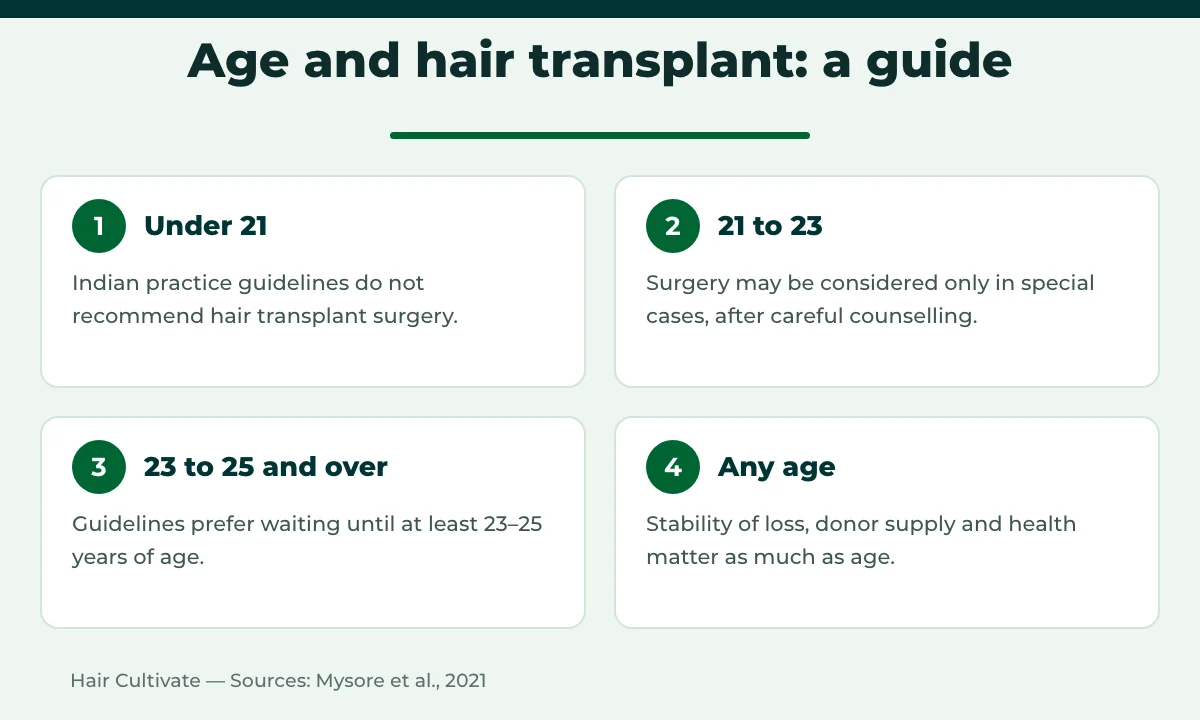
Surgery between 21 and 23 may be considered in special cases, such as:
- Hamilton–Norwood stages 4–6 where medicines are unlikely to help;
- careers that would be affected by delay, such as acting, media or modelling;
- severe psychological distress;
- traction alopecia or secondary scarring alopecia (Mysore et al., 2021).
For these cases, counselling over several sessions, preferably with parents, is advised. The guidelines also grade this advice as based on expert opinion (evidence level 4, grade D), so it is a consensus view rather than a result from large trials (Mysore et al., 2021).
| Age group | What guidance says | Usual approach |
|---|---|---|
| Under 21 | Surgery not recommended | Diagnosis, monitoring and medicine if suitable |
| 21–23 | Only in special cases, with counselling | Careful selection; long-term plan |
| 23–25 and older | Preferred minimum age range | Assessment of stability, donor area and health |
| 20s in general | May be asked to wait and start medicine first | Observation, often for at least a year |
Before the best age for a hair transplant: medication first
Waiting for the best age for a hair transplant does not mean doing nothing. The NHS lists finasteride and minoxidil as the main treatments for male pattern baldness, and notes that they do not work for everyone and only work for as long as they are used (NHS). Women should not use finasteride (NHS).

Indian practice guidelines list topical minoxidil 2–5% and oral finasteride 1 mg per day as the approved drugs (Mysore et al., 2021). In people whose hair loss is unstable or who have many shrinking hairs, one expert suggests 6 to 12 months of medical treatment before surgery. This may reverse some miniaturization and reduce the risk of shock loss after surgery (True, 2021).
A period on medicine also shows how your hair responds. If the loss stabilises, the transplant plan becomes more predictable. Some patients also ask about supportive options such as PRP hair treatment, but the evidence for these is more limited than for approved medicines.
How doctors judge the best age for a hair transplant in your case
Because there is no universal number, your doctor will look for signs that your personal best age for a hair transplant has arrived. The assessment usually covers four areas.
- How much hair has been lost. One expert considers transplantation generally safe when more than 50% of the native hair density in the recipient area has been lost (True, 2021).
- How many hairs are shrinking. If more than about 15% of the hairs in the recipient area are miniaturized, the risk of shock loss rises (True, 2021).
- Donor density. Less than 60 follicular units per cm² in the donor region is considered low density (True, 2021).
- Family history and expected progression. These help confirm the limits of the safe donor area; guidelines advise surgeons to err on the side of caution (Mysore et al., 2021).
Time with hair loss can matter as much as age itself. In a biopsy study of 82 men with pattern hair loss, the number of follicles at the back of the scalp was linked to how long the hair loss had lasted, while age was not linked to any hair measure (Khunkhet et al., 2021). This is one more reason why the best age for a hair transplant is an individual decision rather than a birthday.
Is there an upper age limit?
There is no fixed upper limit to the best age for a hair transplant in the guidelines discussed here. For older patients, the questions are mostly about health and donor supply. Guidelines call for a detailed medical evaluation before surgery, with special attention to blood thinners, heart disease and diabetes (Mysore et al., 2021).

A review of complications notes that central scalp necrosis can follow large sessions in elderly or vascularly compromised patients (Kerure & Patwardhan, 2018). This is a reason for careful planning of session size, not a ban on surgery.
Age can even help planning. Experts describe more restrictive donor boundaries for patients who might live to 80 or beyond, because some hair loss can continue into old age (Kumaresan & Mysore, 2018).
What matters more than age
When doctors decide on the best age for a hair transplant, they look at the whole picture. These factors often matter more than the exact number of years:
- Stability of hair loss. Unstable hair loss is one of the reasons a person may not be a suitable candidate (True, 2021).
- Amount of loss. Insufficient hair loss is also a reason not to operate (True, 2021).
- Donor area. The quality and size of the donor area set the limit of what can be achieved. Read more about methods in our guide to FUE vs FUT.
- Cause of hair loss. Transplants are aimed at permanent inherited baldness; patchy alopecia areata is usually not suitable (NHS).
- Health. A full medical check is essential (Mysore et al., 2021).
- Long-term commitment. Hair loss will progress with age, and patients may need several transplants and long-term medication (Sattur & Sattur, 2021).
Planning for the future, whatever your age
A hair transplant is not a one-time permanent fix for pattern hair loss, because hair loss continues; guidelines advise continuing medical treatment after surgery (Mysore et al., 2021). The NHS warns that hair may keep thinning around the transplanted area and that a good surgeon should plan the transplant to look natural over time (NHS).
Guidelines also note that the safe number of grafts depends partly on the patient’s age and plans for future sessions (Mysore et al., 2021). Whatever your age, the right plan is one that still looks natural in 10 or 20 years. Our patient guide explains the main steps of planning.
Frequently asked questions
What is the best age for a hair transplant for men?
There is no single best age for a hair transplant. Indian practice guidelines do not recommend surgery before 21 and prefer waiting until at least 23–25 (Mysore et al., 2021). After that, stability of hair loss and donor supply matter more than age.
Can I have a hair transplant at 18?
Surgery at this age is generally not advised. Guidelines do not recommend it under 21, and experts advise a period of observation and medicine first (Mysore et al., 2021; True, 2021).
Is 30 a good age for a hair transplant?
One expert notes that most men with very early hair loss reach Norwood class 5–6 by 30 without treatment, so the pattern is often clearer by then (True, 2021). Whether 30 is the best age for a hair transplant in your case depends on how stable your loss is and on your donor area.
Am I too old for a hair transplant at 60?
Not necessarily. Older patients need a careful health check, and large sessions need extra care in people with poor blood supply (Mysore et al., 2021; Kerure & Patwardhan, 2018).
Why should I take medicine before a transplant?
Medicine can slow further loss, may reduce shock loss when used before surgery in unstable cases, and shows how your hair responds (True, 2021). It only works while you use it (NHS).
Does the best age for a hair transplant differ for women?
Women’s hair loss is assessed differently, and finasteride is not used in women (NHS). Our page on female hair transplant explains the main considerations.
If you would like to know whether now is the right time for you, you can send clear photos of your scalp for a free hair analysis on WhatsApp (+905444768387) or through our contact page.
References
- Mysore V, Kumaresan M, Garg A, et al. Hair transplant practice guidelines. J Cutan Aesthet Surg. 2021;14(3):265–284. PMC8611706
- True RH. Is every patient of hair loss a candidate for hair transplant? Deciding surgical candidacy in pattern hair loss. Indian J Plast Surg. 2021;54(4):435–440. PMC8719975
- Sattur SS, Sattur IS. Patient counselling and medicolegal aspects of hair transplant surgery. Indian J Plast Surg. 2021;54(4):441–445. PMC8719947
- Kumaresan M, Mysore V. Controversies in hair transplantation. J Cutan Aesthet Surg. 2018;11(4):173–181. PMC6371731
- Kerure AS, Patwardhan N. Complications in hair transplantation. J Cutan Aesthet Surg. 2018;11(4):182–189. PMC6371733
- Khunkhet S, Chanprapaph K, Rutnin S, Suchonwanit P. Histopathological evidence of occipital involvement in male androgenetic alopecia. Front Med (Lausanne). 2021;8:790597. PMC8645552
- Cortez GL, Hassun K, Linhares LRP, et al. Male androgenetic alopecia. An Bras Dermatol. 2025;100(2):308–321. PMC11962920
- American Academy of Dermatology. Hair loss: hair transplant. aad.org
- Cleveland Clinic. Male pattern baldness (androgenic alopecia). clevelandclinic.org
- NHS. Hair transplant; Hair loss. nhs.uk; nhs.uk
This article is for general information and does not replace a consultation with a qualified doctor.


