 Italiano
 Türkçe
 Español
 Русский
 فارسی
 Français
 English
 العربية


The Norwood scale is the most widely used way to describe how far male pattern hair loss has progressed. It sorts hair loss into seven stages, from a full hairline to a narrow horseshoe of hair at the sides and back of the head. Doctors use it to record hair loss, follow it over time and discuss treatment. This guide explains each stage in plain words, the “type A” and “vertex” variants, what the scale cannot tell you, and what each stage may mean for medication and hair transplant planning.
Key takeaways
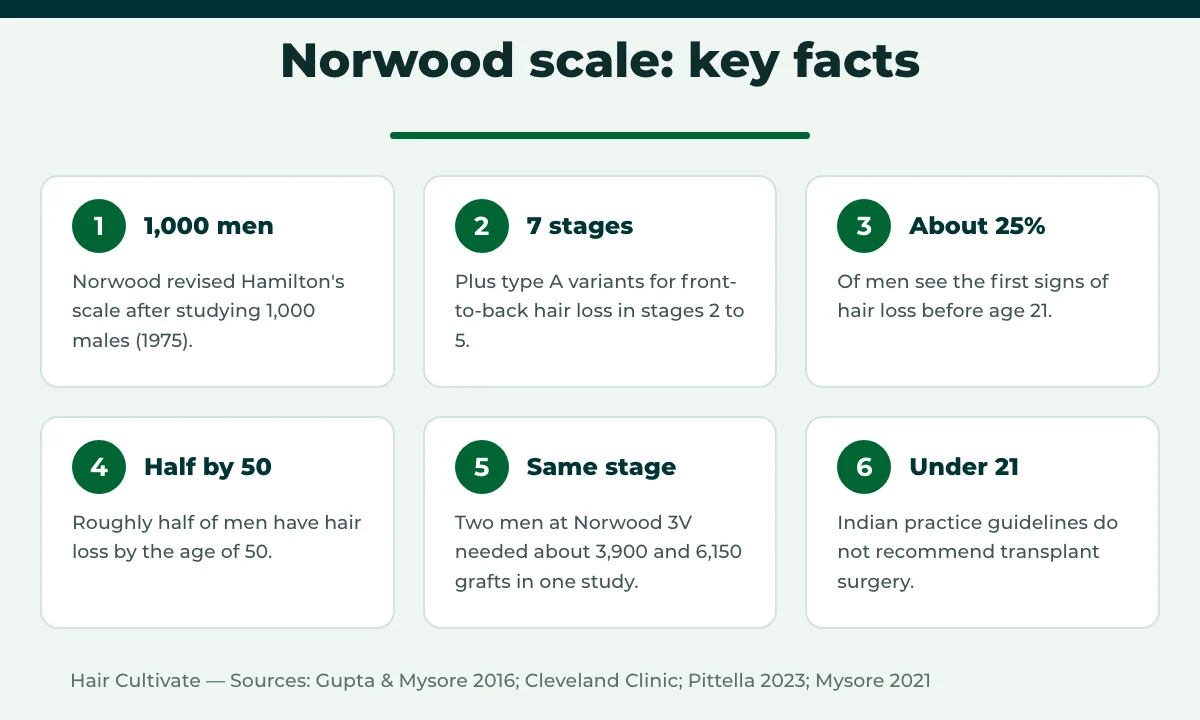
- The Norwood scale has seven stages; Norwood created it in 1975 after studying 1,000 men, building on Hamilton’s earlier work (Gupta & Mysore, 2016).
- Stage 3 is the first stage that is counted as baldness; stage 3 vertex describes loss mainly at the crown (Gupta & Mysore, 2016).
- About 25% of men see the first signs of hair loss before age 21, and about half have hair loss by 50 (Cleveland Clinic).
- Men at the same stage can need very different numbers of grafts, so the stage alone cannot plan surgery (Pittella et al., 2023).
- Male pattern hair loss usually keeps progressing, so treatment plans must think about the future pattern, not only the current one (Mysore et al., 2021).
Table of contents
- What is the Norwood scale?
- Why the stages matter
- The 7 stages explained
- Type A and vertex variants
- Limits of the Norwood scale
- What each stage means for treatment
- Norwood scale and graft numbers
- Age and future hair loss
- After a transplant
- Frequently asked questions
- References
What is the Norwood scale?
The Norwood scale, also called the Hamilton–Norwood classification, is a visual classification of male pattern hair loss. Male pattern hair loss is the common, inherited form of balding, known medically as androgenetic alopecia. The NHS describes it as a permanent type of hair loss that usually runs in families (NHS).
The scale has a long history. In 1951, Hamilton studied more than 300 men and described eight types of balding. In 1975, Norwood revised this system after studying 1,000 men. He noted that thinning usually begins at the temples and the crown and then spreads over the top of the scalp (Gupta & Mysore, 2016).
Today it is the most widely used classification for male hair loss. A 2025 review describes it as seven stages, with a subtype “A” for men whose loss affects mainly the front (Cortez et al., 2025). Together with the Ludwig scale for women, it is used to stage hair loss and to assess the response to treatment (Gupta & Mysore, 2016).
Why the stages matter: how pattern hair loss progresses
Male pattern hair loss is common and it tends to get worse with age. Cleveland Clinic states that it affects two-thirds of all men. About 25% of men see the first signs before age 21, and by age 50 about half have hair loss (Cleveland Clinic). A 2025 review reports a similar picture: about 30% of men around age 30 and 50% at age 50 (Cortez et al., 2025).
The cause is a mix of genes and hormones. In the hair follicle, testosterone is converted into dihydrotestosterone (DHT). DHT makes sensitive follicles shrink over time, a process called miniaturization. The growth phase of each hair becomes shorter and the hairs become thinner, until they look like fine “vellus” hair (Cortez et al., 2025).
This is why staging is useful. It gives a common language to describe where a man is today. A treatment plan that only fits the current Norwood stage may look unnatural years later.
The 7 stages of the Norwood scale explained
Below is each stage, based on the descriptions in a medical review and in Cleveland Clinic patient information (Gupta & Mysore, 2016; Cleveland Clinic).
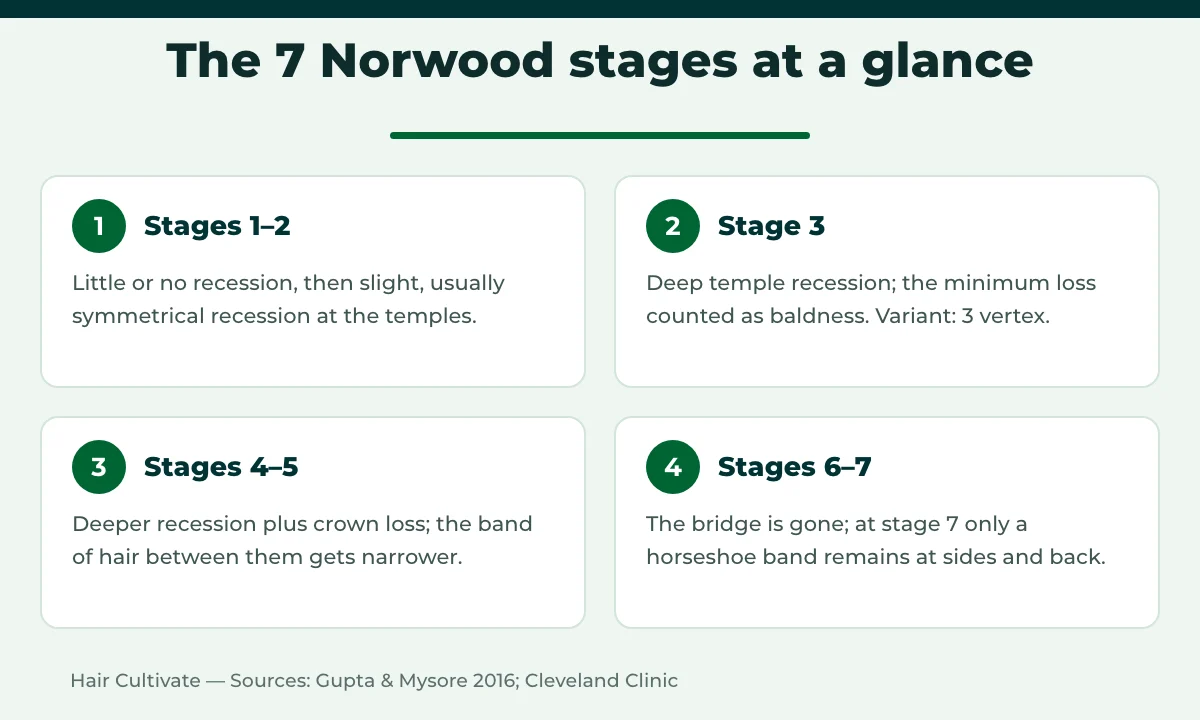
Stage 1: little or no recession
There is little or no hair loss or hairline recession.
Stage 2: slight recession at the temples
There is a triangular, usually symmetrical recession at the temples. The change is small.
Stage 3 and stage 3 vertex
The temple recession becomes deep, and the hairline may look like an “M” or a “U”. This is the minimum hair loss that Norwood considered to be baldness. In the stage 3 vertex variant, the main loss is at the crown, with only limited recession at the temples (Gupta & Mysore, 2016).
Stage 4: deeper recession and crown loss
The recession at the front is more severe, and there is sparse hair or no hair at the crown. A band of moderately dense hair across the top still separates the two areas.
Stage 5: the bridge becomes narrow
The front and crown areas are still separate, but less clearly. The band of hair between them is narrower and thinner. Cleveland Clinic describes this stage as the point where the recession starts to connect with the bald spot on the crown.
Stage 6: the bridge is lost
The bridge of hair across the top of the head is gone or very sparse, and the front and crown areas join into one larger bald area.
Stage 7: a horseshoe band remains
This is the most severe stage. Only a narrow band of hair remains at the sides and back of the head, in a horseshoe shape. This hair is often sparse and fine (Gupta & Mysore, 2016).
Norwood scale type A and vertex variants
Not every man loses hair in the classic temples-plus-crown pattern. The scale includes a “type A” variant for men whose hairline moves back from front to back, without a separate bald spot at the crown (Gupta & Mysore, 2016).

- Type 2A: the whole hairline sits a little higher, but the loss is still mild.
- Type 3A: the hairline has moved further back towards the level of the ears.
- Type 4A: the recession has moved past the level of the ears but has not reached the crown.
- Type 5A: the bald area now includes the crown. Loss beyond this point looks the same as stages 6 or 7.
The vertex variant (stage 3 vertex) is the opposite case: the crown thins first while the front stays fairly intact.
What the Norwood scale cannot tell you
The scale is simple and well known, but it has clear limits. Reviewers have called it too detailed and complicated for surgical use, and noted that it misses some patterns, such as a bald patch at the crown or back of the head with a preserved hairline. They also say it is not very helpful in choosing a surgical method (Gupta & Mysore, 2016).
Other authors point out that classic scales are mainly qualitative. Two examiners can put the same man in different stages, and men in the same stage can have very different head sizes and shapes (Pittella et al., 2023).
It also does not measure several things that matter for treatment:
- Density. It shows where hair is missing, not how thin the remaining hair is.
- Miniaturization. It does not show how many hairs are shrinking but still visible.
- Donor supply. It does not show how much permanent hair is available at the back and sides.
- Speed of progression. It shows today’s pattern, not how fast it is changing.
- Women. It is a poor fit for female pattern hair loss, which is usually graded with other scales such as Ludwig (Cortez et al., 2025).
The BASP system, based on more than 2,200 people, can be used for both men and women (Gupta & Mysore, 2016).
What each Norwood scale stage means for treatment
The stage does not decide treatment on its own. Age, family history, donor area, stability of loss and goals also count. The table below gives a general overview, based on published guidance. It is not a personal plan.
| Norwood stage | What it usually means | Points often discussed |
|---|---|---|
| 1–2 | Little or slight recession at the temples | Monitoring; medication if active thinning. Surgery is generally not advised for insufficient hair loss |
| 3 and 3 vertex | First stage counted as baldness | Medication; a transplant may be discussed for the temples or hairline, with a plan for future loss |
| 4–5 | Front and crown both affected | Medication plus surgery is often discussed; more than one session may be needed |
| 6–7 | Large bald area, limited fringe | Donor supply becomes the main limit; full coverage may not be possible |
Stages 1–2: watch, protect and avoid early surgery
At the first stages, the main goal is usually to slow down or stop further loss. The NHS lists finasteride and minoxidil as the main treatments for male pattern baldness, and notes that they only work for as long as they are used (NHS). Cleveland Clinic says minoxidil can take two to four months and finasteride at least three months to show results (Cleveland Clinic).
A practice guideline from India lists “insufficient hair loss” among the reasons why a person may not be a suitable candidate for surgery (True, 2021). The same review notes that a high level of miniaturization in the recipient area raises the risk of shock loss, the temporary shedding of native hair after surgery.
Stage 3: the first real decision point
Stage 3 is where many men first think about a transplant. Some surgeons consider transplantation reasonable when more than half of the native hair density in the recipient area has been lost (True, 2021). At this stage, the hairline design should allow for further recession in the future. You can read more about how techniques compare in our guide to FUE vs FUT.
Stages 4–5: combined plans and more grafts
At stages 4 and 5, both the front and the crown are affected. One review notes that 5-alpha reductase inhibitors such as finasteride work better on the crown than on the front (Cortez et al., 2025). Rarely is a single transplant session enough for pattern hair loss (True, 2021).
Stages 6–7: donor supply decides
At the most advanced stages, the bald area is large and the donor fringe is limited. Patients should be told that in advanced baldness it may not be possible to cover all bald areas satisfactorily (Sattur & Sattur, 2021). The aim is often good coverage of the front and top, with lower density elsewhere.
Norwood scale and graft numbers
Many people ask how many grafts each Norwood stage needs. There is no fixed number. In a 2023 study that proposed a new measuring method, two men who were both classified as Norwood 3 vertex needed very different estimates: about 3,900 grafts in one case and about 6,150 in the other. A Norwood 5 patient was estimated at about 9,000 grafts, and a Norwood 6 patient at about 9,300 (Pittella et al., 2023).
These estimates describe full coverage, not what can always be harvested. Indian practice guidelines give an optimum of 2,500 to 3,000 grafts per session and a lifetime upper limit of about 4,000 to 6,500 scalp grafts over several sessions, depending on the donor area (Mysore et al., 2021). This gap between demand and supply is why advanced Norwood scale stages need careful planning. For a fuller explanation, see our patient guide for hair transplant planning.
Norwood scale, age and future hair loss
Age changes how a Norwood scale stage should be read. A stage 3 pattern in a man of 22 is different from the same pattern in a man of 50, because the younger man has many years of possible progression ahead.
One expert review warns that many men who start losing hair in their late teens or early twenties end up at Norwood class 5–6 by age 30 without treatment, and advises deferring surgery for at least a year while the loss is observed (True, 2021). The American Academy of Dermatology (AAD) notes that a man in his 20s may be asked to wait and to start hair loss medicine first (AAD).
The Indian practice guidelines do not recommend surgery for people younger than 21, and prefer waiting until at least 23–25 years of age. Surgery at 21–23 may be considered in special cases, such as Hamilton–Norwood stages 4–6 where medicines are unlikely to help (Mysore et al., 2021). The same guidelines say crown reconstruction is better avoided in young people.
After a transplant: the stage can still change
A transplant does not stop male pattern hair loss. The NHS warns that hair may continue to thin around the transplanted area, and a good surgeon should plan for this (NHS). Practice guidelines state that a hair transplant is not a one-time permanent fix for androgenetic alopecia, and that patients should continue medical treatment after surgery (Mysore et al., 2021).
In other words, your stage can keep moving after surgery, even though the transplanted hair usually stays. Cleveland Clinic notes that touch-up procedures may be needed (Cleveland Clinic). Continuing medicine, if your doctor recommends it, helps protect the native hair around the grafts.
If you are a woman with thinning hair, the Norwood scale is usually not the right tool. Our page on female hair transplant explains how female hair loss is assessed differently.
Frequently asked questions
What Norwood scale stage am I?
You can compare your hairline and crown with the stage descriptions above, but self-assessment is not always accurate. A doctor who examines your scalp, ideally with magnification (trichoscopy), can give a more reliable stage.
Is Norwood stage 2 already balding?
Not necessarily. Stage 2 shows only slight recession at the temples. Norwood counted stage 3 as the minimum loss that counts as baldness (Gupta & Mysore, 2016).
Can medication move me back down the Norwood scale?
Medicines such as finasteride and minoxidil can slow loss and regrow some hair in some men, but they do not work for everyone and only work while they are used (NHS). Regrown hair is lost if the treatment stops (Cleveland Clinic).
At which Norwood scale stage can I have a hair transplant?
There is no single stage. Surgeons look at how much density has been lost, the donor area, your age and how stable your loss is. Very early loss is usually not a reason for surgery (True, 2021).
How fast do men move through the stages?
The speed differs from person to person. Male pattern hair loss tends to worsen with age (Cortez et al., 2025). One review notes that many men whose loss starts in their late teens or early twenties reach Norwood 5–6 by age 30 without treatment (True, 2021).
Does the Norwood scale work for women?
It is a poor fit for most women. Female pattern hair loss is usually graded with other systems such as the Ludwig scale, which has three grades (Gupta & Mysore, 2016).
Is Norwood 7 too advanced for a transplant?
Not always, but full coverage may not be possible. The result depends mainly on the donor supply, and many patients aim for good frontal coverage rather than full density (Sattur & Sattur, 2021).
If you would like to know your Norwood scale stage and whether treatment or a hair transplant in Turkey could suit you, you can send clear photos of your scalp for a free hair analysis on WhatsApp (+905444768387) or through our contact page.
References
- Gupta M, Mysore V. Classifications of patterned hair loss: a review. J Cutan Aesthet Surg. 2016;9(1):3–12. PMC4812885
- Cortez GL, Hassun K, Linhares LRP, et al. Male androgenetic alopecia. An Bras Dermatol. 2025;100(2):308–321. PMC11962920
- Pittella F, Castro CG, Trivellini R, et al. PRECISE Scale: a quantitative classification for androgenetic alopecia and its application to hair transplantation. Aesthetic Plast Surg. 2024;48(5):775–784. PMC10980655
- Mysore V, Kumaresan M, Garg A, et al. Hair transplant practice guidelines. J Cutan Aesthet Surg. 2021;14(3):265–284. PMC8611706
- True RH. Is every patient of hair loss a candidate for hair transplant? Deciding surgical candidacy in pattern hair loss. Indian J Plast Surg. 2021;54(4):435–440. PMC8719975
- Sattur SS, Sattur IS. Patient counselling and medicolegal aspects of hair transplant surgery. Indian J Plast Surg. 2021;54(4):441–445. PMC8719947
- Cleveland Clinic. Male pattern baldness (androgenic alopecia). clevelandclinic.org
- NHS. Hair loss; Hair transplant. nhs.uk; nhs.uk
- American Academy of Dermatology. Hair loss: hair transplant. aad.org
This article is for general information and does not replace a consultation with a qualified doctor.


